Ruddy Turnstones Arenaria interpres are well-known shore birds around the world. They used to be classified as plovers, but are now counted with sanderling. Fortunately they are distinctive enough not to be confusable with the many other species of shore bird with which they mix.
Their foraging methods are classified into 6 broad categories, though I imagine that if peckish, they may opt for all of these in the one feeding session.
Routing — rootling through piles of seaweed by flicking, ‘bulldozing’, and pecking it to expose small crustaceans or gastropod molluscs hidden underneath.
Turning stones — living up to its name name, flicking stones with its bill to uncover hidden snaily and shrimpy creatures.
Digging — using small flicks of the bill to make holes in sand or mud and then gobbling up the prey revealed.
Probing — inserting the bill right into the ground to get at concealed gastropods.
Hammering — cracking open shells using the bill as a hammer, then winkling out the occupant.
Surface pecking — short, shallow pecks to get at prey just below the surface of the sand.
Between them, these turnstones seem to be using methods 1, 3, 4 and 6
This female bird has clearly dug down in the sand to the length of its bill
This male is digging deep…
When they are not actively feeding, turnstones enjoy group preening sessions
They are also very good at just standing around having a companionable chat…
…or a post-prandial snooze…
…or just enjoying the scenery in groups…
…or simply having a peaceful paddleAll photos by RH on the Delphi Club beach (where I’ve never seen one actually turn a stone)
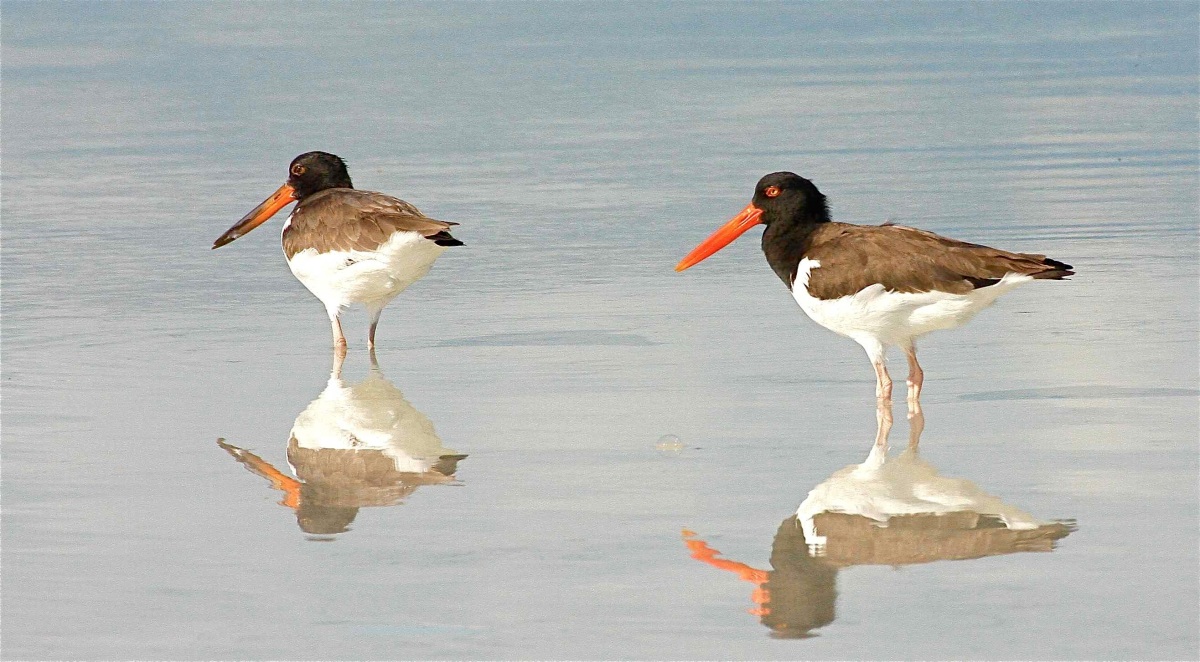
The American Oystercatcher Haematopus palliatus is a familiar shorebird, with the significant advantage that it cannot be mistaken for any other shore species either to look at or to hear. Among all those little sandpipers and plovers, the handsome AMOY stands out from the crowd.
Photos by Tom Sheley
Photos by Bruce Hallett
Here are two recordings of oystercatchers, unmistakeable call sounds that will probably be instantly familiar.
Lopez Lanus / Xeno-Canto
Krzysztof Deoniziak / Xeno-Canto
I like the rather dishevelled appearance of this AMOY from Jim Todd, fly fisherman, author of ‘The Abaco Backcountry’, and intrepid kayak explorer around the coast of Abaco
Two photos taken on the Delphi beach by Charlie SkinnerA low ‘in-flight’ shot by Bruce Hallett
This fine video from Audubon shows close-up views of the American Oystercatcher, and unleashes more of the distinctive call-sounds – an insistent wittering – of the species.
For some time, I found it difficult to distinguish American and Eurasian Oystercatchers. The markings of both species are variable according to gender, age, season and so on, but are generally very similar. Mrs RH noticed the salient difference at once – the eyes. The AMOY has bright orange eyes with red eye-rings; the EUROY’s eyes are the reverse colouring, as this example shows.
Eurasian Oystercatcher (spot the difference)
Credits: Tom Sheley, Bruce Hallett, Jim Todd, Charlie Skinner, Xeno-Canto, Audubon, BBC
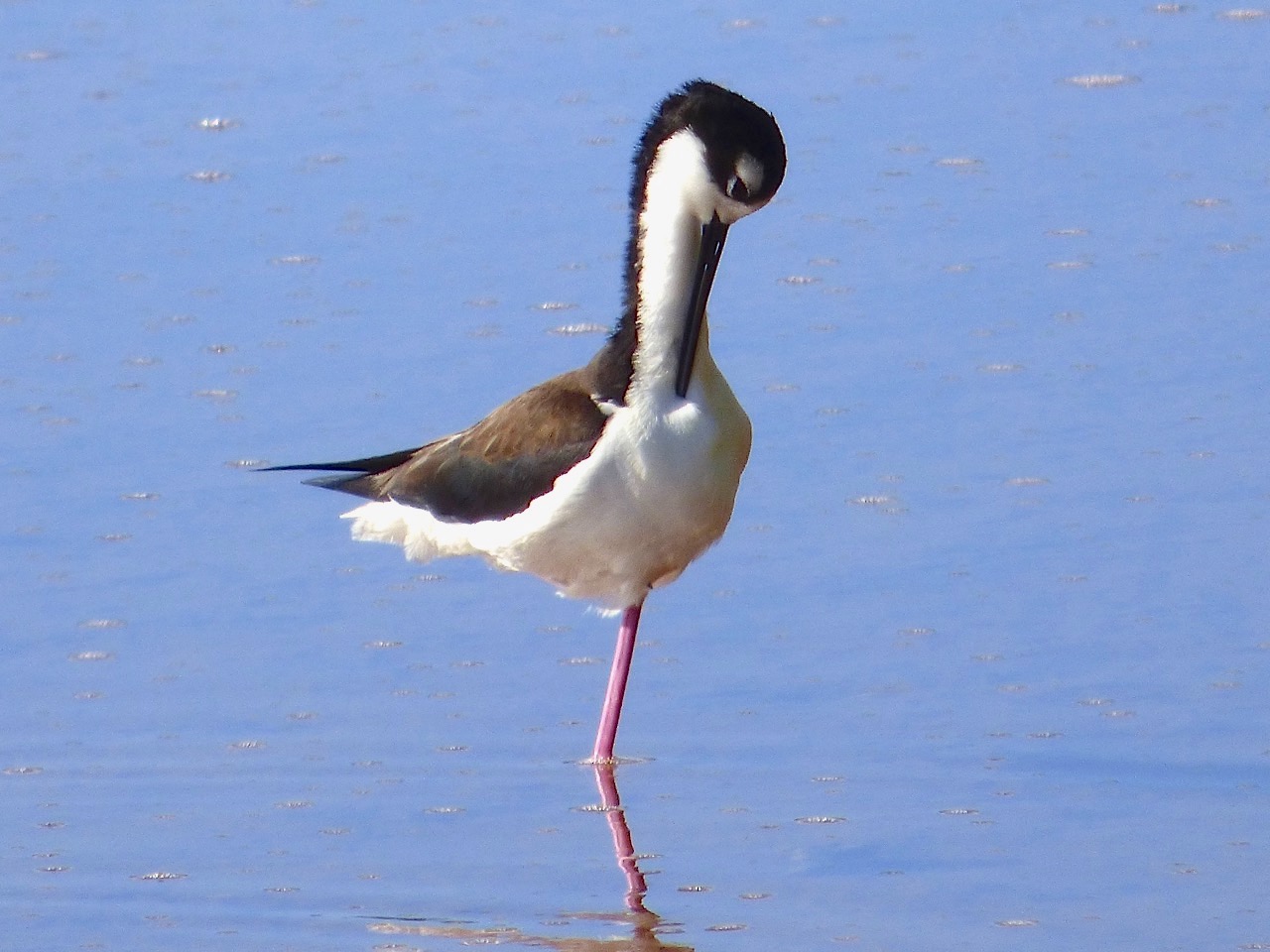
There’s something wrong in the picture above. Count up how many pink legs you can see. It’s three between the two birds. I assumed of course that ‘Oner’ had a perfectly good serviceable leg tucked up into its undercarriage. I admired the balancing skills involved in resting one leg while nonchalantly standing on the other.
We were watching this pair of black-necked stilts Himantopus mexicanus at the pond at Gilpin Point, which at certain times can be ‘Stilt Central’. These birds are permanent breeders on Abaco and are without a doubt the most beautiful of all the waders.
After 10 minutes observing this pair, there was no question about it – the right leg was completely and utterly missing. This had no obvious ill-effects on the bird – it was still able to throw a good pose (above) and to preen (below). And the other bird carried on as normal.
BNSs are territorial and in particular can become ‘proactive’ (ie aggressive) in protecting the area near a nest. I once mistakenly got close to a nest, not even knowing it was there. I soon learnt – a parent BNS came wading towards me, zigzagging in the water, shouting and carrying on in a way that immediately said ‘my nest is nearby’. And when I meanly stood my ground it suddenly took off and flew straight at my head…
A shouty stilt
BLACK-NECKED STILT ALARM CALL
Jim Holmes / Xeno Canto
All photos: Keith Salvesen / Rolling Harbour Abaco; Audio file Jim Holmes / Xeno Canto
The Kirtland’s Warbler (Setophaga kirtlandii): there are probably more dedicated KIWA experts out there than there are birds of this scarce species. Estimates of bird numbers vary wildly, but if I take a consensus of the mean of an approximate average of the median as ± 5000 individuals, I’d probably be in the ballpark named “Current Thinking“.
THAT SOUNDS QUITE RARE, RIGHT?
Around 50 years ago, the species was all but extinct – perhaps fewer than 500 birds in total, a barely sustainable population. In 1975, Brudenell-Bruce estimated 1000. I’ll mention some of the reasons later. In the 1970s, the Kirtland’s Warbler Recovery Plan was instituted with the twin objectives of protecting the vulnerable breeding habitat – basically large areas of jack pine; and of monitoring and management aimed at encouraging an increase in numbers. Around that time, they became IUCN listed as vulnerable, but more recently, population growth has resulted in a recategorisation to the more optimistic near-threatened category.
AND THEY LIVE WHERE, EXACTLY?
In spring and summer almost the entire KIWA population lives and breeds in very specific areas of Michigan and Ontario, where jack pines are found. There are signs that the range has expanded slightly in Michigan and more widely into Wisconsin and Ohio as the numbers have increased.
A Kirtland’s Warbler in the jack pines of Michigan (Vince Cavalieri)
In the fall and winter the population migrates to the Bahamas & TCI, where they tend to choose remote scrub and coppice areas to live until the spring when they return north in April. This range map shows the extremely specialist habitat choices of these migratory birds.
A Kirtland’s Warbler in Ohio
SO THEY ARE REALLY FOUND ON ABACO?
Yes – but they are notoriously hard to find. To give you an idea, I checked the eBird stats for Abaco sightings over the last 10 years: 9 successful trips reported, with 18 birds seen in all**. There were 3 groups comprising 6, 4, and 2 birds; and the rest were single birds. Abaco ornithologist and guide Woody Bracey is the go-to man for finding these little birds. Two years ago we were in his party that saw 4 in the space of a couple of hours. I was supposedly the photographer, but unaccountably found myself in completely the wrong place for the first 3. The 4th flew off a branch and straight at my head as I raised the camera… I felt the wind as it passed on its way deep into the coppice. I’m not proud of my effort; the fuzzy lemon item beyond the twigs and leaves is a KIWA (you’ll have to take my word for it…).
HAVE ANY BEEN SEEN ON ABACO THIS YEAR?
Last week, Woody took another party to the main hotspot in the Abaco National Park, a protected area at the southern end of the island. The park is huge, covering more than 20,000 acres of (mostly) pine forest. These birds are tiny, about 14 cms long and weighing 14 gms. Despite which they found a female and then a male KIWA in their favoured habitat beyond the pine forest. Those are the only 2 I’ve heard about this winter season.
Kirtland’s Warbler, Abaco Bahamas, 12 April 2018
WHAT DO I LOOK OUT FOR?
Gray head with a blueish tinge, gray-brown back
Yellow throat & underside, with some dark streaking
Females are paler and more streaked
Split eye rings – white crescents above and below eyes
Frequent tail pumping and bobbing (‘tail-wagging’ J. Bond)
WHAT DO THEY SOUND LIKE?
Some would say ‘chip-chip-chip-too-too-weet-weet’. Elsewhere I have found they produce ‘a loud tchip, song an emphatic flip lip lip-lip-lip-tip-tip CHIDIP‘ (Arnott). You be the judge!
Ross Gallardy / Xeno-Canto
WHAT ARE THE MAIN THREATS TO THE SPECIES?
Mankind is the primary threat. The breeding areas are particularly vulnerable from deforestation and clearance of the jack pines that are essential for successful nesting and breeding – and therefore the survival of the species.
Encroachment of development is another threat, as with so many species.
There is a further threat of nest parasitism by brown-headed cowbirds, to which KIWAs are especially vulnerable.
In the winter grounds where the habitat is mostly remote or in protected areas, there is rather less of a problem from these factors – for now at least.
Overall, habitat degradation at one end of the migration – in particular the breeding grounds – poses a serious risk; at both ends, extinction could loom again.
WHO WAS MR KIRTLAND?
Jared Potter Kirtland (1793-1877)
Jared P. Kirtland (1793 – 1877) was an Ohio scholar, doctor, judge, politician and amateur naturalist. He was a man of many and varied interests and talents, not-untypical of his time. In the field of natural history, Kirtland’s name lives on in his warbler; and also in a couple of snake species.
**I realise eBird is not the be-all and end-all for sighting reports. It hasn’t been in existence for as long as 10 years, and not everyone uses it anyway. And awareness of the Bahamas as the winter home for KIWAs is a surprisingly recent development (as with piping plovers). As awareness increases, so do birder interest, habitat knowledge, and consequently reports of sightings.
Another example of the ‘twigs in the way’ problem for photographers
Credits: Bruce Hallett (1, 2, 3); Vince Cavalieri (4); Tom Sheley (5); Unattributable (me, in fact) 6; Woody Bracey (7, 9); Tony Hepburn (8); Lionel Levene (10); Birds of North America (range map); Ross Gallardy / Xeno-Canto (audio file); Birdorable (cartoon). Special thanks for all use permissions for images of this rare bird.
The white-cheeked pintail Anas Bahamensis is also known as the Bahama Pintail. It is a gregarious species, often found in large numbers on lakes and ponds. An excellent place to see them on Abaco is at the pond by Hole 11 at Treasure Cay golf course. Don’t all rush at once – and if you do follow up the hint, check in at the Clubhouse to get permission – there may be a competition in progress… You’ll see many other waterbird species there, and I will do a follow-up post about them. Do mind your head – if someone yells ‘fore’ they will probably not be counting duck species.
The male and female of the species are very similar. However, in the image below there’s one bird that stands out from the others… and I don’t mean the American Coot. Near the bottom right is aLEUCISTICvariant of the Bahama Duck, a genetic condition similar to albinism.
Here is a close-up of the same duck on dry land. These variants are known as Silver Bahama Pintails. They are worth more than the standard version. You can see some good comparative pictures and find out more atMALLARD LANE FARMS
Here is a more extreme wiki-example of a silver Bahama pintail
Another excellent place for pintails is the large pond at Gilpin Point near Crossing Rocks area of South Abaco. Strictly, it is on private land, but the owner Perry is happy to share the birds. There is a wonderful variety of waterbird life there. I have seen great egrets, tri-colored herons, little blue herons, yellow-crowned night herons, belted kingfishers and elegantBLACK-NECKED STILTSthere, besides several duck species. I have also seen a sora there (twice), a small, furtive rail that skulks in the reeds and foliage at the edge of the water, profoundly hoping that you won’t notice it… If you are birding on Abaco from Delphi, ask Peter or Max for the location. Or else contact me.
“On Reflection…”
All photos except wiki thumbnail: Keith Salvesen / Rolling Harbour
The Yellow-throated Warbler (Setophaga dominica) is a most helpful warbler, in that what you see is what you get. You needn’t go to embarrassing lengths to determine whether it has a Yellow Rump. It doesn’t make extravagant geographical claims like the Cape May, Kentucky, Tennessee, Nashville or Connecticut warblers. It doesn’t disguise its warblerdom with a confusing name like ‘American Redstart’ or ‘Ovenbird’. Nor with a weird warbler name that is completely obscure like the Prothonotary. It’s a winter resident only, so it won’t try to puzzle you in the summer. The males and females are roughly similar in appearance, unlike so many species. All-in-all, a most agreeable and obliging little bird. Here are a few to enjoy, before I spoil the magic slightly…
I said earlier that the magic of the apparently simple ID of a warbler that lives up to its name would have to be spoiled. I’m afraid the images below rather undo the certainties I’d promised… two more species common to Abaco, also named for their yellow throats (though note: the yellow extends to more than just the throat) .
BAHAMA YELLOWTHROAT
COMMON YELLOWTHROAT
You’d really think that someone at Audubon Towers or Cornell Castle might have thought of calling these two species ‘Bahama’ and ‘Common’ Masked Warblers, wouldn’t you – after all there’s a Hooded Warbler, which indeed has a hood. No other warbler has a mask like these two. Then any confusion could be avoided.
Abaco has two permanently resident woodpecker species, theWEST INDIAN WOODPECKERand theHAIRY WOODPECKER. There is a third, migratory woodpecker species that is a fairly common winter resident, the yellow-bellied sapsucker Sphyrapicus varius. Like its woodpecker cousins, the sapsucker drills holes in trees (see below). The dual purpose is to release the sap, which it eats, and to attract insects that it also eats. A two-course meal, if you like. They’ll also eat insects on an undrilled tree, and even ‘hawk’ for them in flight. They balance their diet with fruit and berries.
The distinctive patterns of sapsucker holes may completely encircle the trunk of a tree with almost mathematical precision. This is sometimes described as ‘girdling’ and may have a damaging effect on a tree, sometimes even killing it if the bark is severely harmed. This may require preventive measures in orchards for example, though note that in the US Yellow-bellied Sapsuckers are listed and protected under the Migratory Bird Treaty Act so radical action is prohibited.
YELLOW-BELLIED SAPSUCKER SOUNDS
DRUMMING (Xeno-Canto / Richard Hoyer)
CALL (Xeno-Canto / Jonathon Jogsma)
On Abaco, palms are a favourite tree for the sapsuckers. There are several palms along the Delphi beach, and this year I noted that one coconut palm in particular had seen plenty of sapsucker action, with the drill holes girdling the entire trunk from top to bottom.
In their breeding grounds yellow-bellied sapsuckers excavate a large cavity in a softwood tree as a nest. They mate for life, and often return to the same nest year every year, with the pair sharing nesting duties. I have no idea whether the pair migrate south for the winter together, or whether they agree to take a break from each other. I’d like to think it’s the former…
Credits: Photos Gerlinde Taurer, Tom Sheley, RH; Cornell Lab (Range Map) & Xeno-Canto (YBS recordings as credited above)
Species featured in ‘The Delphi Club Guide to the Birds of Abaco’ by Keith Salvesen, pp 242-3
Many of the birds shown here were photographed in or around the grounds of Delphi. More recently, they have to an extent been displaced by red-winged blackbirds which are of course very fine birds but in large numbers sound (may I say this? Is this just me?) quite irritating after a while. Whereas the thrush of course has a sweet and melodious song, like this (my own recording – turn up the vol):
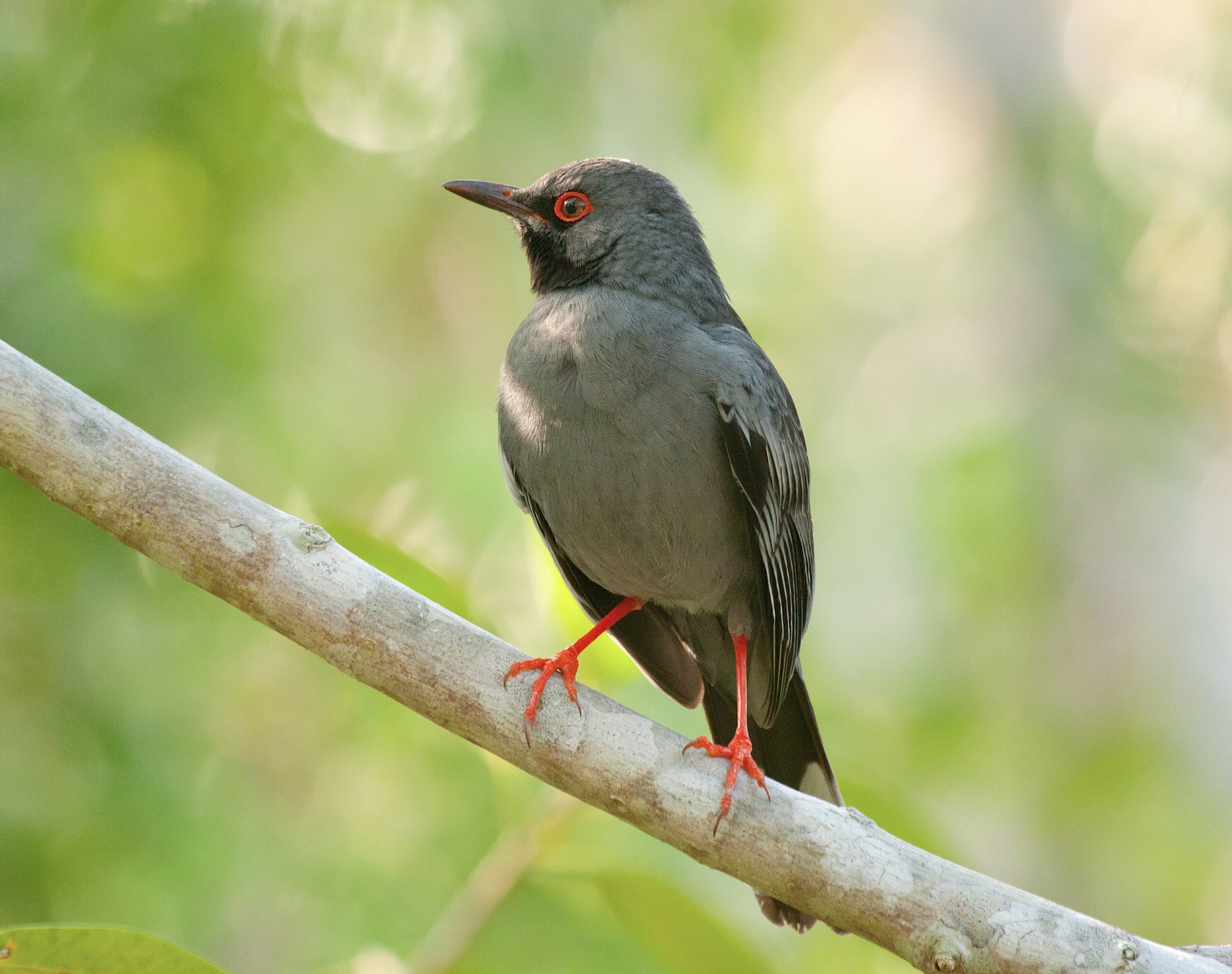
The eyes of the RLT are at least as prominent a feature as their legs. Lots of birds have red legs. Very few have such remarkable bright, fiery eye-rings, even in a youngster.
This photo from birdman Tom Sheley is my favourite – a perfect composition
Photo Credits: Tom Sheley (1, 11); Peter Mantle (2, 4); Gerlinde Taurer (3); Mr & Mrs Harbour (5, 6, 7); Charles Skinner (8, 9); Erik Gauger (10). Lo-fi audio recording: RH
The LA SAGRA’S FLYCATCHER(Myiarchus sagrae) is a common resident breeding species of flycatcher on Abaco, and these very pretty small birds can be seen in many habitats – pine forest, scrubland, coppice and gardens, for example. They are insectivores, as the name suggests, but they also eat seeds and berries.
As a ‘tyrant flycatcher’, this little bird is a member of the largepasserineorder that includes kingbirds, pewees and phoebes, with which they are sometimes confused.
Unlike many bird species, adult LSFs are very similar in appearance in both sexes. Whatever the gender, they are sometimes confused with their cousins the Cuban Pewees, but those have a very distinctive eye-crescent.
Cuban Pewee – note eye-crescent, absent in the LSF
Both species have a tiny hook at the end of the (upper) beak – to help trap insects, I assume
Another thing to notice about LSFs is the amount of rufous brown in their plumage, particularly on the wings and tail – and even at the base of the beak. This coloration is absent from their larger cousin kingbirds, the loggerhead and the gray.
WHAT TO LISTEN OUT FOR
Hans Matheve @ Xeno-Canto
A hint of a crest is visible in this photo
WHO WAS ‘LA SAGRA’?
La Sagra was a multi-talented Spanish botanist. Ramón Dionisio José de la Sagra y Peris (1798–1871) was also a writer, economist, sociologist, politician, anarchist, and founder of the world’s first anarchist journal El Porvenir (‘The Future’). At one time he lived in Cuba and became director of Havana’s Botanical Garden. His name lives on more significantly in ornithological than in anarchist circles.
Ramón Dionisio José de la Sagra y Peris
Here are stamps from the Cayman Islands and Cuba featuring the La Sagra’s Flycatcher. The Cuban stamp commemorates the death of Juan Gundlach, the man who chose La Sagra’s name to bestow on this bird. And Gundlach’s name lives on in the Bahama Mockingbird Mimus gundlachii…
Photo Credits: Gerlinde Taurer (1, 4); Tom Reed (2, 6); Keith Salvesen (3, 5, 11); Charles Skinner (7, 8); Peter Mantle (9); Tom Sheley (10); Ramon and stamps, open source
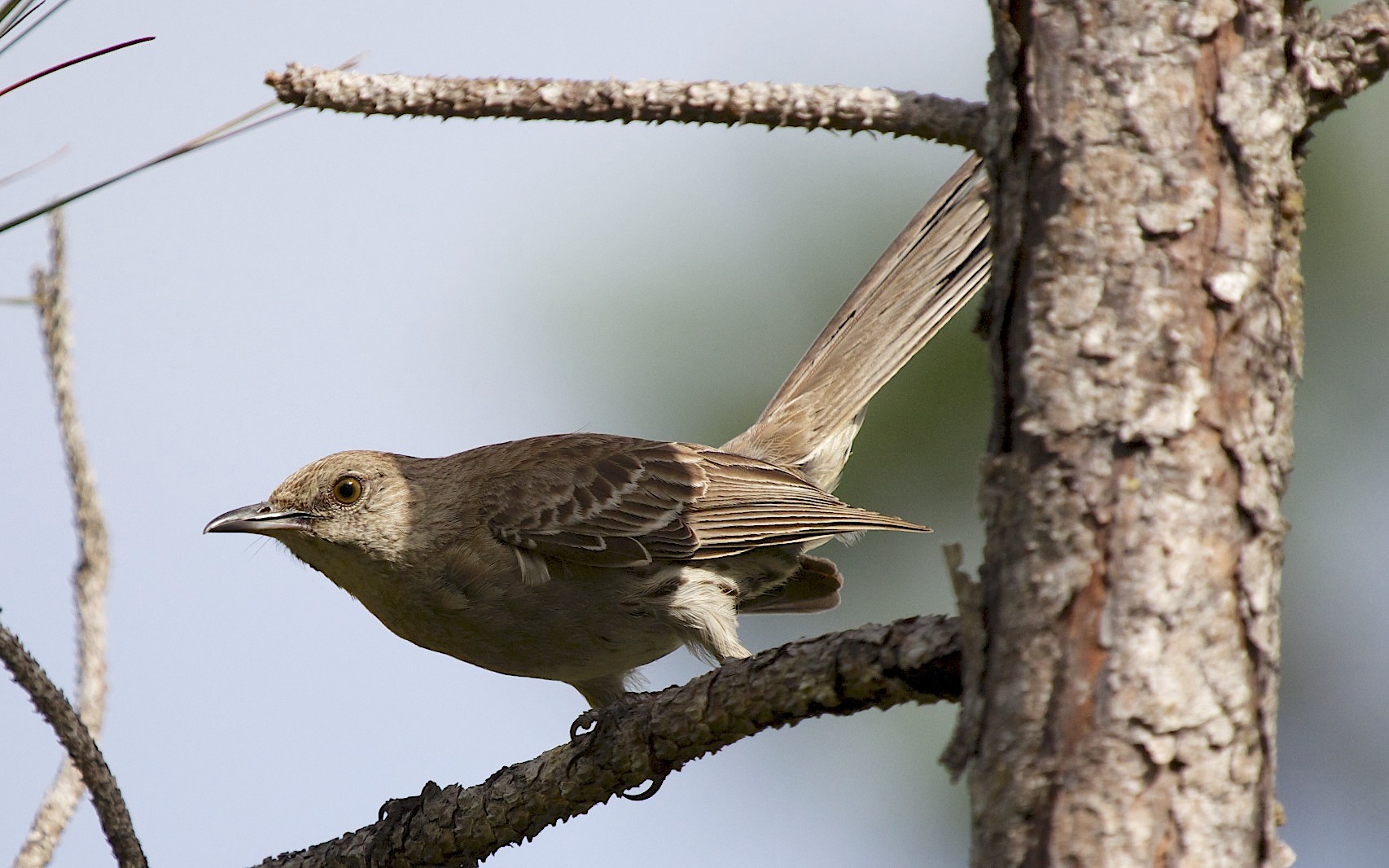
The Bahama Mockingbird Mimus gundlachii is similar to its slightly smaller cousin, the widespread Northern Mockingbird Mimus polyglottis. The range of Bahama Mockingbirds is not restricted to the Bahamas themselves, and includes areas of Cuba, Jamaica and TCI, so despite the name they are not an endemic species to the Bahamas. They are also occasional vagrants to the United States, especially – for reasons of proximity – southeastern Florida.
The Bahama Mockingbird is browner than the greyish Northern Mockingbird, and has distinctive streaking and spotting to its breast and undercarriage. This may extend to what you might describe as the bird’s ‘trouser legs’, though I’m sure there’s a more technically correct term.
Both mockingbird species are found on Abaco. The NMs are ubiquitous in towns, settlements, gardens, coppice and pine forest, whereas BMs are shyer and tend to be found in the pine forest and well away from humans and their operations.
I am astounded by the beauty and variety of their song. It consists of very varied notes and phrases, each repeated 3 or 4 times before moving on to the next sounds in the repertoire. Here is a short 18 second example I recorded, using my unpatented iPhone method, for which seeHERE.
For those with interest in birdsong, here is a longer 1:13 minute song from the same bird, with largely different sounds from the first recording made minutes earlier. There’s even a decent stab at imitation of a 1960s Trimphone™. I could have stayed listening for far longer.
An apparently new subspecies, the scarlet-faced mockingbird. In fact the bird had been feeding on red berries, and had managed to collect plenty of the juice round the base of its beak.
Range maps show the stark contrast between the very limited range of the Bahama Mockingbird and the vast distribution of the Northern Mockingbird. An example is below, for comparison.
Photos Credits: Tom Sheley (1, 6); Peter Mantle (2); Charlie Skinner (3); Keith Salvesen (4, 7, 8, 9); Alex Hughes (5); Susan Daughtrey (10). Range maps eBird & wiki.


 All photos by RH on the Delphi Club beach (where I’ve never seen one actually turn a stone)