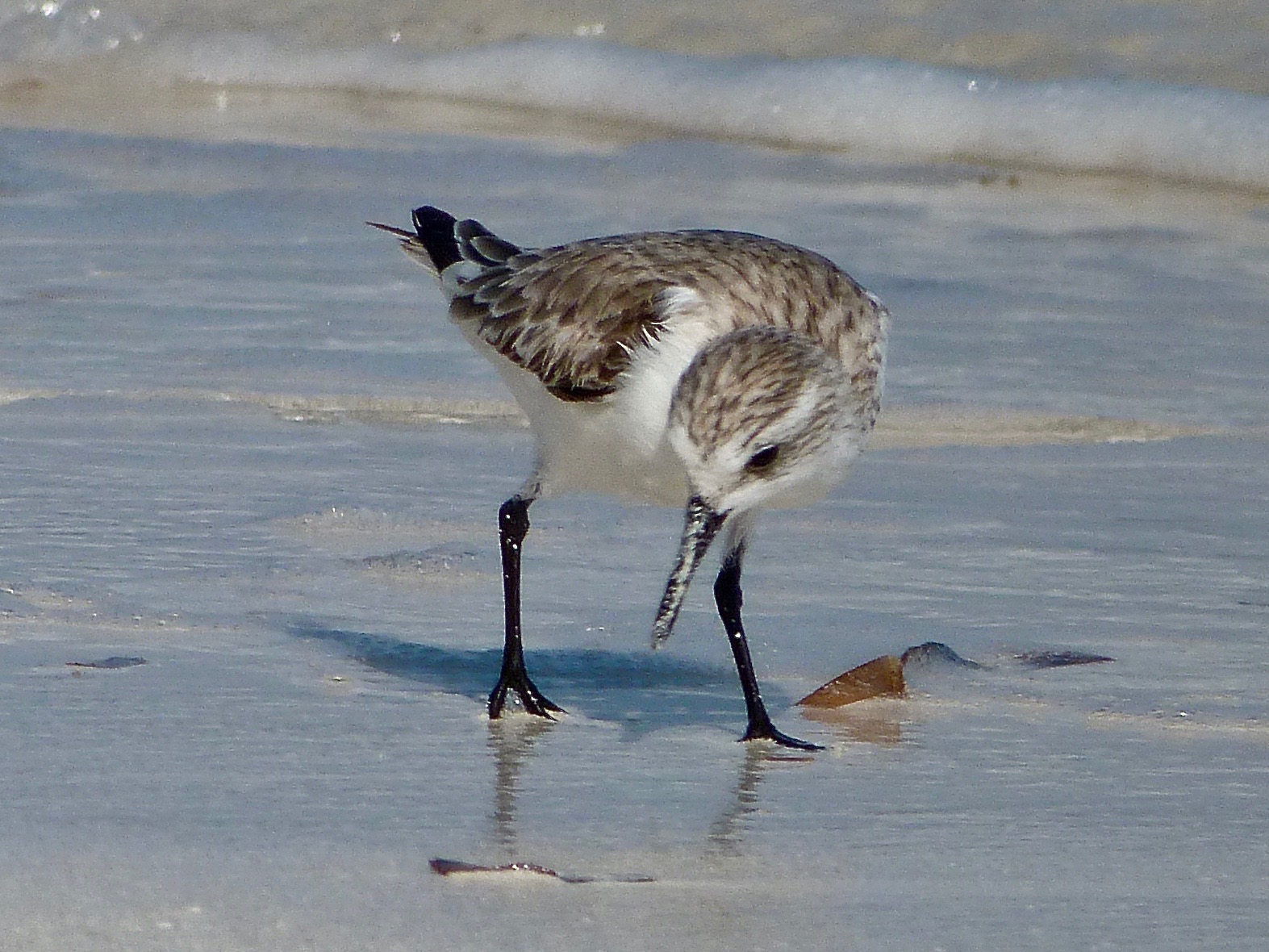
SANDERLINGS ON ABACO
VIDEO 1 The scuttling and scooting around of sanderlings on a mission
VIDEO 2 Bathtime in a tide-pool and assorted comings & goings…
All photos and movies RH
The magnificent Osprey Pandion haliaetus is one of the world’s most successful raptors and can be found on every continent except Antarctica.

On Abaco the Osprey is a permanent breeding resident, and while certainly not an ‘every day bird’, the chances of seeing one are reasonable. They are fairly often seen flying over the bay at Delphi, or out on the Marls. A pair recently nested at Sandy Point close to Nancy’s restaurant.

There are few more exhilarating sights in the world of birds than an osprey swooping from a great height into the sea, emerging with a large fish held characteristically ‘fore and aft’ in its talons, and flying into the distance with heavy wing-beats. This wonderful close-up by wildlife photographer PHIL LANOUE shows an osprey that has actually managed to grab dinner for two…
This bird looks as if it is poised to dive onto some hapless fish
10 PANDION POINTS TO PONDER
PUTTING THE ‘PREY’ INTO ‘OSPREY’

A utility post makes a perfect perch for a bonefish snack
The impressive wingspan of an Abaco osprey
An osprey far out on the Marls. I managed to get some distance shots of it despite having a fishing rod in my hand…


The Osprey is a prolific symbol in national, cultural and sporting themes, and has been depicted on Bahamas stamps. And quite right too.
Wm Shakespeare Coriolanus
I think he [Coriolanus] will be to Rome
As is the osprey to the fish, who takes it
By sovereignty of nature…
Credits: Jim Todd (1, 3), Tom Sheley (2), Phil Lanoue (4), Gareth Rasberry / Wiki (5), Danny Sauvageau (6, 8), Woody Bracey (7), Craig Nash (9), RH (Marls pics) – thanks for all image use permissions

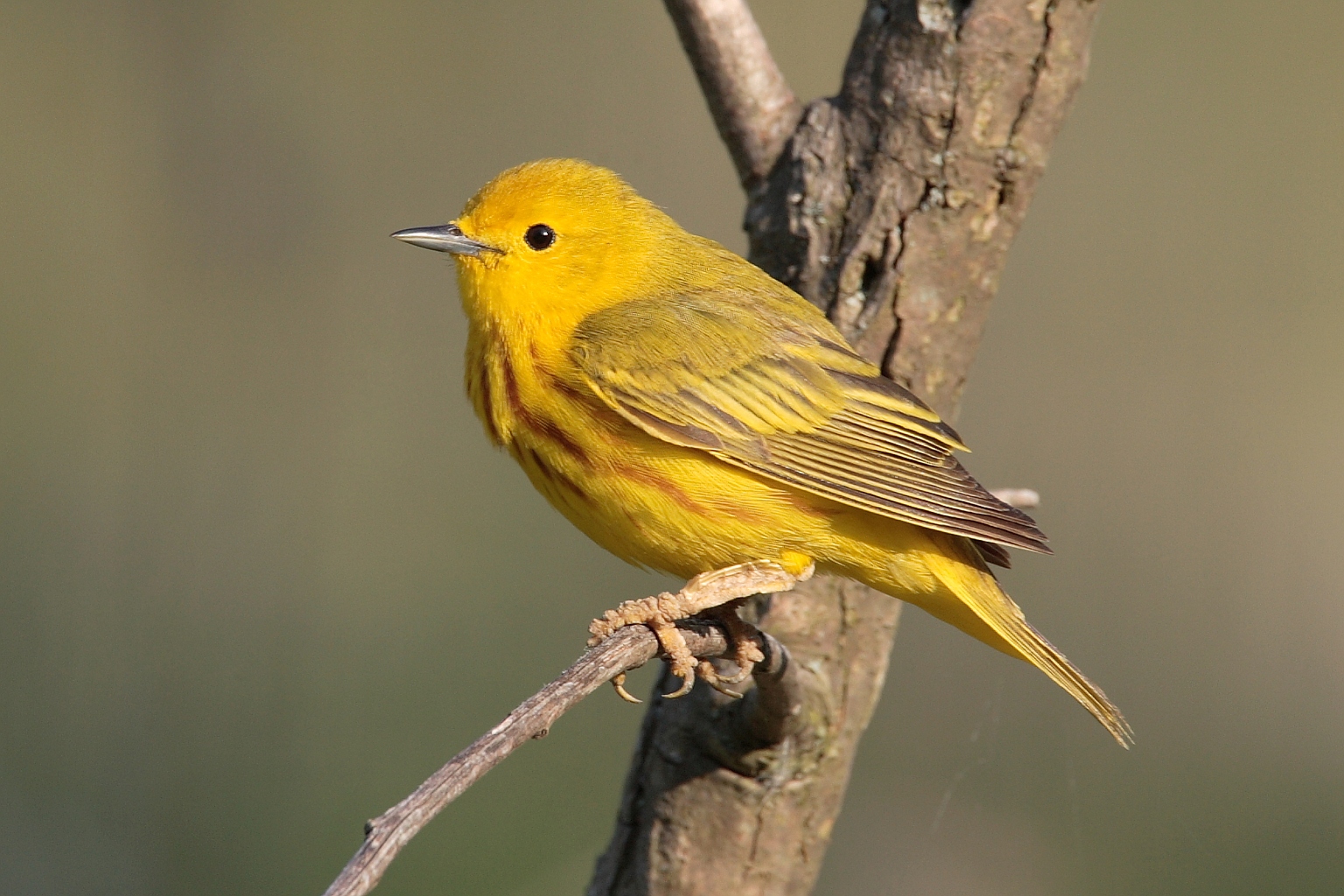
Of the 37 WARBLER SPECIES recorded for Abaco, 25 are mainly or partly yellow. So talk of a ‘yellow warbler’ can as easily be a general description matching any one of a number of species, as a particular description of the one and only Yellow Warbler Setophaga petechia. This small sunny bird is a common permanent resident on Abaco, one of only 5 resident warblers. The other 4 don’t help the situation much, by dint of all being yellow to a greater or lesser extent.
My general rule of thumb is that the Yellow Warbler out-yellows all the rest (though the winter-resident PROTHONOTARY gives it a run for its money), with the adult males bright and cheerful all over and the females rather less glaring but still demonstrably yellow from beak to tail tip.
Q. ARE THEY ALWAYS EASY TO SEE? A. SEE BELOW, GO FIGURE
Q. CAN YOU SHOW MORE PRETTY FEMALES? A. BY ALL MEANS

Q. SO YEWAs ARE COMMON? HAVE YOU EVER PHOTOGRAPHED ONE? A. ONLY HOPELESSLY
Q. DO THEY HAVE AN ATTITUDE PROBLEM? A. ONLY VERY RARELY
A THREAT TO THE SPECIES Shiny Cowbirds, luckily still rare on Abaco, favour yellow warbler nests for their parasitic egg-laying, with sadly predictable results. These cowbirds properly belong in South America, but they are gradually spreading north through the Caribbean, and have now reached Florida. I’m beginning to take a (purely personal) hard line on invasive species where they diminish and destroy indigenous species: eradication. The feral peacocks of Casuarina, now several generations down the line from their original introduction as exotic pets, do no harm and are undeniably decorative. But would you prefer the pretty yellow warbler and its fledglings in your garden, or the shiny cowbird that displaced them?
Credits: Tom Sheley (1,2,5,9); MDF (3)Bruce Hallett (4); Gerlinde Taurer (6,7); RH (8)
And finally… the song that out-yellows all other songs with the word ‘yellow’ in the title – it is the only song called just that one word!

The red-winged blackbird (Agelaius phoeniceus) has previously hopped around these pages in the context of a (my!) simple way to RECORD BIRDS using a smart-phone, trim the result and convert it into an mp3 (or even a ring-tone – I have a great Abaco parrot one to startle friends, family and indeed complete strangers). Now we move on to a more important topic, namely courtship and so forth. And boy, don’t male RWBs fancy themselves when trying to impress the laydeez…
We had taken a truck into backcountry between the pine forest and the Marls, with Tom and his impressive camo-camera with its 10 foot lens.
We found formerly cultivated fields – evidence of the defunct sugar cane industry – and then we came unexpectedly to a large expanse of open scrubland, with the track straggling through the middle.
And there, on carefully chosen vantage points, was an array of RWBs. 
This bird was within range of my comparatively puny camera, and I watched as it arranged itself into various elegant poses in the late afternoon sun. All around were their ‘rusty door hinge’ calls, of which this is an example (in fact a female, recorded at Casaurina, hence the background sound of lapping waves).
These acres of open land were not far inland, and there was a slight breeze to ease the heat. This caused the occasional ruffling of feathers, and the need to spruce up…
The purpose of all this was of course to impress the opposite sex (behaviour not confined to bird species). There were plenty of females around, also similarly perching on vantage points for similar display-with-view-to-dating-maybe-more reasons.


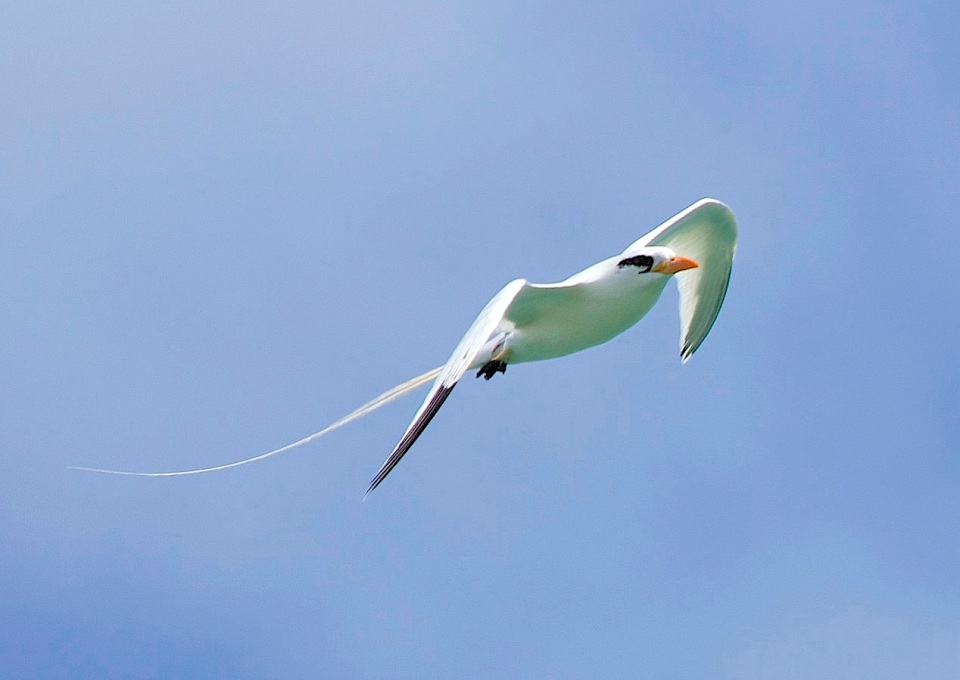
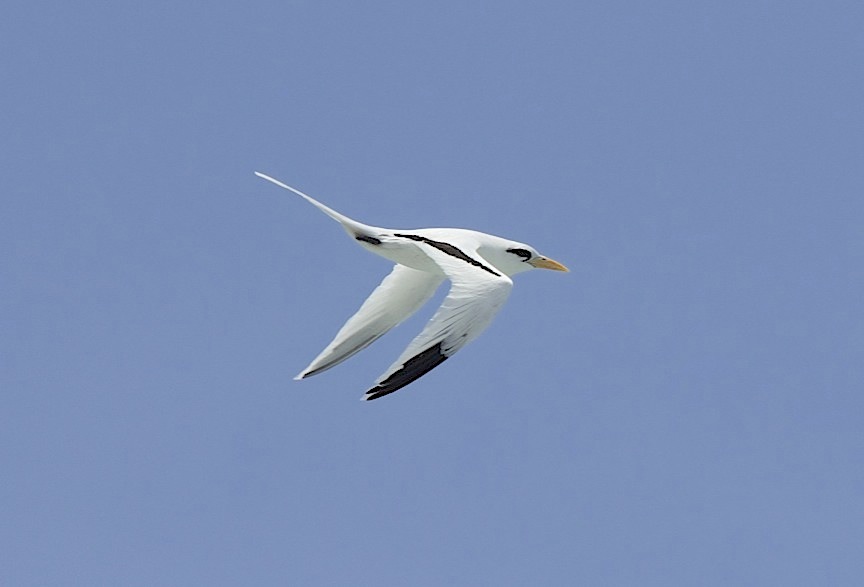
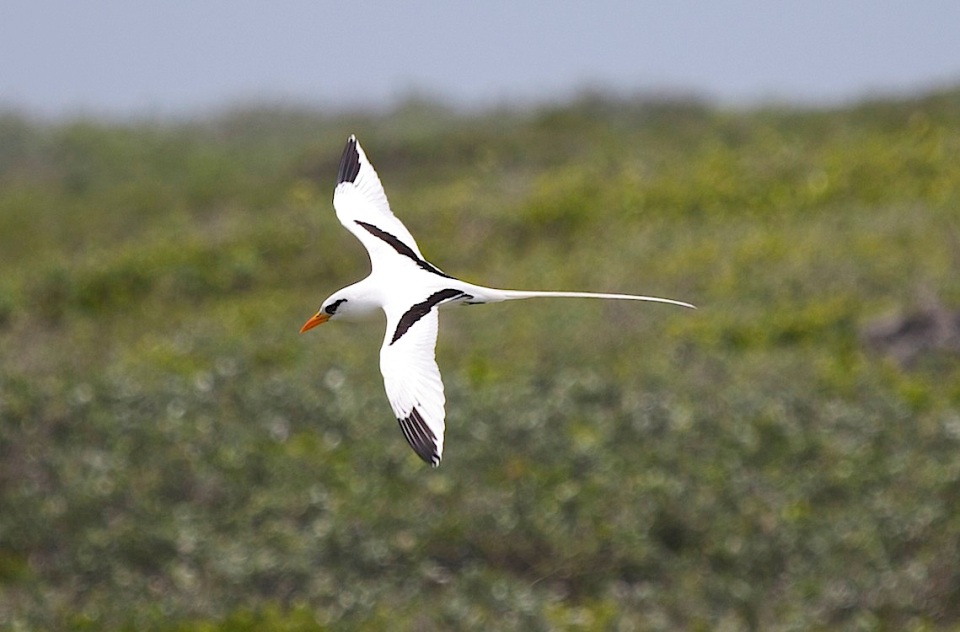
A competition to decide the most elegant bird found on Abaco (of 350+ recorded species) is a simpler task than it sounds. Colourfulness doesn’t come into (sorry, painted bunting, Abaco parrot & co). Nor cuteness, rarity, popularity and so on. Some birds don’t make the starting line at all (but we love you, ungainly limpkins and raucous clumsy-flying Anis). Best to judge from a different viewpoint: is there one bird that in flight is invariably beautiful to watch, in a way that can make you catch your breath…?


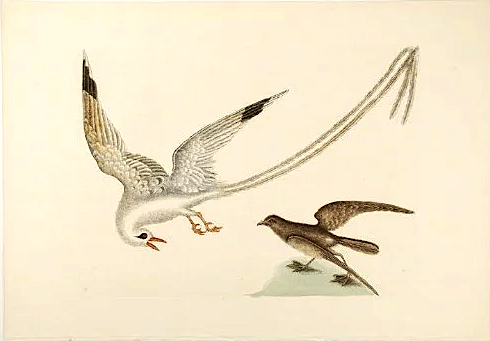
The caribbean white-tailed tropicbird (Phaethon lepturus catesbyi) is one of six types of tropicbird found worldwide. It is named after pioneering naturalist MARK CATESBY, who predated John James Audubon. Click the link to find out more about him. Catesby’s depiction (below) of a ‘Phaeton’ must be one of the earliest.
Catesby’s Tropicbird

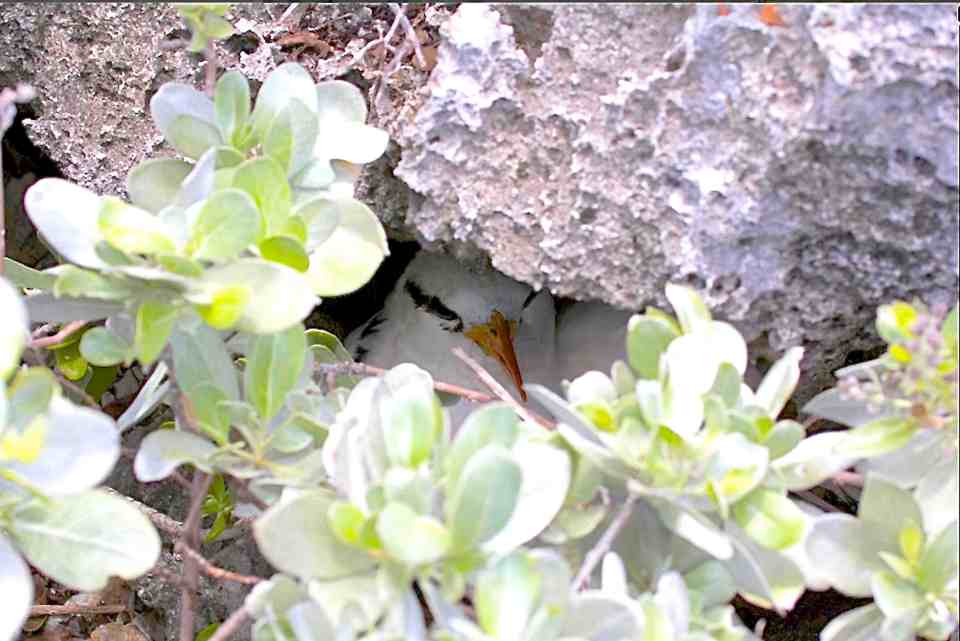
In the Bahamas, tropicbirds are summer resident only and breed on the islands. Abaco is fortunate to have several breeding colonies, not all in remote or inaccessible places. Female tropicbirds lay a single egg directly onto the ground or on rocky ledges and in rocky holes. One might suppose that such limited egg production with a somewhat high-risk nesting policy, coupled with modern problems such as habitat destruction, might affect numbers. However, these fine birds seem to be doing well, and are IUCN-listed ‘Least Concern’.
This tropicbird on Abaco has found a safe place to nest in a rocky hole
Tropicbirds have a variety of local names in the Caribbean, for example ‘longtail’ and ‘bosun bird’ (after their screeching call). They plunge-dive for fish, but are inexpert swimmers. This is a factor I am prepared to overlook in the elegance contest. They were born to fly high, not to paddle about.


THE STORY OF TB THE TROPICBIRD
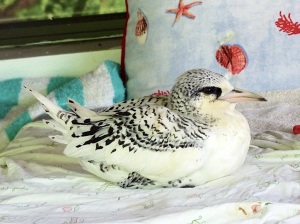
A couple of years ago, a tropicbird chick was rescued by a dive boat and given to Melissa Maura, well-known for her animal magic, to care for. She nurtured ‘TB’, giving him a soft bed and providing him with a swimming pool. To begin with, it looked as though he might not be able to fly at all, but as he became stronger he started to flap his wings.


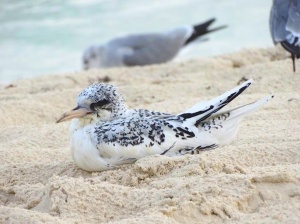
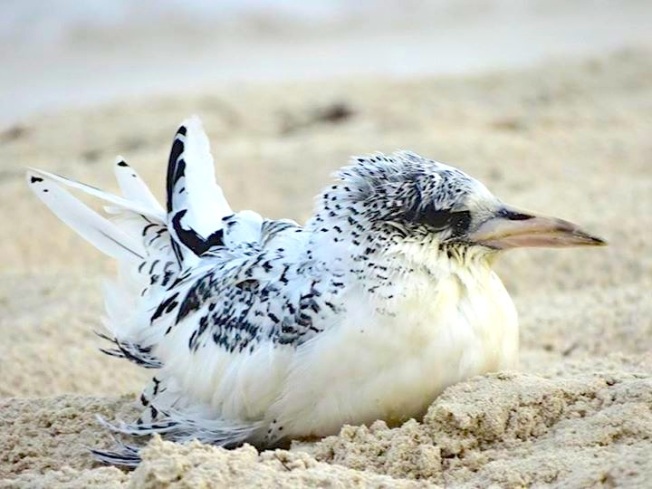
Then it was time to go to the beach, get acquainted with sand and sea, and practise flying. I have some pathetic photos of an exhausted TB lying flat out on the sand after his initial attempts to fly. But Melissa and TB persevered with the flying practice and in due course TB began to get the hang of it. Finally, the great day arrived. Melissa and a friend took TB down to the beach and launched him into the air. He took off, flying strongly away, never to return. A moment of triumph mixed with poignance.


You are very welcome to propose a rival in the elegance stakes in the comment box!
Credits: Main photos Alex Hughes; TB images Melissa Maura


Abaco has a recorded 37 warbler species. Of these, most are winter residents and some are rarer migratory transients. Only 5 are permanently resident on Abaco: the Bahama Warbler, Bahama Yellowthroat, Olive-capped Warbler, Pine Warbler and Yellow Warbler. You can read about all 5 HERE
I realise that I haven’t posted about OCWs in their own right; and that as a species they have been unfairly lumped in (by me) with more general warbler posts. Time to put that right by showing some exclusively OCW photos.
OCWs have an unusually restricted range, despite which they remain IUCN-listed ‘Least Concern’. These pretty birds are native only to the western and eastern ends of Cuba, Grand Bahama, and Abaco. Their natural habitat is pine forests and to a lesser extent in mixed forest and coppice areas.
If you are lucky enough to see an OCW on Abaco, it’s worth thinking about the rich and unspoilt habitat that ensures its survival there. These little birds, along with other important bird species, enjoy a safe haven in the vast acres of pine forest.
Photo credits: Bruce Hallett (1, 2, 3, 6); Tom Sheley (4, 5); Tom Reed (7)

Neotropic or Olivaceous Cormorants Phalacrocorax brasilianus. Smaller cousins of the familiar double-crested cormorant, and occupying a quite different range. In the northern Bahamas they are considered to be uncommon summer residents whereas the big guys are common year-round residents. However the neotropics’ range has spread in the last decade and they may become more noticeable on Abaco. Right now, Abaco is pretty much the northern boundary.
In many ways, cormorants are taken rather for granted – ubiquitous black guardians of the coastal margins. But seen close-to, they have their glamour. This is especially true of the slimmer neotropics, with precious jewels for eyes and intricate plumage patterns that a mere fly-past cannot reveal.
Male and female neotropic cormorants: a caption contest in the making…


“FAST FOOD ON THE WING”
The Antillean Nighthawk Chordeiles gundlachii has several local names such as ‘killakadick’ and ‘pi-di-mi-dix’, and variations on the theme – presumably onomatopoeic. The photos below illustrate these wonderful birds in flight and on the ground.
Paul Marvin / Xeno-Canto
The speed of flight and the jagging paths make the nighthawks extremely hard to photograph. It’s far easier when they are on the ground…
Credits: Woody Bracey (1, 4); Tom Sheley (2); Sandy Walker (3); Birds Caribbean (5), Susan Daughtrey (6); Paul Marvin at Xeno-Canto for the sound recording


The above birds with the purple ‘gorgets’ are males; below are two females

A Woodstar in the coppice at Delphi – I had about 5 seconds to get this (not very good) shot!
Credits: Bruce Hallett (1, 2); Tom Sheley (3, 4); Tara Lavallee (5); Keith Salvesen (6)
The Columbidae of Abaco: all are permanent breeding residents
White-crowned Pigeon

White-winged dove

Eurasian Collared Dove

Common Ground Dove (Tobacco Dove)

Zenaida Dove

Key West Quail-Dove

Rock Pigeon

Mourning Dove
The birds shown above represent the 8 species found on Abaco. However, in New Providence, there is a beautiful pigeon that has not yet made its way over to Abaco and has yet to be introduced there.
Pied Imperial Pigeon (Nassau)

Photo credits: Gerlinde Taurer (1); Alex Hughes (2); Tom Sheley (3, 7, 13); Tony Hepburn (4); Keith Salvesen (5, 8, 14); Bruce Hallett (6, 9, 10); Woody Bracey (11, 16, 17); Milton Harris (12); Charles Skinner (15)