The Yellow-throated Warbler (Setophaga dominica) is a most helpful warbler, in that what you see is what you get. You needn’t go to embarrassing lengths to determine whether it has a Yellow Rump. It doesn’t make extravagant geographical claims like the Cape May, Kentucky, Tennessee, Nashville or Connecticut warblers. It doesn’t disguise its warblerdom with a confusing name like ‘American Redstart’ or ‘Ovenbird’. Nor with a weird warbler name that is completely obscure like the Prothonotary. It’s a winter resident only, so it won’t try to puzzle you in the summer. The males and females are roughly similar in appearance, unlike so many species. All-in-all, a most agreeable and obliging little bird. Here are a few to enjoy, before I spoil the magic slightly…
I said earlier that the magic of the apparently simple ID of a warbler that lives up to its name would have to be spoiled. I’m afraid the images below rather undo the certainties I’d promised… two more species common to Abaco, also named for their yellow throats (though note: the yellow extends to more than just the throat) .
BAHAMA YELLOWTHROAT
COMMON YELLOWTHROAT
You’d really think that someone at Audubon Towers or Cornell Castle might have thought of calling these two species ‘Bahama’ and ‘Common’ Masked Warblers, wouldn’t you – after all there’s a Hooded Warbler, which indeed has a hood. No other warbler has a mask like these two. Then any confusion could be avoided.
Abaco has two permanently resident woodpecker species, theWEST INDIAN WOODPECKERand theHAIRY WOODPECKER. There is a third, migratory woodpecker species that is a fairly common winter resident, the yellow-bellied sapsucker Sphyrapicus varius. Like its woodpecker cousins, the sapsucker drills holes in trees (see below). The dual purpose is to release the sap, which it eats, and to attract insects that it also eats. A two-course meal, if you like. They’ll also eat insects on an undrilled tree, and even ‘hawk’ for them in flight. They balance their diet with fruit and berries.
The distinctive patterns of sapsucker holes may completely encircle the trunk of a tree with almost mathematical precision. This is sometimes described as ‘girdling’ and may have a damaging effect on a tree, sometimes even killing it if the bark is severely harmed. This may require preventive measures in orchards for example, though note that in the US Yellow-bellied Sapsuckers are listed and protected under the Migratory Bird Treaty Act so radical action is prohibited.
YELLOW-BELLIED SAPSUCKER SOUNDS
DRUMMING (Xeno-Canto / Richard Hoyer)
CALL (Xeno-Canto / Jonathon Jogsma)
On Abaco, palms are a favourite tree for the sapsuckers. There are several palms along the Delphi beach, and this year I noted that one coconut palm in particular had seen plenty of sapsucker action, with the drill holes girdling the entire trunk from top to bottom.
In their breeding grounds yellow-bellied sapsuckers excavate a large cavity in a softwood tree as a nest. They mate for life, and often return to the same nest year every year, with the pair sharing nesting duties. I have no idea whether the pair migrate south for the winter together, or whether they agree to take a break from each other. I’d like to think it’s the former…
Credits: Photos Gerlinde Taurer, Tom Sheley, RH; Cornell Lab (Range Map) & Xeno-Canto (YBS recordings as credited above)
Species featured in ‘The Delphi Club Guide to the Birds of Abaco’ by Keith Salvesen, pp 242-3
Many of the birds shown here were photographed in or around the grounds of Delphi. More recently, they have to an extent been displaced by red-winged blackbirds which are of course very fine birds but in large numbers sound (may I say this? Is this just me?) quite irritating after a while. Whereas the thrush of course has a sweet and melodious song, like this (my own recording – turn up the vol):
The eyes of the RLT are at least as prominent a feature as their legs. Lots of birds have red legs. Very few have such remarkable bright, fiery eye-rings, even in a youngster.
This photo from birdman Tom Sheley is my favourite – a perfect composition
Photo Credits: Tom Sheley (1, 11); Peter Mantle (2, 4); Gerlinde Taurer (3); Mr & Mrs Harbour (5, 6, 7); Charles Skinner (8, 9); Erik Gauger (10). Lo-fi audio recording: RH
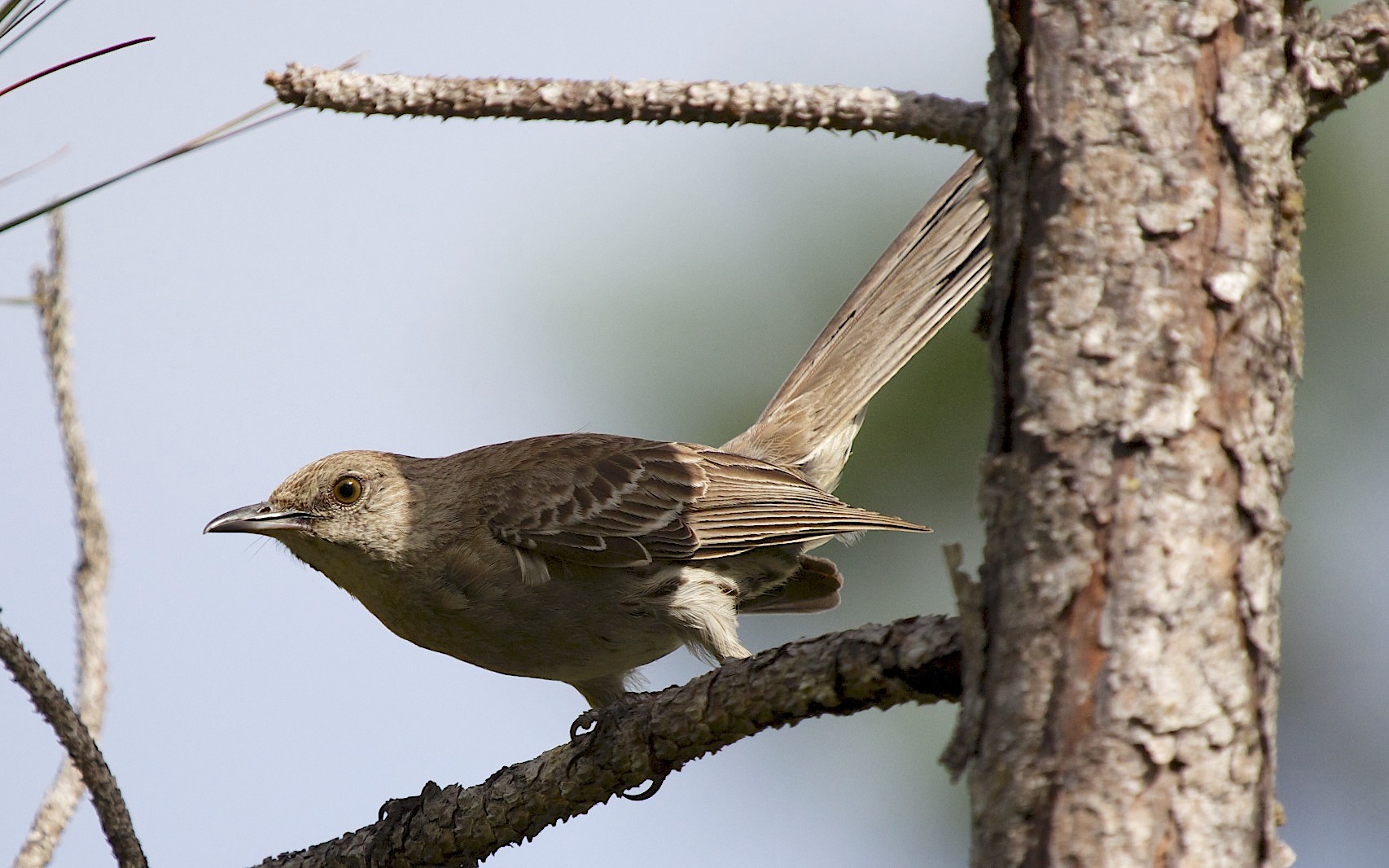
The Bahama Mockingbird Mimus gundlachii is similar to its slightly smaller cousin, the widespread Northern Mockingbird Mimus polyglottis. The range of Bahama Mockingbirds is not restricted to the Bahamas themselves, and includes areas of Cuba, Jamaica and TCI, so despite the name they are not an endemic species to the Bahamas. They are also occasional vagrants to the United States, especially – for reasons of proximity – southeastern Florida.
The Bahama Mockingbird is browner than the greyish Northern Mockingbird, and has distinctive streaking and spotting to its breast and undercarriage. This may extend to what you might describe as the bird’s ‘trouser legs’, though I’m sure there’s a more technically correct term.
Both mockingbird species are found on Abaco. The NMs are ubiquitous in towns, settlements, gardens, coppice and pine forest, whereas BMs are shyer and tend to be found in the pine forest and well away from humans and their operations.
I am astounded by the beauty and variety of their song. It consists of very varied notes and phrases, each repeated 3 or 4 times before moving on to the next sounds in the repertoire. Here is a short 18 second example I recorded, using my unpatented iPhone method, for which seeHERE.
For those with interest in birdsong, here is a longer 1:13 minute song from the same bird, with largely different sounds from the first recording made minutes earlier. There’s even a decent stab at imitation of a 1960s Trimphone™. I could have stayed listening for far longer.
An apparently new subspecies, the scarlet-faced mockingbird. In fact the bird had been feeding on red berries, and had managed to collect plenty of the juice round the base of its beak.
Range maps show the stark contrast between the very limited range of the Bahama Mockingbird and the vast distribution of the Northern Mockingbird. An example is below, for comparison.
Photos Credits: Tom Sheley (1, 6); Peter Mantle (2); Charlie Skinner (3); Keith Salvesen (4, 7, 8, 9); Alex Hughes (5); Susan Daughtrey (10). Range maps eBird & wiki.
These small birds Columbina passerina are also known as tobacco doves. Although they sometimes perch in the branches of trees, you are more likely to encounter them on the ground, where they forage for seeds, fruit, and insects.
They will often fly in front of a person or vehicle in short fluttering stages, keeping out of reach but never going too far ahead.When they fly, their undersides flash reddish-brown (sometimes described as chestnut) – hence (I presume) the tobacco dove name.
The common ground dove is one of the world’s smallest doves – roughly 6 inches long. Its beak has a black tip, and its feathers have a pinkish tinge. The feathers on the head and the breast look rather like scales. Females are similar to males but tend to be greyer.
Common ground doves mate with their partner for life, and a pair may have 2 or even 3 broods a year. Both parents feed the young birds until they are ready to feed themselves. Rather amazingly, hatchlings can fledge in 11 days.
I had embedded a sound file of the dove sound to listen out for. For some glitchy reason it wasn’t working. So a description of the song / call will have to do. It’s a (frankly) rather monotonous and subdued little ‘whoop’.
My own attempts to photograph a CGD satisfactorily have been rather feeble. I have taken plenty of photos of them on the ground, but nothing memorable, let alone useable. However the one below surprised me by flying onto a branch quite near me, and I had time to squeeze the trigger before it flew off again. Far from perfect compared with others on this page, but I’m not going to let that little detail prevent me from showing it…
Photo Credits: Tom Reed (1), Tom Sheley (2, 3), Nina Henry (4, 5, 6), Keith Salvesen (7); Audio – Andrew Spenser / Xeno Canto
The gull-billed tern Gelochelidon nilotica had a name upgrade from Sterna nilotica some years ago, and was awarded the honour of its own genus. Let’s be clear at the outset: there’s no such thing as a tern-billed gull, which slightly lessens the scope for species confusion.
There are 12 species of tern recorded for Abaco. Only one, the royal tern, is a permanent resident. There is one winter resident, the Forster’s tern and there a 6 summer resident terns of varying degrees of commonness. The other four are transient or vagrant, and probably not worth making a special trip to Abaco to find. The GBT is designated SB3, a summer breeding resident that is generally uncommon, though might be more common in particular areas.
TERN TABLE****I know! Too tempting…
The bird gets its name from it short, thick gull-like bill. It’s quite large in tern terms, with a wingspan that may reach 3 foot. They lose their smart black caps in winter.
There are 6 species of GBT worldwide, and it is found in every continent. While many terns plunge-dive for fish, the GBT mostly feeds on insects in flight, and will also go after birds eggs and chicks. Small mammals and amphibians are also on the menu.
All photos were taken by Alex Hughes, a contributor to “THE BIRDS OF ABACO”, when he spent some time on Abaco a while back in connection with the conservation of the Abaco Parrot and the preservation of the habitat integrity of their nesting area in the Abaco National Park
Until 2016 the black-faced grassquit Tiaris bicolor was officially classified with other passerine emberizidae (e.g. antillean bullfinches & sundry New World sparrows). The classifications committee of the American Ornithological Union recently moved them to join tanager-type species, specifically the dome-nesting ones. Now they are considered to be closely related to Darwin’s finches; and they join the broader category that includes tanagers, grosbeaks, and buntings.
All photographs taken on Abaco, as credited below
THE BFG EVERYDAY TWITTERING SONG
THE BFG DISPLAY BUZZING SONG
Credits: Alex Hughes (1, 10); Tom Sheley (2, 3); Bruce Hallett (4, 9); Tom Reed (5, 11); Becky Marvil (6); Peter Mantle (7); Gerlinde Taurer (8); Keith Salvesen (12); Whatbird? (sound files)
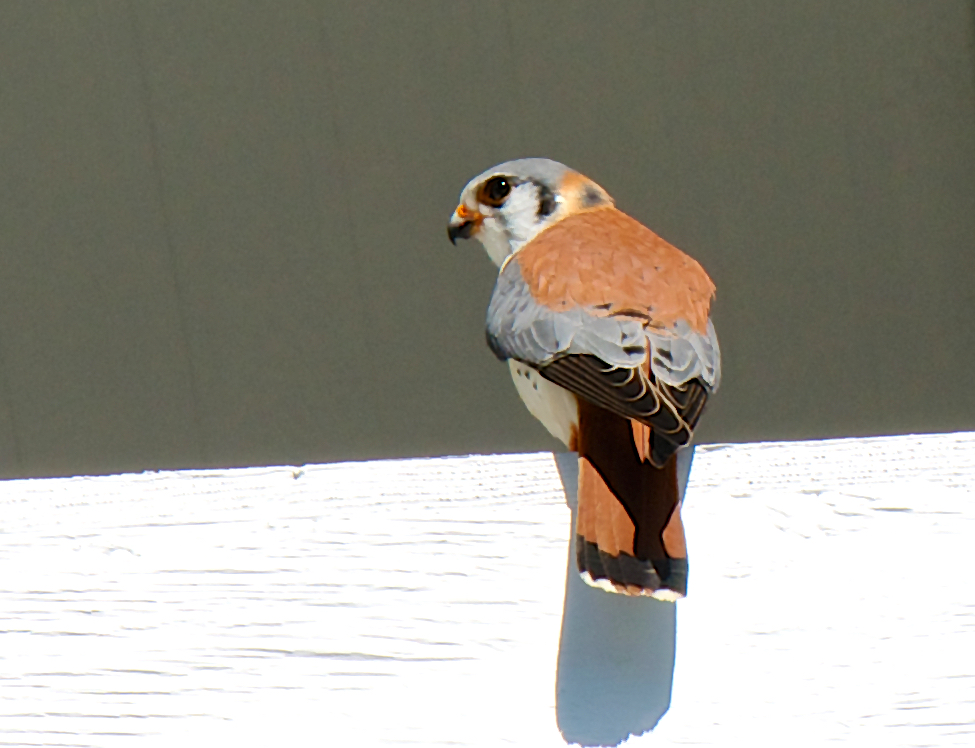
As many or most of the images show, utility wires (also posts) are a favourite perch for kestrels. They get an unimpeded view of the only thing that really matters in their lives – outside the breeding season, of course – PREY.
In my experience it’s quite rare to see AMKEs on the ground – unless they are in the act of ripping up some hapless rodent pinned to the earth. I was with photographer Tom Sheley when he captured this fine bird in the grass.
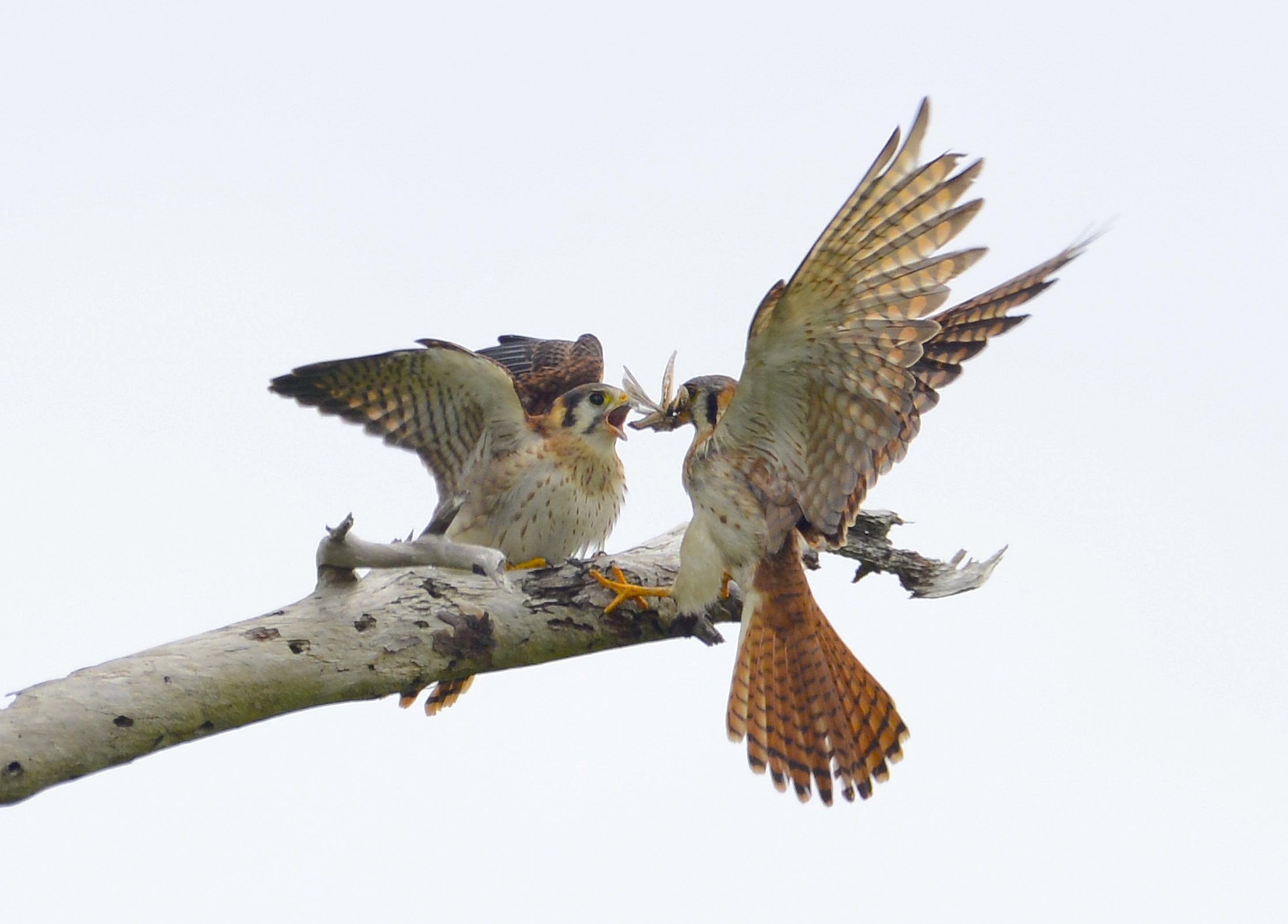
Tom also took this outstanding photo, on an overcast day, of a kestrel feeding its fledgeling a large insect.
An AMKE at Treasure Cay
A richly-coloured specimen
A kestrel in streamlined flight, with its feet tucked tightly under its body
Bird on the Wire
Credits: Bruce Hallett (1, 11); Charles Skinner (2); Peter Mantle (3, 9); Tom Sheley 4, 5, 6); Nina Henry (7); Keith Salvesen (10); Tom Reed (8)
You can read about Fregata magnificens and their courtship displays, gular pouches, nesting habits, names, uses to mankind (if any), and 10 magnificent facts about them at my Rolling Harbour site HERE. These birds are sky-pirates, stealing fish in the air from other birds. Tropicbirds are a particular target. They catch fish and keep them in their gullets as they fly back to the nest to feed their young. The frigatebirds will swoop on them, catch them by the leg and hold them upside-down until they regurgitate the fish. Often the frigate bird will manage to release the tropicbird and dive to catch the fish before it hits the water.
CLICK LOGO TO VIEW A BBC / DAVID ATTENBOROUGH CLIP OF AN AERIAL ROBBERY
Film clip: Female FB has TB by the leg & shakes it until the fish (circled) drops out
A MAN-O-WAR GALLERY
A male in flight (a most unusual shot, taken from above)
Juveniles being delinquent
A female in flight: the white front is the invariable distinguishing feature
10 FACTS ABOUT FRIGATEBIRDS
The largest of several frigatebird species around the world
Found in tropical and subtropical waters
Females have white fronts – easily distinguishable from males in flight
Adult wingspan is 7+ feet = largest wing-area / bodyweight ratio of any bird
Can remain in flight and far out to sea for many days
The Tricolored Heron Egretta tricolor is one of 6 heron species found on Abaco, and is a permanent breeding resident. To which can be added 4 sorts of egret to complete a line up of expert fishers, all equally at home hunting in the water or from the shore, or surveying the scene from nearby vantage points like bushes and trees. A long neck, a long bill and long legs make this heron species ideally adapted for wading. Like other herons and egrets, it will stand stock-still waiting for the perfect fish to swim into range. However they are also active hunters, and will stalk prey or chase it by striding quickly through the water in pursuit. They eat fish, crustaceans, reptiles, and insects.
The heron and egret species of Abaco
Breeding plumage: smart blue bill and a fish to put in it
Credits: Phil Lanoue (1, 7); Dan Pancamo (2); Keith Salvesen (3); Woody Bracey (4); Bruce Hallett (5)