A single wonderful photo (not mine!)… says it all
Credit: Fabulous in-flight shot by Nina Henry (contributor to ‘Birds of Abaco’)
I was looking at the list of the dozens of Abaco bird species I have featured over the years, when I was struck by the complete omission of one of Abaco’s most significant small birds – the Bahama Warbler Setophaga flavescens. This warbler species is of the most important in the Bahamas for several reasons, any one of which should have prompted me to showcase this lovely bird before now.

The Bahama warbler is a significant species with a near-unique status in the Bahamas:
Until 2011, the BAWA was classified as a subspecies of the YELLOW-THROATED WARBLER. The ornithological powers-that-be then recognised that the two species were distinct in both appearance and in vocalisation, and split them into separate species (this splitting / amalgamating process occurs annually and plays havoc with the precious ‘Life Lists’ kept with such rigour by ardent birders**.

The BAWA has such a confined range that even the extensive reach of the wonderful Cornell Lab of Ornithology has not got as far as this bird. The info sections of the otherwise comprehensive website for Neotropical Birds are blank and waiting for someone to upload some details. Here are a few facts in one of a very good series of info-graphics produced by the BAHAMAS NATIONAL TRUST.
** I have never even started a Life List, which demonstrates just how lightweight I am as a bird person
Credits: Alex Hughes (1, 4); Bruce Hallett (2, 6); Woody Bracey (3); Tom Sheley (5); Range Map, Cornell; Info G, BNT
One of the joys of being a sanderling is that rock pools fill and empty diurnally. At some time during daylight, there’s the certainty of a quick dip. I was lying on the beach when I took this short video, so that I didn’t spook the birds. I was equipped with a smallish camera (I drowned it the following day. By mistake I mean) but I kept my distance rather than try to get closer and spoil their joyful bathing.
I caught these little birds at a critical moment. You can tell that the tide is coming in fast. The peeps are becoming edgy, and weighing up the joys of immersion in a pool with the less enjoyable prospect of being washed out of the pool by the next wave. Within a minute or so, they had all flocked down the shoreline for a foraging session.
Images / video: Keith Salvesen / Rolling Harbour

There are twelve (12!) species of tern – ‘swallows of the sea’ – that to a greater or lesser extent may be found on Abaco. Whether they will actually be visible at any given time is less certain, though. For a start, the only resident species is the lovely Royal Tern, available at many locations on Abaco and the cays throughout the year.
ROYAL TERNS Thalasseus maximus PR1
In the slightly less commonly-found category are the summer migrant terns that, by definition, are only in residence for around half the year. Four of these are fairly common in certain areas, and actually breed on Abaco; these include arguably the prettiest of all, the bridled tern. The other two tern species (gull-billed and sandwich) are more rare and as far as I can make out do not breed locally; or perhaps only rarely.
LEAST TERN Sternula antillarum SR B 1
BRIDLED TERN Onychoprion anaethetus SR B 2
ROSEATE TERN Sterna Dougallii SR B 2
SOOTY TERN Onychoprion anaethetus SR B 2
GULL-BILLED TERN Gelochelidon nilotica SR 3
SANDWICH TERN Thalasseus sandvicensis SR 4
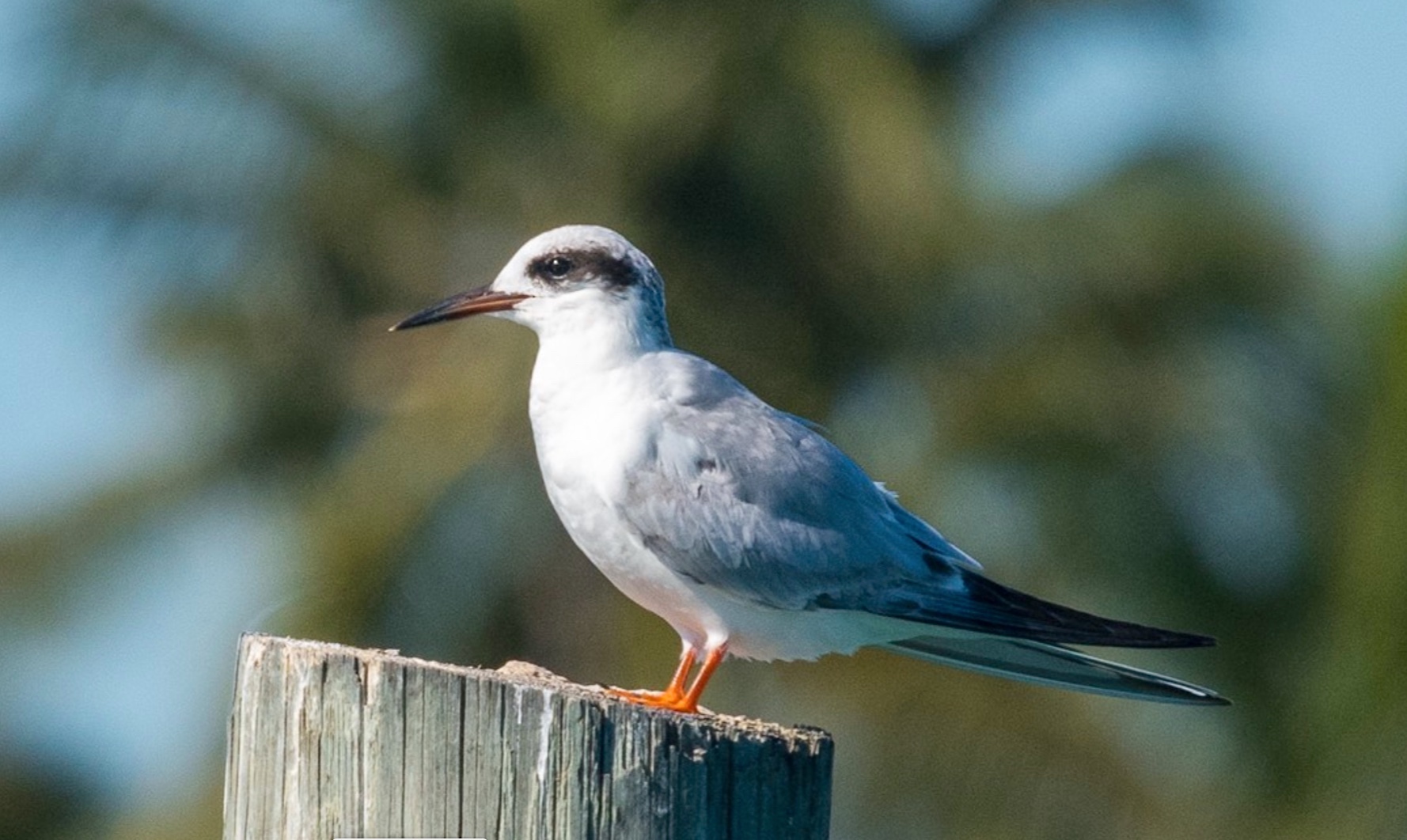
There is one rare winter resident migratory tern species. I had to check when the last one was recorded for Abaco. It was of course only in January this year, when ace birder-photographer Sally Chisholm saw one at Treasure Cay and managed to photograph it for posterity.
FORSTER’S TERN Sterna forsteri WR 4
The final four ‘Abaco’ terns are very much the occasional visitors. Three of them pass over the Bahamas on their longer migration, but may make a pit-stop around Abaco to take on fuel. Likelihood of sighting one? Slender but not impossible… The fourth, the Arctic Tern, is a very rare vagrant, a bird well away from its usual home or migration route as the result of storms or faulty satnav or sheer happenstance. Don’t travel to the Bahamas intent on seeing one.
CASPIAN TERN Hydroprogne caspia TR 4
As for the remaining three species, they are the transient black tern and common tern; and the vanishingly rare vagrant Arctic tern (the clue is in the name). No photos of any of these I’m afraid, so here’s a handy checklist instead.
ELECTIVE MUSICAL DIGRESSION
Written by Peter Seeger a few years earlier, Turn x 3 was released in 1965, the title track on the second album from the Byrds. At a rather febrile time in US history (Vietnam, draft riots, black civil rightists v cops and so on), this unusually palliative and thoughtful song with its religious connotations to some extent stood for peace and hope in a time of turmoil.
PS the somewhat laboured title of this post shoehorns in the name of another Byrds album, ‘The Notorious Byrd Brothers’
Photo credits: Keith Salvesen (1, 2, 3, 5, 18); Tony Hepburn (4); Alex Hughes (10, 11); Bruce Hallett (6, 7, 12); Woody Bracey (8, 13, 16); Duncan Wright (9); Dick Daniels (14); Sally Chisholm (15); Keith Kemp (17)

Four principal so-called ‘tyrant flycatchers’ (Tyrannidae) are found on Abaco: the loggerhead kingbird, the gray kingbird, the La Sagra’s flycatcher and the Cuban pewee. These are common permanent residents, except for the gray kingbird which is a summer resident only. Several other flycatcher species are found on Abaco, but they are very uncommon winter residents, rare transients, or vagrants.
Loggerheads seem to have two methods of observing humans and their mysteries. One is by perching on a branch or in a shrub, watching intently. They stay quite still… until suddenly launching into the air to intercept some passing insect with their hooked beaks (so-called ‘hawking’), before returning to their perch. And staring at you again. The other method is to follow you round, either flying slightly ahead as you progress; or fluttering in the coppice alongside you; or playing catch-up from behind.
The collective names for a group of kingbirds are: a Court, a Coronation, or a Tyranny
A humorous conversation
A rather wind-blown gull in non-breeding plumage
WHAT DO LAUGHING GULLS SOUND LIKE? ARE YOU OVERSENSITIVE?
I made a couple of short recordings of the gulls in full humour mode; also a short video of the breeding pair above. If you have never heard them before, you might want to listen to the full 30 seconds. For anyone else there’s a convenient lull at around 15 secs before they kick off again.
All photos, audio clip, video: Keith Salvesen / Rolling Harbour

Bahama Warbler, Abaco Bahamas (Bruce Hallett)

There are 37 warbler species recorded for Abaco. They fall into three distinct categories. Surprisingly perhaps, only 5 species are permanently resident on Abaco, ie non-migratory. Then there are warblers that commute from the breeding grounds of North America to warmer climes in the Fall, returning in the Spring to breed. Some will be familiar – PALM WARBLER, AMERICAN REDSTART, BLACK-AND -WHITE WARBLER. Others, like the HOODED WARBLER, are less common. One or two are very rare indeed, such as the KIRTLAND’S WARBLERS that choose Abaco as a winter destination. Finally there are the so-called transients, warbler species that use the northern Bahamas as a stopover during their longer migratory flights, such as the BLACKPOLL WARBLER.
The 5 permanent residents don’t migrate, so there is a chance to find them year round. The pine forests will generally be the best place to start the quest. Importantly, 2 of the 5 species are endemic birds to the Bahamas and can be found nowhere else: BAHAMA YELLOWTHROAT and BAHAMA WARBLER. The latter and the OLIVE-CAPPED WARBLER, are very range-restricted, and only found on Abaco and Grand Bahama.
PHOTO CREDITS Bruce Hallett (1, 3, 5, 8, 11); Gerlinde Taurer (2); Tom Sheley (4, 6, 7); Tom Reed (9); Alex Hughes (10, 11)
CHECKLIST CODES based on the complete checklist and codes for Abaco devised by Tony White with Woody Bracey for “THE DELPHI CLUB GUIDE TO THE BIRDS OF ABACO” by Keith Salvesen

Here are some gorgeous white-tailed tropicbirds (Phaethon lepturus catesbyi) seen within the last week near the Low Place on Man-o-War Cay. There were 6 in the group, flying high, flying low, circling, dipping down, flirting – all of this taking place just offshore.
Sally Chisholm, Abaco birder and photographer, was with Todd Pover of CWFNJ, engaged in the final piping plover count of the season before the birds return to their summer breeding grounds [check out ABACO PIPING PLOVER WATCH if you are interested]. Sally and Todd were distracted from the matter in hand as the group of tropicbirds glided and swooped through the air. It was a free demonstration of beautiful flying skills that can be matched by few other species.
It became obvious that courtship was involved. As Sally vividly describes it, “The birds were observed for more than 15 minutes making wide circles, at times flying out of sight across towards Great Abaco and coming back flying low over the same area on MOW. Two birds would interact with a lot of “keck-keck-keck”, and then one of the pair flew down to land several times in the same crevice of the iron shore. It first appeared that the bird was landing for food but none of the photos showed anything carried. The display looked to be one of courtship and was amazing to watch”.
TROPICAL TOPICS
Credits: All photos, Sally Chisholm except the fantastic nest shot, Melissa Maura (many thanks to both for use permission – I’ve never got a decent photo of one); Audubon NA
SANDHILL CRANE: ABACO’S NOVELTY BIRD (2)In mid-December, Kaderin Mills of the Bahamas National Trust saw Abaco’s first-ever reported Sandhill Crane (Antigone canadensis) in the Fox Town area of North Abaco. Woody Bracey was quickly onto the news and in the afternoon he took photos of the bird. I posted about this exciting (because a new species is always exciting) event, with details about its significance plus facts, maps etc HERE
Six weeks later, the crane is still in residence. In the meantime a number of birders have been to see the new novelty bird for Abaco in what has become a small but significant birding hotspot right at the top end of the island, in area round the Church, the Primary School, and the Clinic. The crane is now firmly on the eBird map for the Bahamas.
This elegant visitor seems to be quite tame and unfazed by its new fame. People watch while it forages for invertebrates in the grass, pausing to check on bystanders before resuming its feeding. It tolerates the presence of humans without showing fear, let alone flying away.
The call of the Sandhill Crane sounds like this:
To test its reaction, a recording was played and immediately the crane responded and called out to the (apparent) co-crane. The bird has also (rather sadly?) been seen by locals by the door of the Church, looking at its reflection and even making pecking motions at it. A lonely crane, maybe.
This bird is likely to remain disappointed by any expectation or hope of company. With any luck in the Spring, the instinctive call to the north (Canada and nearby US) will persuade it to migrate back to sandhill habitat to join a flock in the summer breeding grounds.
It is always a somewhat melancholy occurrence when a fine bird like this – or like last season’s lone BALD EAGLE – takes a wrong turn on their migration or perhaps get blown off course and finds itself on its own, species-wise. This bird seems to be taking it in its (longish) stride, however, and it has become something of a celebrity avian for the local folk. It will be interesting to find out when the migration urge finally encourages its flight away from its unusual overwintering habitat.
Credits: Chris Johnson (1); Erika Gates / Martha Cartwright (2, 4); Elwood ‘Woody’ Bracey (3, 5, 6); Audubon (7); Ian Cruickshank / Xeno Canto (audio); Birdorable (cartoon); and a tip of the hat to the School Principal, to Kadie Mills, and to Uli Nowlan who uploaded her sighting to eBird.

The Smooth-billed Ani (Crotophaga ani) – aka Cemetery Bird – is the third member of the cuckoo family found on Abaco, the others being the MANGROVE CUCKOO and the YELLOW-BILLED CUCKOO. You can (it’s voluntary) find out more about them in an earlier article HERE.
I have returned to these engagingly gregarious birds and their raucous ways because Paul Harding has recently captured a sequence of a small group of anis behaving so endearingly that they are irresistible. Not for them the oddly incompetent fluttering flight, nor the disorganised, unbalanced landing technique. It’s simply a matter of getting settled on a branch, and then making room for one more in the middle (or perhaps resisting it…).
Hey – make room for another one…
Yay, I’m in… a bit squished but…
That’s better… all settled now….
Let the racket begin!