Reduced to 18mb for 10 second loading (no noticeable loss of definition)
Below the screen BIRDS OF ABACO enlarges the screen; DOWNLOAD will do just that
The top bar contains all the usual ways to make adjustments to the contents
This is the penultimate version before printing, with a few crop marks etc
Please let me know if there are any problems with the download
The download is free and can be scrolled on-screen or saved in the usual way. Do share with family and friends. By all means use parts – eg the Checklist – to print for reference. It’s fine to print out a single complete copy for personal use only.
As mentioned in previous posts, I am asking those who choose to download the book to make a modest charitable donation to a local wildlife-related cause or to a local school or an organisation that inspires kids to get involved in the natural world around them.
KEITH SALVESEN
March 2024
rollingharbour.delphi@gmail.com
Thanks to all the many people who contributed to the book including 30 photographers who took brilliant photos; 3 Bahamas bird experts who contributed greatly to the composition and accuracy of the book; the superb printers Conti in Italy; Peter Mantle the inspiration and eminence grise; and my wife Sally whose publishing and editorial skills are second to none, and her patience limitless.
A small New World songbird of the cardinal subfamily
Flags and other colourful festive decorations
PAINTED BUNTING
Few birds radiate Yuletide vibes better than Painted Buntings, with their perfect festive colours. Here is a seasonal flock of them to enjoy. A very happy Christmas to those who kindly continue to visit Rolling Harbour.
The Greater Antillean Bullfinch Loxigilla violacea is a pretty bird, easy to find and to identify. They love feeders, and they are responsive to ‘pishing’, that irritating (?) noise that birders make to unseen avians in the coppice to persuade them to reveal themselves. Adult males are black with bright red accessories (hence “police bird”); females are paler with orangey accessories; and juveniles look a bit scruffy and patchy. Here’s a GAB gallery to enjoy.
Credits: Erik Gauger (1); Alex Hughes (2, 3); Tom Sheley (4, 6); Keith Salvesen (5); Charles Skinner (7); Gerlinde Taurer (8); Bruce Hallett (9)
The American Redstart Setophaga ruticilla is a distinctive bird, males being orange and black, and females yellow and black. The dissimilar colouring between the sexes of these little warblers is due to differing carotin levels in each. These unmistakeable winter residents are common on Abaco and in the Northern Bahamas generally. They are an easy warbler for new birders look out for, being unlike any other small warblerish-looking bird. All the birds here were photographed on Abaco.
TEN REDSTARTLING FACTS (& a comment)
The Latin name means moth-eating red-tail (‘start’ is an archaic word for tail)
AMRE are among the most common New World warblers
Occasionally they are found as far afield as Europe
They are almost entirely insect-eaters, with occasional berries or seeds for variety
Males are late developers, tending to skew the sex ratio: too many of them
They are inclined to monogamy, but only to an extent. Two-or-more-timing goes on
The most aggressive males get the pick of the habitats
This all begins to sound like human behaviour (not strictly a fact, so it doesn’t count)
Their fanned tails are for display, and maybe to surprise insects into breaking cover
Redstarts suffer badly from predators, especially in the breeding season
They are popular with coffee farmers for keeping insect numbers down
The American Redstart (f & m) as depicted by JJ Audubon
There are twelve species of tern – ‘swallows of the sea’ – that to a greater or lesser extent may be found on Abaco. Whether they will actually be visible at any given time is less certain, though. For a start, the only resident species is the lovely Royal Tern, available at many locations on Abaco and the cays throughout the year. The rest are migratory or just passing through.
PERMANENT RESIDENTS
ROYAL TERNS Thalasseus maximus PR1
MIGRATORY TERNS: SUMMER
In the slightly less commonly-found category are the summer migrant terns that, by definition, are only in residence for around half the year. Four of these are fairly common in certain areas, and actually breed on Abaco; these include arguably the prettiest of all, the bridled tern. The other two tern species (gull-billed and sandwich) are more rare and as far as I can make out do not breed locally; or perhaps only rarely.
LEAST TERN Sternula antillarum SR B 1
BRIDLED TERN Onychoprion anaethetus SR B 2
ROSEATE TERN Sterna Dougallii SR B 2
SOOTY TERN Onychoprion anaethetus SR B 2
GULL-BILLED TERN Gelochelidon nilotica SR 3
SANDWICH TERN Thalasseus sandvicensis SR 4
MIGRATORY TERNS: WINTER
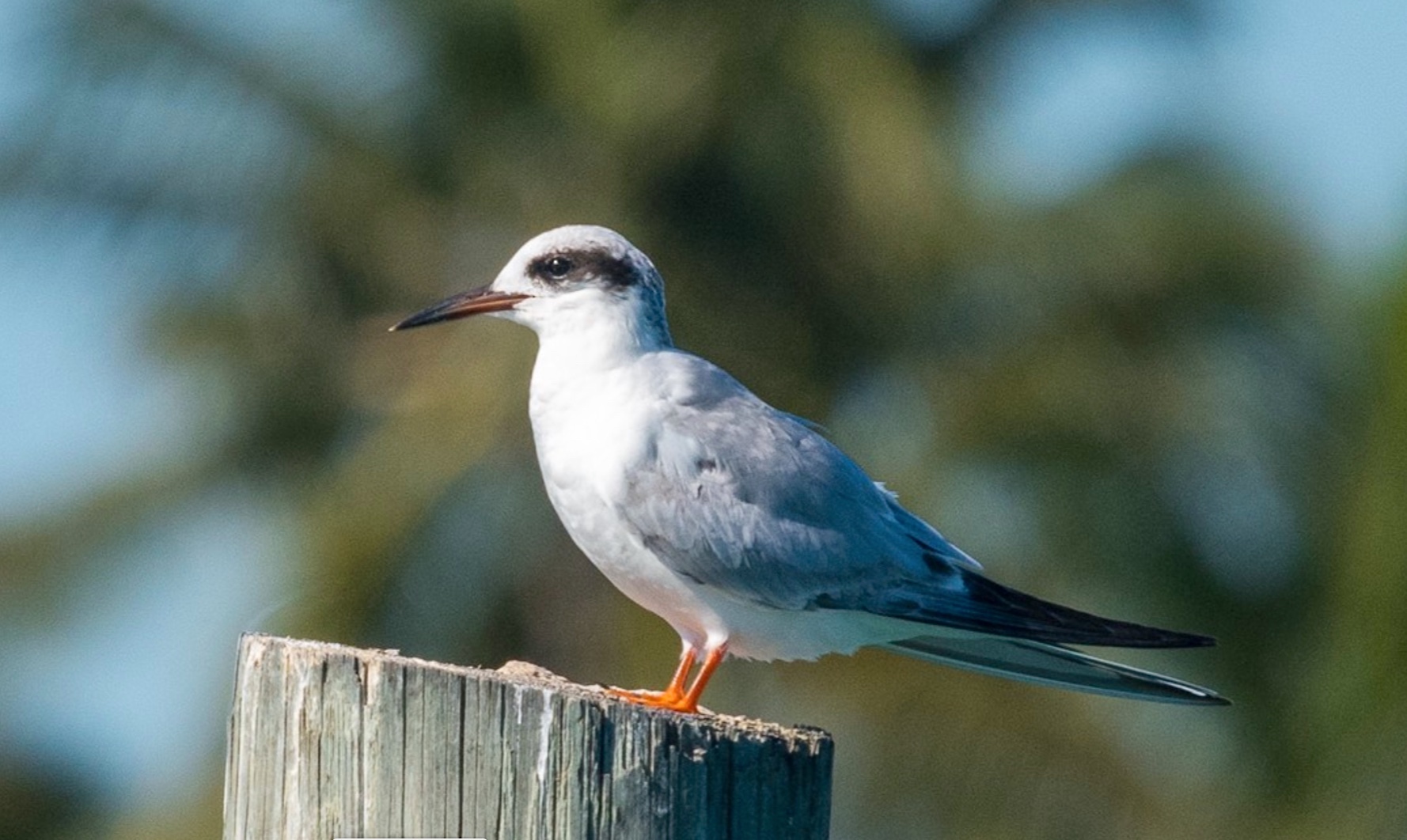
There is one very rare winter resident migratory tern species, with few records of sightings for Bahamas and until early 2019, no photographic record for Abaco until Sally Chisholm saw one at Treasure Cay and managed to capture it for posterity.
FORSTER’S TERN Sterna forsteri WR 4
OCCASIONAL & RARE VISITORS
A further four tern species are very much occasionals that drop by. Three of them pass over the Bahamas on their longer migration, but may make a pit-stop around Abaco to take on fuel. Likelihood of sighting one? Slender but not impossible… the Caspian tern below was photographed on Abaco. The fourth, the Arctic Tern, is a very rare vagrant, a bird well away from its usual home or migration route as the result of storms or faulty satnav or sheer happenstance. Don’t travel to the Bahamas intent on seeing one.
CASPIAN TERN Hydroprogne caspia TR 4
The remaining species are the transient black tern and common tern; and the vanishingly rare vagrant Arctic tern. No photos of any of these I’m afraid. Here’s a handy checklist of all the tern species.
ELECTIVE MUSICAL DIGRESSION
Written by Pete Seeger, Turn x 3 was released in 1965, the title track on the second album by The Byrds. At a rather febrile time in US history (Vietnam, draft riots, civil rightists v cops and so on), this unusually palliative and thoughtful song with its religious connotations to some extent stood for peace and hope in a time of turmoil.
PS the somewhat laboured title of this post shoehorns in the name of another Byrds album, ‘The Notorious Byrd Brothers’
Photo credits: Keith Salvesen (1, 2, 3, 5, 18); Tony Hepburn (4); Alex Hughes (10, 11); Bruce Hallett (6, 7, 12); Woody Bracey (8, 13, 16); Duncan Wright (9); Dick Daniels (14); Sally Chisholm (15); Keith Kemp (17)
West Indian Woodpecker . Abaco . Bahamas (π Keith Salvesen)
The WEST INDIAN WOODPECKER Melanerpes superciliaris is one of Abaco’s specialist birds. Islanders and regular visitors will be familiar with the sight – and indeed the raucous sound – of these beautiful birds. They are commonly found throughout Abaco and the cays. Possibly their rarity across the wider Bahamas is underestimated. The only other island where these birds are found is San Salvador. Formerly resident on Grand Bahama, they are believed to be extirpated there. Abaco is very fortunate to enjoy their noisy company.
Waves and incoming tide – a little too close for comfort on the edge of the pool…
One of the joys of being a sanderling is that rock pools fill and empty diurnally. At some time during daylight, there’s the certainty of a quick dip. I was lying on the beach when I took this short video, so that I didn’t spook the birds. I was equipped with a smallish camera (I drowned it the following day. By mistake I mean) but I kept my distance rather than try to get closer and spoil their joyful bathing.
I caught these little birds at a critical moment. You can tell that the tide is coming in fast. The peeps are becoming edgy, and weighing up the joys of immersion in a pool with the less enjoyable prospect of being washed out of the pool by the next wave. Within a minute or so, they had all flocked down the shoreline for a foraging session.
Four principal so-called ‘tyrant flycatchers’ (Tyrannidae) are found on Abaco: the loggerhead kingbird, the gray kingbird, theLa Sagra’s flycatcher and the Cuban pewee. These are common permanent residents, except for the gray kingbird which is a summer resident only. Several other flycatcher species are found on Abaco, but they are very uncommon winter residents, rare transients, or vagrants.
Loggerheads seem to have two methods of observing humans and their mysteries. One is by perching on a branch or in a shrub, watching intently. They stay quite still… until suddenly launching into the air to intercept some passing insect with their hooked beaks (so-called ‘hawking’), before returning to their perch. And staring at you again. The other method is to follow you round, either flying slightly ahead as you progress; or fluttering in the coppice alongside you; or playing catch-up from behind.
A typical quizzical loggerhead sideways look… all flycatchers do this
The collective names for a group of kingbirds are: a Court, a Coronation, or a Tyranny
Photo Credits: Keith Salvesen at Sandy Point, Abaco Bahamas
WHAT DO LAUGHING GULLS SOUND LIKE? ARE YOU OVERSENSITIVE?
I made a couple of short recordings of the gulls in full humour mode; also a short video of the breeding pair above. If you have never heard them before, you might want to listen to the full 30 seconds. For anyone else there’s a convenient lull at around 15 secs before they kick off again.
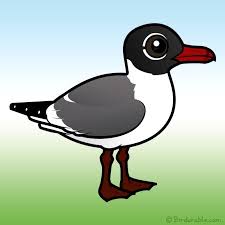
Breeding adult (Birdorable)
All photos, audio clip, video: Keith Salvesen / Rolling Harbour





 THE BIRDS OF ABACO

