


Credits: Gerlinde Taurer & Nina Henry: photographed on Abaco, Bahamas for “The Birds of Abaco”

Credits: Gerlinde Taurer & Nina Henry: photographed on Abaco, Bahamas for “The Birds of Abaco”

There are twelve species of tern – ‘swallows of the sea’ – that to a greater or lesser extent may be found on Abaco. Whether they will actually be visible at any given time is less certain, though. For a start, the only resident species is the lovely Royal Tern, available at many locations on Abaco and the cays throughout the year. The rest are migratory or just passing through.

PERMANENT RESIDENTS
ROYAL TERNS Thalasseus maximus PR1


MIGRATORY TERNS: SUMMER
In the slightly less commonly-found category are the summer migrant terns that, by definition, are only in residence for around half the year. Four of these are fairly common in certain areas, and actually breed on Abaco; these include arguably the prettiest of all, the bridled tern. The other two tern species (gull-billed and sandwich) are more rare and as far as I can make out do not breed locally; or perhaps only rarely.
LEAST TERN Sternula antillarum SR B 1


BRIDLED TERN Onychoprion anaethetus SR B 2


ROSEATE TERN Sterna Dougallii SR B 2

SOOTY TERN Onychoprion anaethetus SR B 2

GULL-BILLED TERN Gelochelidon nilotica SR 3


SANDWICH TERN Thalasseus sandvicensis SR 4


MIGRATORY TERNS: WINTER
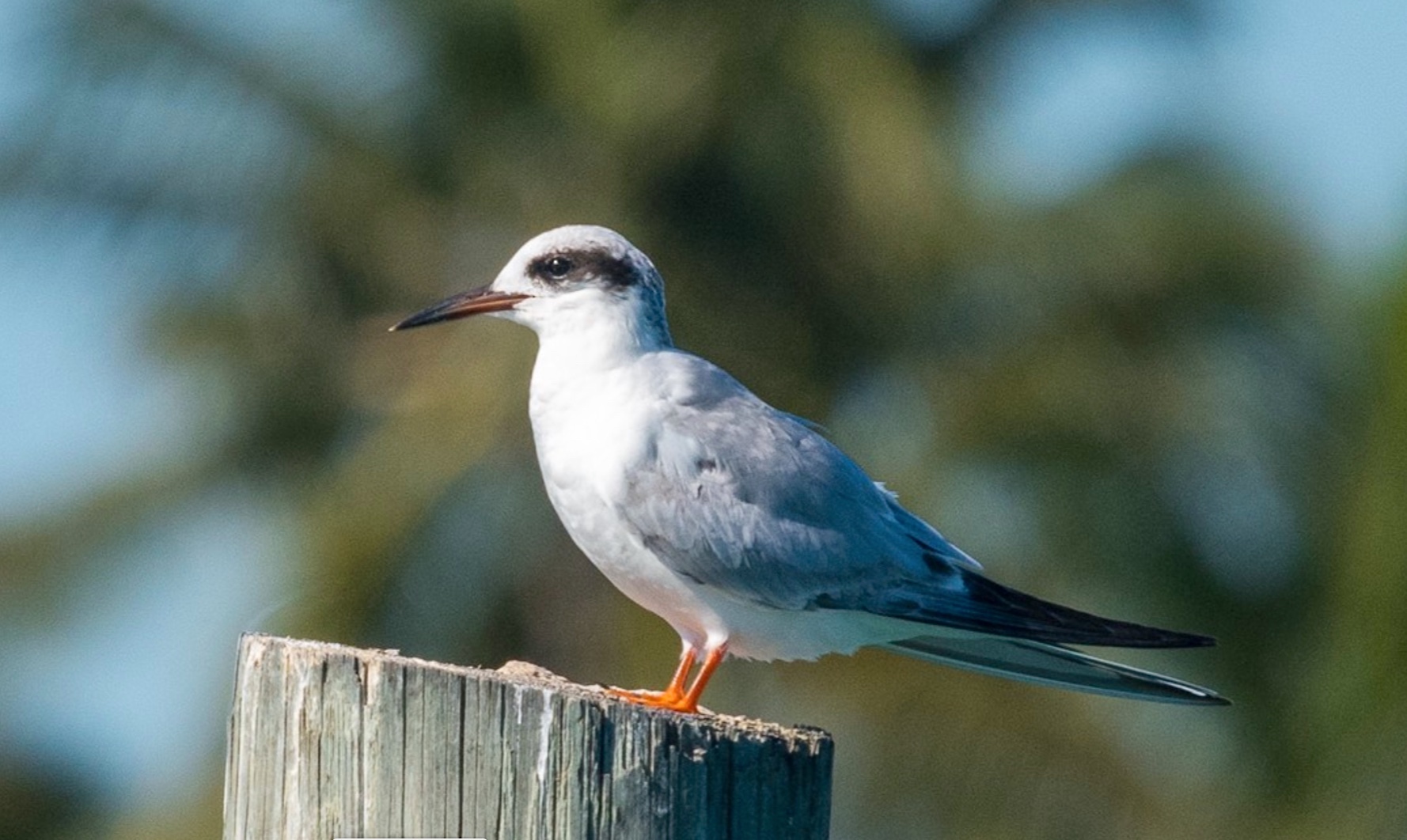
There is one very rare winter resident migratory tern species, with few records of sightings for Bahamas and until early 2019, no photographic record for Abaco until Sally Chisholm saw one at Treasure Cay and managed to capture it for posterity.
FORSTER’S TERN Sterna forsteri WR 4

OCCASIONAL & RARE VISITORS
A further four tern species are very much occasionals that drop by. Three of them pass over the Bahamas on their longer migration, but may make a pit-stop around Abaco to take on fuel. Likelihood of sighting one? Slender but not impossible… the Caspian tern below was photographed on Abaco. The fourth, the Arctic Tern, is a very rare vagrant, a bird well away from its usual home or migration route as the result of storms or faulty satnav or sheer happenstance. Don’t travel to the Bahamas intent on seeing one.
CASPIAN TERN Hydroprogne caspia TR 4


The remaining species are the transient black tern and common tern; and the vanishingly rare vagrant Arctic tern. No photos of any of these I’m afraid. Here’s a handy checklist of all the tern species.

ELECTIVE MUSICAL DIGRESSION

Written by Pete Seeger, Turn x 3 was released in 1965, the title track on the second album by The Byrds. At a rather febrile time in US history (Vietnam, draft riots, civil rightists v cops and so on), this unusually palliative and thoughtful song with its religious connotations to some extent stood for peace and hope in a time of turmoil.
PS the somewhat laboured title of this post shoehorns in the name of another Byrds album, ‘The Notorious Byrd Brothers’
Photo credits: Keith Salvesen (1, 2, 3, 5, 18); Tony Hepburn (4); Alex Hughes (10, 11); Bruce Hallett (6, 7, 12); Woody Bracey (8, 13, 16); Duncan Wright (9); Dick Daniels (14); Sally Chisholm (15); Keith Kemp (17)

WEST INDIAN WOODPECKER Melanerpes superciliaris

The WEST INDIAN WOODPECKER Melanerpes superciliaris is one of Abaco’s specialist birds. Islanders and regular visitors will be familiar with the sight – and indeed the raucous sound – of these beautiful birds. They are commonly found throughout Abaco and the cays. Possibly their rarity across the wider Bahamas is underestimated. The only other island where these birds are found is San Salvador. Formerly resident on Grand Bahama, they are believed to be extirpated there. Abaco is very fortunate to enjoy their noisy company.
‘BAHAMA DUCK‘ Anas bahamensis


Photos taken on Abaco by Gerlinde Taurer, a major contributor to “Birds of Abaco”

The MANGROVE CUCKOO (Coccyzus minor) is one of three cuckoo species found on Abaco and in the wider Bahamas. The yellow-billed cuckoo is another; and the noisy black smooth-billed anis are cuckoos by species though not in appearance.

You will notice that some of the birds shown have got fat insects in their beaks. Their preference is for caterpillars and grasshoppers, but they are happy to eat other insects, spiders, snails, lizards and (with a nod to an all-round healthy diet) fruit.


These cuckoos are shy birds and fairly hard to spot in the coppice unless they are on the move. You may see one flying across a track ahead of a vehicle, flashing its distinctive tail. Here are a couple of recordings of their call, described in various ways, for example as “gawk gawk gawk gawk” or “gauk gauk”. I’m not sure I hear it quite like that but I can’t think of a sensible way to write it out phonetically…
Jesse Fagan / Xeno-Canto
Cornell Lab / Allaboutbirds

Credits: Bruce Hallett, Alex Hughes, Tom Sheley, Gerlinde Taurer and the late Tony Hepburn; Audio – Xeno-Canto & Cornell Lab. All photos taken on Abaco!


Bananaquits (Coereba flaveola) are small, colourful, and delightful birds of the coppice and garden. Besides their obvious attractiveness, the birds have in recent years enjoyed an uniquity: the status of being the sole species in the family Coerebidae.

However this singular status has really been a kind of avian parking place due to past, present (and doubtless future) uncertainty of the right category for these birds. Like so many avian species these days, they are subject to the rigours and vagaries of continual reclassification by the ornithological powers-that-be.

Bananaquits are, broadly speaking, passerines – essentially birds that perch. The nominal ‘passer’ was specifically awarded to sparrows by BRISSON, a contemporary of Linnaeus. Recently, bananaquits have suffered mysterious migrations of their classification ranging from the generalised ‘passerine‘ to the vague incertae sedis (= ‘uncertain group‘) to uncomfortable inclusion with tanagers / emberizids.

The debate over the appropriate classification for this pretty little bird (of which there are many subspecies in the broad Caribbean region) – rumbles on. A new way to confuse the issue is the suggestion that the bananaquit should be split into 3 species. In some areas, I believe this has happened at least informally.

Elsewhere there are doubters, sceptics, and champions of other group inclusions. The most obvious beneficiaries of all this will be dedicated birders, who may end up with two extra species to add to their ‘Lifer’ lists. Personally I’d like to think that the birds themselves will stay ahead of the curve in their own category, maintaining the mystery of their precise status while humans argue about what to call them.
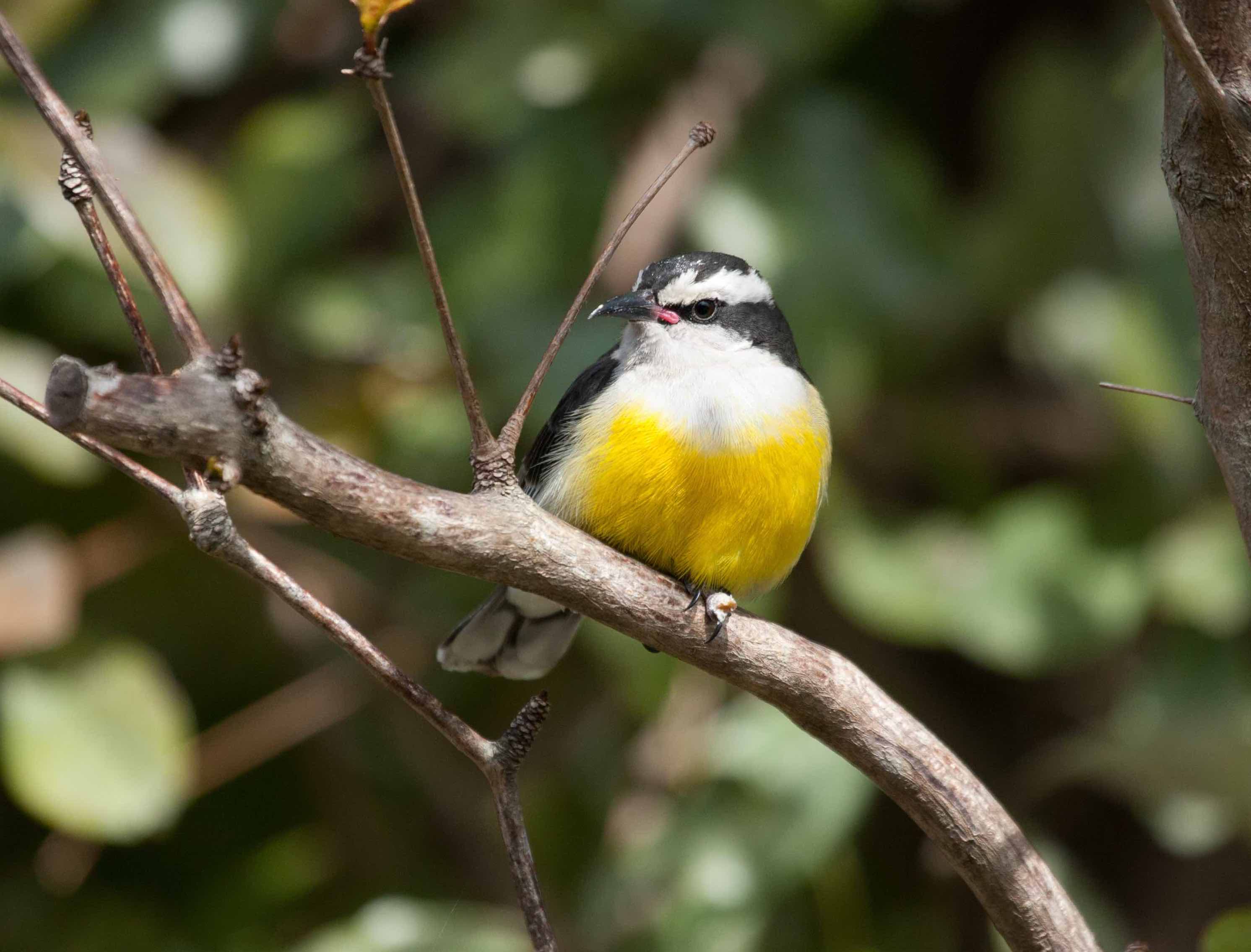
CREDITS: Keith Salvesen / Rolling Harbour (1); Gerlinde Taurer (2); Craig Nash (3, 7); Tom Sheley (4, 5); Erik Gauger (6). All birds photographed on Abaco, Bahamas
Bananaquit perched on yellow elder, the National flower of the Bahamas

Credit: Fabulous in-flight shot by Nina Henry (contributor to ‘Birds of Abaco’)

Waves and incoming tide – a little too close for comfort on the edge of the pool…
One of the joys of being a sanderling is that rock pools fill and empty diurnally. At some time during daylight, there’s the certainty of a quick dip. I was lying on the beach when I took this short video, so that I didn’t spook the birds. I was equipped with a smallish camera (I drowned it the following day. By mistake I mean) but I kept my distance rather than try to get closer and spoil their joyful bathing.
I caught these little birds at a critical moment. You can tell that the tide is coming in fast. The peeps are becoming edgy, and weighing up the joys of immersion in a pool with the less enjoyable prospect of being washed out of the pool by the next wave. Within a minute or so, they had all flocked down the shoreline for a foraging session.
Images / video: Keith Salvesen / Rolling Harbour


Four principal so-called ‘tyrant flycatchers’ (Tyrannidae) are found on Abaco: the loggerhead kingbird, the gray kingbird, the La Sagra’s flycatcher and the Cuban pewee. These are common permanent residents, except for the gray kingbird which is a summer resident only. Several other flycatcher species are found on Abaco, but they are very uncommon winter residents, rare transients, or vagrants.


Loggerheads seem to have two methods of observing humans and their mysteries. One is by perching on a branch or in a shrub, watching intently. They stay quite still… until suddenly launching into the air to intercept some passing insect with their hooked beaks (so-called ‘hawking’), before returning to their perch. And staring at you again. The other method is to follow you round, either flying slightly ahead as you progress; or fluttering in the coppice alongside you; or playing catch-up from behind.

A typical quizzical loggerhead sideways look… all flycatchers do this
The collective names for a group of kingbirds are: a Court, a Coronation, or a Tyranny

Photo Credits: Keith Salvesen at Sandy Point, Abaco Bahamas

A humorous conversation

A rather wind-blown gull in non-breeding plumage


WHAT DO LAUGHING GULLS SOUND LIKE? ARE YOU OVERSENSITIVE?
I made a couple of short recordings of the gulls in full humour mode; also a short video of the breeding pair above. If you have never heard them before, you might want to listen to the full 30 seconds. For anyone else there’s a convenient lull at around 15 secs before they kick off again.
Breeding adult (Birdorable)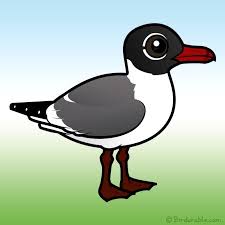
All photos, audio clip, video: Keith Salvesen / Rolling Harbour

 THE BIRDS OF ABACO