The Tricolored Heron Egretta tricolor is one of 6 heron species found on Abaco, and is a permanent breeding resident. To which can be added 4 sorts of egret to complete a line up of expert fishers, all equally at home hunting in the water or from the shore, or surveying the scene from nearby vantage points like bushes and trees. A long neck, a long bill and long legs make this heron species ideally adapted for wading. Like other herons and egrets, it will stand stock-still waiting for the perfect fish to swim into range. However they are also active hunters, and will stalk prey or chase it by striding quickly through the water in pursuit. They eat fish, crustaceans, reptiles, and insects.
The heron and egret species of Abaco
Breeding plumage: smart blue bill and a fish to put in it
Credits: Phil Lanoue (1, 7); Dan Pancamo (2); Keith Salvesen (3); Woody Bracey (4); Bruce Hallett (5)
The American Redstart Setophaga ruticilla is a distinctive bird, males being orange and black, and females yellow and black. The dissimilar colouring between the sexes of these little warblers is due to differing carotin levels in each. These unmistakeable winter residents are common on Abaco and in the Northern Bahamas generally. They are an easy warbler for new birders look out for, being unlike any other small warblerish-looking bird. All the birds here were photographed on Abaco.
TEN REDSTARTLING FACTS (& a comment)
The Latin name means moth-eating red-tail (‘start’ is an archaic word for tail)
AMRE are among the most common New World warblers
Occasionally they are found as far afield as Europe
They are almost entirely insect-eaters, with occasional berries or seeds for variety
Males are late developers, tending to skew the sex ratio: too many of them
They are inclined to monogamy, but only to an extent. Two-or-more-timing goes on
The most aggressive males get the pick of the habitats
This all begins to sound like human behaviour (not strictly a fact, so it doesn’t count)
Their fanned tails are for display, and maybe to surprise insects into breaking cover
Redstarts suffer badly from predators, especially in the breeding season
They are popular with coffee farmers for keeping insect numbers down
The American Redstart (f & m) as depicted by JJ Audubon
There are twelve species of tern – ‘swallows of the sea’ – that to a greater or lesser extent may be found on Abaco. Whether they will actually be visible at any given time is less certain, though. For a start, the only resident species is the lovely Royal Tern, available at many locations on Abaco and the cays throughout the year. The rest are migratory or just passing through.
PERMANENT RESIDENTS
ROYAL TERNS Thalasseus maximus PR1
MIGRATORY TERNS: SUMMER
In the slightly less commonly-found category are the summer migrant terns that, by definition, are only in residence for around half the year. Four of these are fairly common in certain areas, and actually breed on Abaco; these include arguably the prettiest of all, the bridled tern. The other two tern species (gull-billed and sandwich) are more rare and as far as I can make out do not breed locally; or perhaps only rarely.
LEAST TERN Sternula antillarum SR B 1
BRIDLED TERN Onychoprion anaethetus SR B 2
ROSEATE TERN Sterna Dougallii SR B 2
SOOTY TERN Onychoprion anaethetus SR B 2
GULL-BILLED TERN Gelochelidon nilotica SR 3
SANDWICH TERN Thalasseus sandvicensis SR 4
MIGRATORY TERNS: WINTER
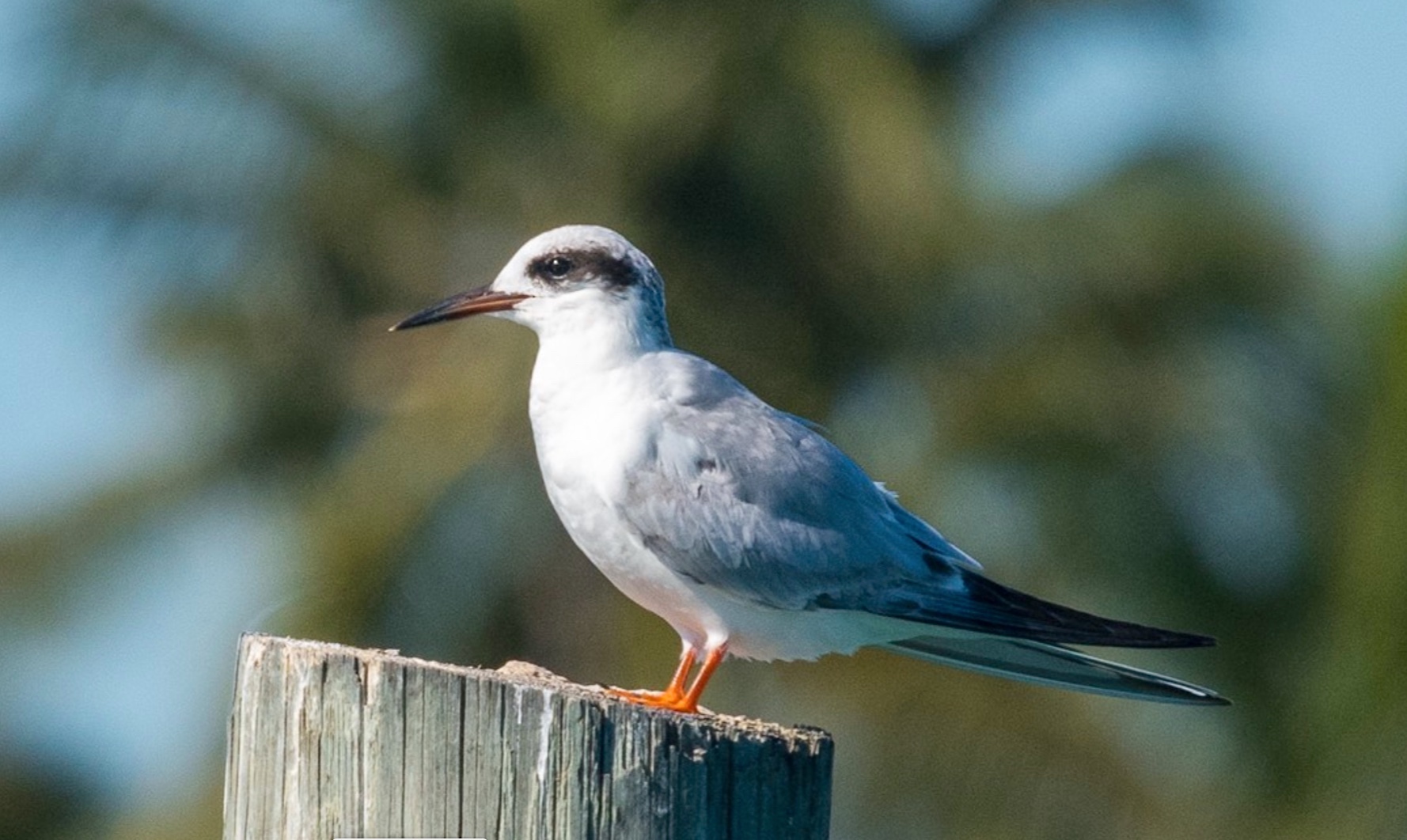
There is one very rare winter resident migratory tern species, with few records of sightings for Bahamas and until early 2019, no photographic record for Abaco until Sally Chisholm saw one at Treasure Cay and managed to capture it for posterity.
FORSTER’S TERN Sterna forsteri WR 4
OCCASIONAL & RARE VISITORS
A further four tern species are very much occasionals that drop by. Three of them pass over the Bahamas on their longer migration, but may make a pit-stop around Abaco to take on fuel. Likelihood of sighting one? Slender but not impossible… the Caspian tern below was photographed on Abaco. The fourth, the Arctic Tern, is a very rare vagrant, a bird well away from its usual home or migration route as the result of storms or faulty satnav or sheer happenstance. Don’t travel to the Bahamas intent on seeing one.
CASPIAN TERN Hydroprogne caspia TR 4
The remaining species are the transient black tern and common tern; and the vanishingly rare vagrant Arctic tern. No photos of any of these I’m afraid. Here’s a handy checklist of all the tern species.
ELECTIVE MUSICAL DIGRESSION
Written by Pete Seeger, Turn x 3 was released in 1965, the title track on the second album by The Byrds. At a rather febrile time in US history (Vietnam, draft riots, civil rightists v cops and so on), this unusually palliative and thoughtful song with its religious connotations to some extent stood for peace and hope in a time of turmoil.
PS the somewhat laboured title of this post shoehorns in the name of another Byrds album, ‘The Notorious Byrd Brothers’
Photo credits: Keith Salvesen (1, 2, 3, 5, 18); Tony Hepburn (4); Alex Hughes (10, 11); Bruce Hallett (6, 7, 12); Woody Bracey (8, 13, 16); Duncan Wright (9); Dick Daniels (14); Sally Chisholm (15); Keith Kemp (17)
West Indian Woodpecker . Abaco . Bahamas (π Keith Salvesen)
The WEST INDIAN WOODPECKER Melanerpes superciliaris is one of Abaco’s specialist birds. Islanders and regular visitors will be familiar with the sight – and indeed the raucous sound – of these beautiful birds. They are commonly found throughout Abaco and the cays. Possibly their rarity across the wider Bahamas is underestimated. The only other island where these birds are found is San Salvador. Formerly resident on Grand Bahama, they are believed to be extirpated there. Abaco is very fortunate to enjoy their noisy company.
The MANGROVE CUCKOO (Coccyzus minor) is one of three cuckoo species found on Abaco and in the wider Bahamas. The yellow-billed cuckoo is another; and the noisy black smooth-billed anis are cuckoos by species though not in appearance.
You will notice that some of the birds shown have got fat insects in their beaks. Their preference is for caterpillars and grasshoppers, but they are happy to eat other insects, spiders, snails, lizards and (with a nod to an all-round healthy diet) fruit.
These cuckoos are shy birds and fairly hard to spot in the coppice unless they are on the move. You may see one flying across a track ahead of a vehicle, flashing its distinctive tail. Here are a couple of recordings of their call, described in various ways, for example as “gawk gawk gawk gawk” or “gauk gauk”. I’m not sure I hear it quite like that but I can’t think of a sensible way to write it out phonetically…
Credits: Bruce Hallett, Alex Hughes, Tom Sheley, Gerlinde Taurer and the late Tony Hepburn; Audio – Xeno-Canto & Cornell Lab. All photos taken on Abaco!
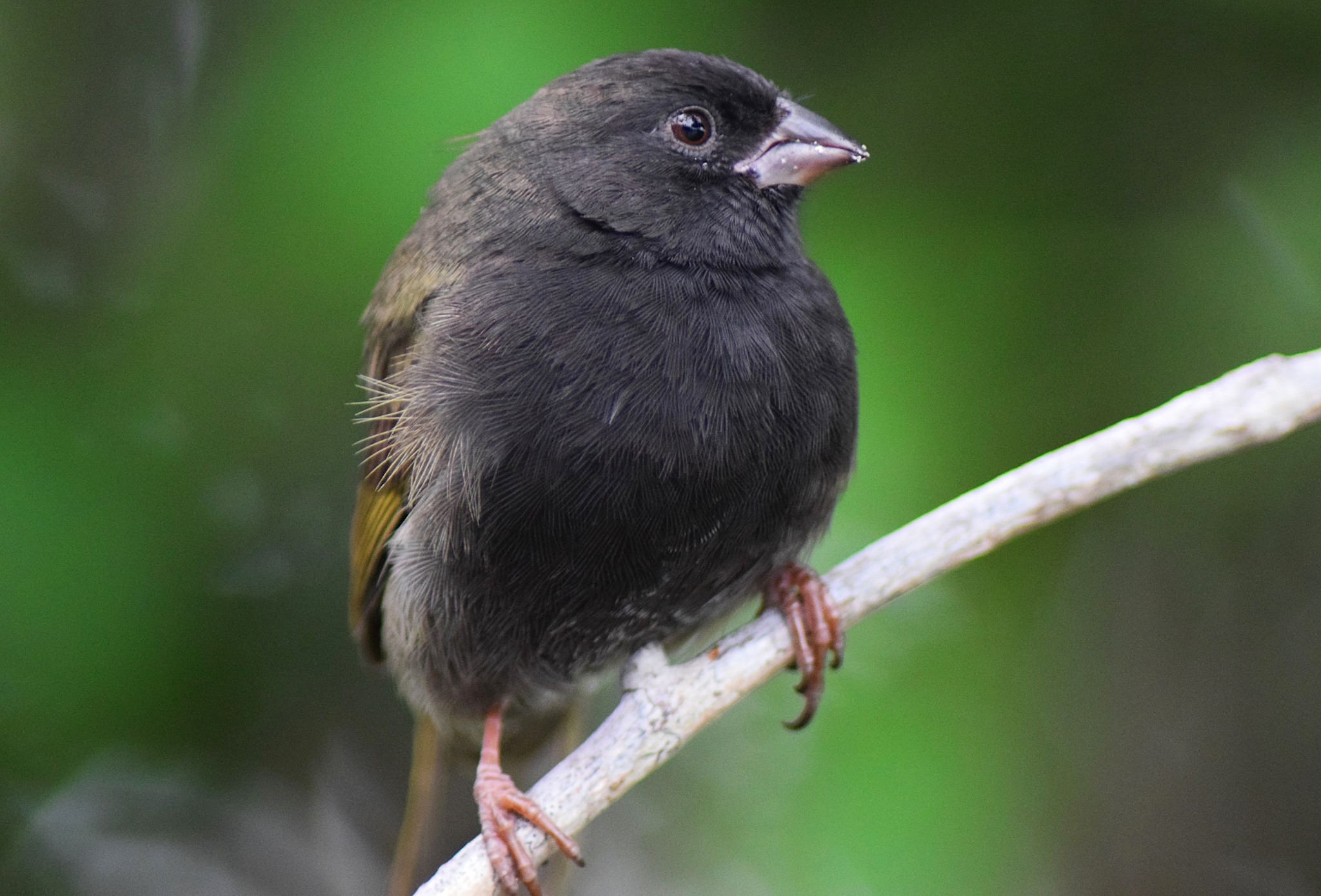
A while back, Black-faced Grassquits Tiaris bicolor were honoured by the American Ornithological Union with a classification change from emberizid to tanager. For the reasons that follow, the species regarded this both as scientific promotion and as merited status elevation. I invited an authoritative Spokesquit to explain why.
*******************
Hi, human friends, I’m a black-faced grassquit and I have a couple of observations to make on behalf of BFGs, if I may. First, we seem to be universally described by you as ‘common’, whereas we are actually quite refined in our behaviour. Secondly, the words most used to portray us are ‘dull’ and ‘drab’. And ‘stubby’. Well, excuse me… I – we – ask you to give us a second look. Maybe check out these images for a start.
Unsurprisingly we were very excited when the perceptive classifications committee of the American Ornithological Union gave us an upgrade. That’s the way we saw it anyway. For many years we were classified under the heading emberizidae.
We kept company with some buddies like the handsome Greater Antillean Bullfinches, but also with a lot of New World sparrows, with whom we (frankly) never felt entirely comfortable. Annoyingly chirpy, for a start.
And so we officially became a type of tanager. They even reckon (rather late in the day, in my view) that we are closely related toDarwin’s finches. So, we are “common”, huh? Now we get to be with other birds that are dome-nesters like us. And how about this – we’ll be in the same list as some really cool birds…
How’s this for a colourful gang to be joining: scarlet tanager, summer tanager, rose-breasted grosbeak, indigo bunting, painted bunting – these are our new cousins. BFGs “dull” and “drab”? I don’t think so.
6 UNDULL FACTS ABOUT BFGS
Make grassy dome-nests (like Bananaquits) and line them with soft grasses
Both sexes build the nest together
Both share egg-sitting duties and later chick-feeding & maintenance
Though quite gregarious by day, for some reason they tend to roost alone
They have a short ‘display’ flight with vibrating wings and a strange buzzing call
Otherwise, their flight is ‘weak, bouncy & fluttering’ (Whatbird assessment)
THE EVERYDAY TWITTERING SONG
THE DISPLAY BUZZING SONG
Photo Credits: Alex Hughes (1, 10); Tom Sheley (2, 3); Bruce Hallett (4, 9); Tom Reed (5, 11); Becky Marvil (6); Peter Mantle (7); Gerlinde Taurer (8); Keith Salvesen (12); Larry Towning (13). Other Credits: ABA, AOU, Whatbird? (sound files)
PIPING PLOVERS Charadrius melodus are specialist shorebirds on Abaco. For a start, they are very rare – the IUCN listing suggests a population of only 8000 mature birds in the world. They are both scarce numerically and limited geographically.
These tiny plovers breed only in a few defined areas of North America – areas that are rapidly reducing mostly for all the usual depressing human-derived causes, for example the exercise of man’s alienable right from time immemorial to drive vehicles all over the nesting sites in the breeding season. The birds are unsurprisingly IUCN listed as ‘near-threatened’.
Piping Plovers breed and nest in the north and produce their chicks. The chicks soon learn to be independent and to fly. From about mid-July, those adults and chicks that have avoided the wheels of the SUVs, the unleashed dogs in the areas set aside for nesting, and the more natural dangers from gulls, start to get the urge to fly south for the winter. The range of their winter grounds is shown in blue on the range map above. It includes the Bahamas in general and Abaco in particular.
Q. WHY ARE THEY CALLED PIPING PLOVERS? A. BECAUSE OF THIS!
Paul Turgeon
I will return soon to the significance of the safe, clean beaches of Abaco and the healthy habitat for the survival of this remarkable little bird. For now, I’ll simply say that loss of habitat, and an increase in the nature and / or extent of environmental threats at either end of the migration, may seriously damage the survival of the species. It follows that habitat degradation at both ends of the migration could see the IUCN listing progress rapidly to vulnerable, endangered, critically endangered and… well, the next category is ‘extinct in the wild’.
If you are interested in shorebirds, in bird migration, in research into bird movements, and in the reason migratory birds are banded, you can find out more at ABACO PIPING PLOVER WATCH(see note below).This is the only season-long research project in the Bahamas, and involves Citizen Scientists on Abaco in the south working with partner Proper Scientists in the breeding grounds in the north. Early next month I will write a follow-up post on these topics.
The photographs in this post were taken in early 2020 on the long crescent of beach at Winding Bay, Abaco by Lisa Davies. Her contribution is precious because the APPW project mentioned above was for many reasons in danger of stalling as the result of the devastating effects of Hurricane Dorian on almost every aspect of island life. Lisa’s discovery of a small flock of a dozen plovers in the sunshine has given impetus to the project – and has resulted in some superb photos.
ABACO PIPING PLOVER WATCH: A POSTSCRIPT
This piece was posted in early January 2020, when no one could have predicted the current worldwide crisis. By then, Abaco Piping Plover Watch had all but stalled on Sept 1 when Dorian wrought its havoc with maximum force early in the season. By the end of the season, the Watch had been in action for 5 years and collected plenty of valuable migration data in conjunction with the breeding grounds. My own connection with Abaco had already lessened. Covid spread. It became clear, sadly, that the time was right to end the project.
Felicia FB – one of several loyal 4-year returners
Credits: All photos by Lisa Davies except header image Bruce Hallett; audio call, Paul Turgeon / Xeno-Canto; range map from WIKI