Following my last gloomy post about the widely-reported die-off of the poor, exhausted migratory great shearwaters, let’s turn with relief to a cheerful bird known to all and admired in coppice and garden: the Greater Antillean Bullfinch Loxigilla violacea. These pretty birds are easy to find and to identify. They love feeders, and they are responsive to ‘pishing’, that irritating (?) noise that birders make to unseen avians in the coppice to persuade them to reveal themselves. Adult males are black with bright red accessories (hence “police bird”); females are paler with orangey accessories; and juveniles look a bit scruffy and patchy. Here’s a GAB gallery to enjoy.
Credits: Erik Gauger (1); Alex Hughes (2, 3); Tom Sheley (4, 6); Keith Salvesen (5); Charles Skinner (7); Gerlinde Taurer (8); Bruce Hallett (9)
Hi, human friends, I’m a black-faced grassquit Tiaris bicolor and I have a couple of observations to make on behalf of BFGS, if I may. First, we seem to be universally described as ‘common’, whereas we are actually quite refined in our behaviour. Secondly, the words most used to portray us are ‘dull’ and ‘drab’. And ‘stubby’. Well, excuse me… I – we – ask you to give us a second look.
And I have some news for you. The perceptive classifications committee of the American Ornithological Union recently gave us an upgrade. That’s the way we see it anyway. For many years we have been classified under the heading Emberizidae.
We kept company with buddies like the Greater Antillean Bullfinches, but also with a lot of New World sparrows, with whom we (frankly) never felt entirely comfortable. Too chirpy, for a start.
Last year, it became official. We are really a type of Tanager. They reckon we are closely related toDarwin’s finches(so, we are “common”, huh?). Now we get to be with other birds that are dome-nesters like us. And how about this – we’ll be in the same list as some really cool birds…
How’s this for a colourful gang to be joining: scarlet tanager, summer tanager, rose-breasted grosbeak, indigo bunting, painted bunting – these are our new cousins. BFGs “dull” and “drab”? I don’t think so.
6 UNDULL FACTS ABOUT BFGS
Make grassy dome-nests (like Bananaquits) and line them with soft grasses
Both sexes build the nest together
Both share egg-sitting duties and later chick-feeding & maintenance
Though quite gregarious by day, for some reason they tend to roost alone
They have a short ‘display’ flight with vibrating wings and a strange buzzing call
Otherwise, their flight is ‘weak, bouncy & fluttering’ (Whatbird’s assessment)
THE EVERYDAY TWITTERING SONG
THE DISPLAY BUZZING SONG
STOP PRESS The day after I had pressed the ‘publish’ button on this post, I came across a great shot by Larry Towning of a BFG on Lubbers Quarters Cay, Abaco (think ‘Cracker P’s Restaurant’). An excellent addition of a bird from a small cay, showing its bright lower-wing flash.
Photo Credits: Alex Hughes (1, 10); Tom Sheley (2, 3); Bruce Hallett (4, 9); Tom Reed (5, 11); Becky Marvil (6); Peter Mantle (7); Gerlinde Taurer (8); Keith Salvesen (12) plus Larry Towning. Other Credits: ABA, AOU, Whatbird? (sound files)
Ruddy Turnstones Arenaria interpres are well-known shore birds around the world. They used to be classified as plovers, but are now counted with sanderling. Fortunately they are distinctive enough not to be confusable with the many other species of shore bird with which they mix.
Their foraging methods are classified into 6 broad categories, though I imagine that if peckish, they may opt for all of these in the one feeding session.
Routing — rootling through piles of seaweed by flicking, ‘bulldozing’, and pecking it to expose small crustaceans or gastropod molluscs hidden underneath.
Turning stones — living up to its name name, flicking stones with its bill to uncover hidden snaily and shrimpy creatures.
Digging — using small flicks of the bill to make holes in sand or mud and then gobbling up the prey revealed.
Probing — inserting the bill right into the ground to get at concealed gastropods.
Hammering — cracking open shells using the bill as a hammer, then winkling out the occupant.
Surface pecking — short, shallow pecks to get at prey just below the surface of the sand.
Between them, these turnstones seem to be using methods 1, 3, 4 and 6
This female bird has clearly dug down in the sand to the length of its bill
This male is digging deep…
When they are not actively feeding, turnstones enjoy group preening sessions
They are also very good at just standing around having a companionable chat…
…or a post-prandial snooze…
…or just enjoying the scenery in groups…
…or simply having a peaceful paddleAll photos by RH on the Delphi Club beach (where I’ve never seen one actually turn a stone)
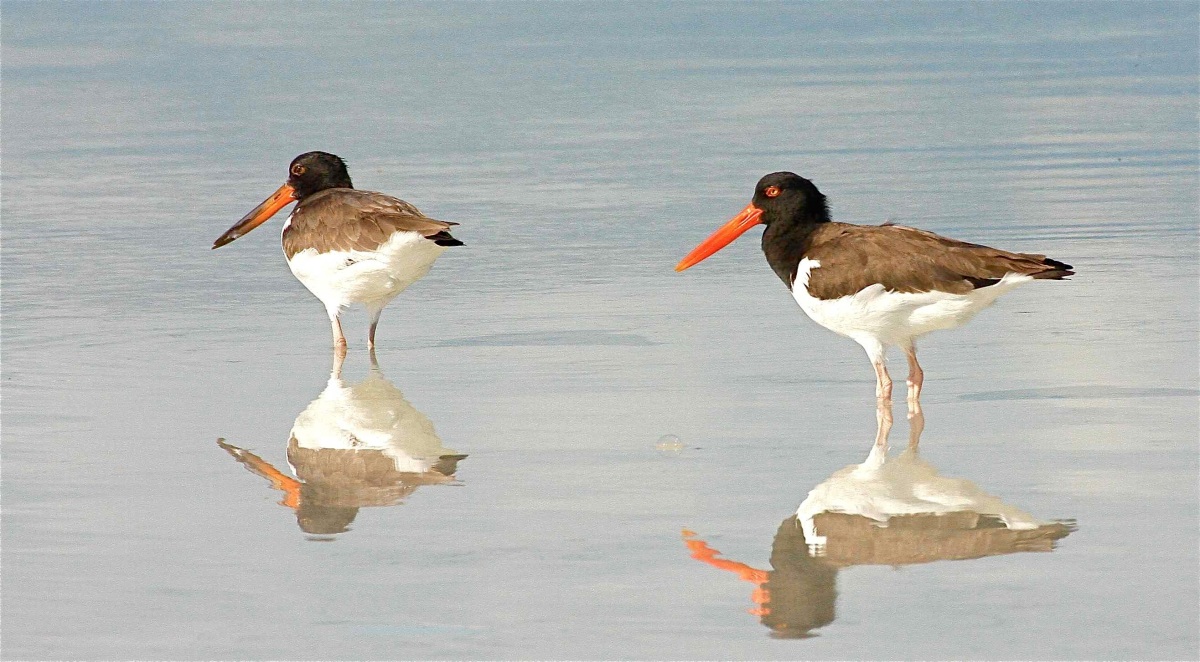
The American Oystercatcher Haematopus palliatus is a familiar shorebird, with the significant advantage that it cannot be mistaken for any other shore species either to look at or to hear. Among all those little sandpipers and plovers, the handsome AMOY stands out from the crowd.
Photos by Tom Sheley
Photos by Bruce Hallett
Here are two recordings of oystercatchers, unmistakeable call sounds that will probably be instantly familiar.
Lopez Lanus / Xeno-Canto
Krzysztof Deoniziak / Xeno-Canto
I like the rather dishevelled appearance of this AMOY from Jim Todd, fly fisherman, author of ‘The Abaco Backcountry’, and intrepid kayak explorer around the coast of Abaco
Two photos taken on the Delphi beach by Charlie SkinnerA low ‘in-flight’ shot by Bruce Hallett
This fine video from Audubon shows close-up views of the American Oystercatcher, and unleashes more of the distinctive call-sounds – an insistent wittering – of the species.
For some time, I found it difficult to distinguish American and Eurasian Oystercatchers. The markings of both species are variable according to gender, age, season and so on, but are generally very similar. Mrs RH noticed the salient difference at once – the eyes. The AMOY has bright orange eyes with red eye-rings; the EUROY’s eyes are the reverse colouring, as this example shows.
Eurasian Oystercatcher (spot the difference)
Credits: Tom Sheley, Bruce Hallett, Jim Todd, Charlie Skinner, Xeno-Canto, Audubon, BBC
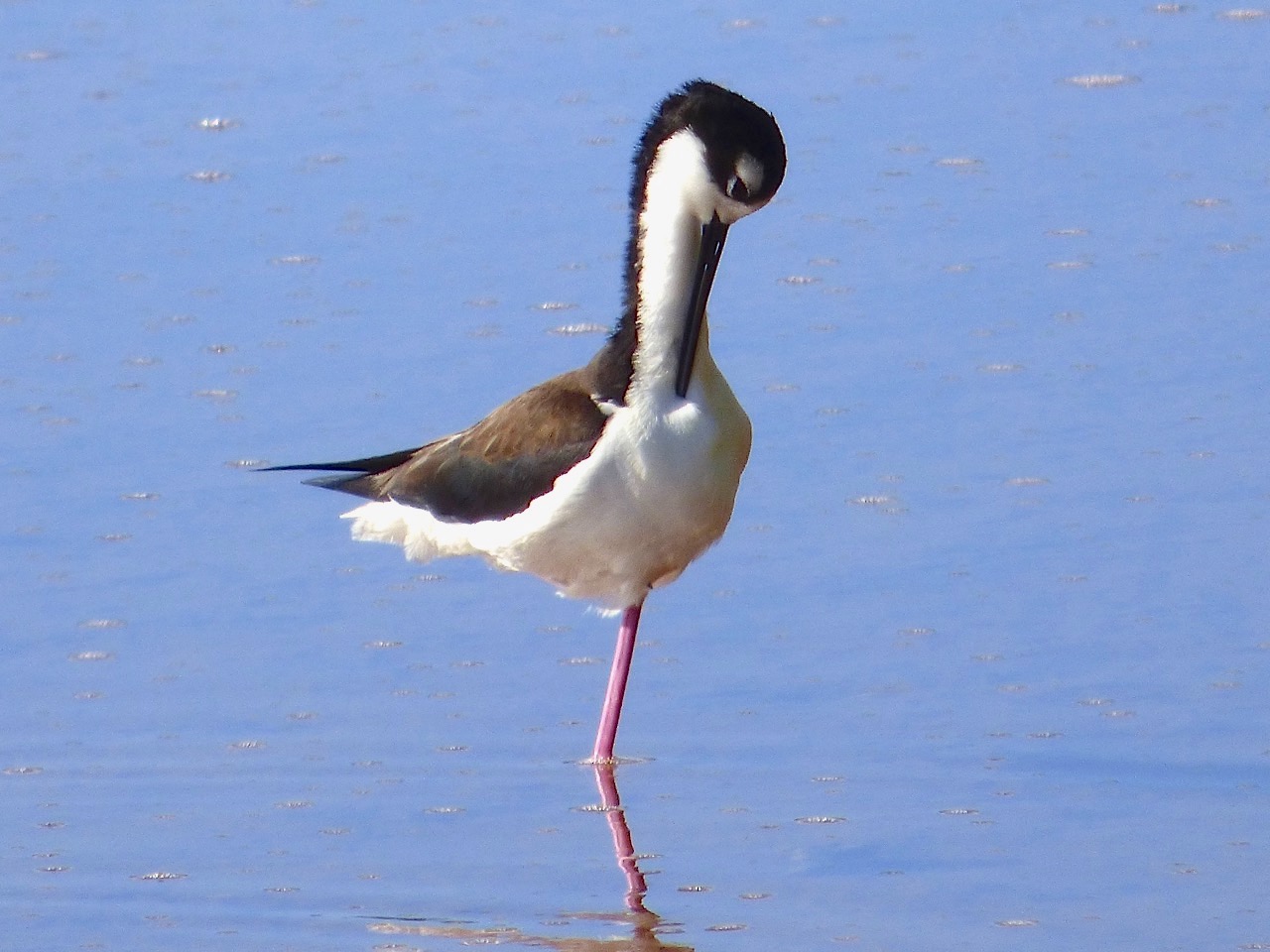
There’s something wrong in the picture above. Count up how many pink legs you can see. It’s three between the two birds. I assumed of course that ‘Oner’ had a perfectly good serviceable leg tucked up into its undercarriage. I admired the balancing skills involved in resting one leg while nonchalantly standing on the other.
We were watching this pair of black-necked stilts Himantopus mexicanus at the pond at Gilpin Point, which at certain times can be ‘Stilt Central’. These birds are permanent breeders on Abaco and are without a doubt the most beautiful of all the waders.
After 10 minutes observing this pair, there was no question about it – the right leg was completely and utterly missing. This had no obvious ill-effects on the bird – it was still able to throw a good pose (above) and to preen (below). And the other bird carried on as normal.
BNSs are territorial and in particular can become ‘proactive’ (ie aggressive) in protecting the area near a nest. I once mistakenly got close to a nest, not even knowing it was there. I soon learnt – a parent BNS came wading towards me, zigzagging in the water, shouting and carrying on in a way that immediately said ‘my nest is nearby’. And when I meanly stood my ground it suddenly took off and flew straight at my head…
A shouty stilt
BLACK-NECKED STILT ALARM CALL
Jim Holmes / Xeno Canto
All photos: Keith Salvesen / Rolling Harbour Abaco; Audio file Jim Holmes / Xeno Canto
The white-cheeked pintail Anas Bahamensis is also known as the Bahama Pintail. It is a gregarious species, often found in large numbers on lakes and ponds. An excellent place to see them on Abaco is at the pond by Hole 11 at Treasure Cay golf course. Don’t all rush at once – and if you do follow up the hint, check in at the Clubhouse to get permission – there may be a competition in progress… You’ll see many other waterbird species there, and I will do a follow-up post about them. Do mind your head – if someone yells ‘fore’ they will probably not be counting duck species.
The male and female of the species are very similar. However, in the image below there’s one bird that stands out from the others… and I don’t mean the American Coot. Near the bottom right is aLEUCISTICvariant of the Bahama Duck, a genetic condition similar to albinism.
Here is a close-up of the same duck on dry land. These variants are known as Silver Bahama Pintails. They are worth more than the standard version. You can see some good comparative pictures and find out more atMALLARD LANE FARMS
Here is a more extreme wiki-example of a silver Bahama pintail
Another excellent place for pintails is the large pond at Gilpin Point near Crossing Rocks area of South Abaco. Strictly, it is on private land, but the owner Perry is happy to share the birds. There is a wonderful variety of waterbird life there. I have seen great egrets, tri-colored herons, little blue herons, yellow-crowned night herons, belted kingfishers and elegantBLACK-NECKED STILTSthere, besides several duck species. I have also seen a sora there (twice), a small, furtive rail that skulks in the reeds and foliage at the edge of the water, profoundly hoping that you won’t notice it… If you are birding on Abaco from Delphi, ask Peter or Max for the location. Or else contact me.
“On Reflection…”
All photos except wiki thumbnail: Keith Salvesen / Rolling Harbour
The Yellow-throated Warbler (Setophaga dominica) is a most helpful warbler, in that what you see is what you get. You needn’t go to embarrassing lengths to determine whether it has a Yellow Rump. It doesn’t make extravagant geographical claims like the Cape May, Kentucky, Tennessee, Nashville or Connecticut warblers. It doesn’t disguise its warblerdom with a confusing name like ‘American Redstart’ or ‘Ovenbird’. Nor with a weird warbler name that is completely obscure like the Prothonotary. It’s a winter resident only, so it won’t try to puzzle you in the summer. The males and females are roughly similar in appearance, unlike so many species. All-in-all, a most agreeable and obliging little bird. Here are a few to enjoy, before I spoil the magic slightly…
I said earlier that the magic of the apparently simple ID of a warbler that lives up to its name would have to be spoiled. I’m afraid the images below rather undo the certainties I’d promised… two more species common to Abaco, also named for their yellow throats (though note: the yellow extends to more than just the throat) .
BAHAMA YELLOWTHROAT
COMMON YELLOWTHROAT
You’d really think that someone at Audubon Towers or Cornell Castle might have thought of calling these two species ‘Bahama’ and ‘Common’ Masked Warblers, wouldn’t you – after all there’s a Hooded Warbler, which indeed has a hood. No other warbler has a mask like these two. Then any confusion could be avoided.
Abaco has two permanently resident woodpecker species, theWEST INDIAN WOODPECKERand theHAIRY WOODPECKER. There is a third, migratory woodpecker species that is a fairly common winter resident, the yellow-bellied sapsucker Sphyrapicus varius. Like its woodpecker cousins, the sapsucker drills holes in trees (see below). The dual purpose is to release the sap, which it eats, and to attract insects that it also eats. A two-course meal, if you like. They’ll also eat insects on an undrilled tree, and even ‘hawk’ for them in flight. They balance their diet with fruit and berries.
The distinctive patterns of sapsucker holes may completely encircle the trunk of a tree with almost mathematical precision. This is sometimes described as ‘girdling’ and may have a damaging effect on a tree, sometimes even killing it if the bark is severely harmed. This may require preventive measures in orchards for example, though note that in the US Yellow-bellied Sapsuckers are listed and protected under the Migratory Bird Treaty Act so radical action is prohibited.
YELLOW-BELLIED SAPSUCKER SOUNDS
DRUMMING (Xeno-Canto / Richard Hoyer)
CALL (Xeno-Canto / Jonathon Jogsma)
On Abaco, palms are a favourite tree for the sapsuckers. There are several palms along the Delphi beach, and this year I noted that one coconut palm in particular had seen plenty of sapsucker action, with the drill holes girdling the entire trunk from top to bottom.
In their breeding grounds yellow-bellied sapsuckers excavate a large cavity in a softwood tree as a nest. They mate for life, and often return to the same nest year every year, with the pair sharing nesting duties. I have no idea whether the pair migrate south for the winter together, or whether they agree to take a break from each other. I’d like to think it’s the former…
Credits: Photos Gerlinde Taurer, Tom Sheley, RH; Cornell Lab (Range Map) & Xeno-Canto (YBS recordings as credited above)
Species featured in ‘The Delphi Club Guide to the Birds of Abaco’ by Keith Salvesen, pp 242-3
Many of the birds shown here were photographed in or around the grounds of Delphi. More recently, they have to an extent been displaced by red-winged blackbirds which are of course very fine birds but in large numbers sound (may I say this? Is this just me?) quite irritating after a while. Whereas the thrush of course has a sweet and melodious song, like this (my own recording – turn up the vol):
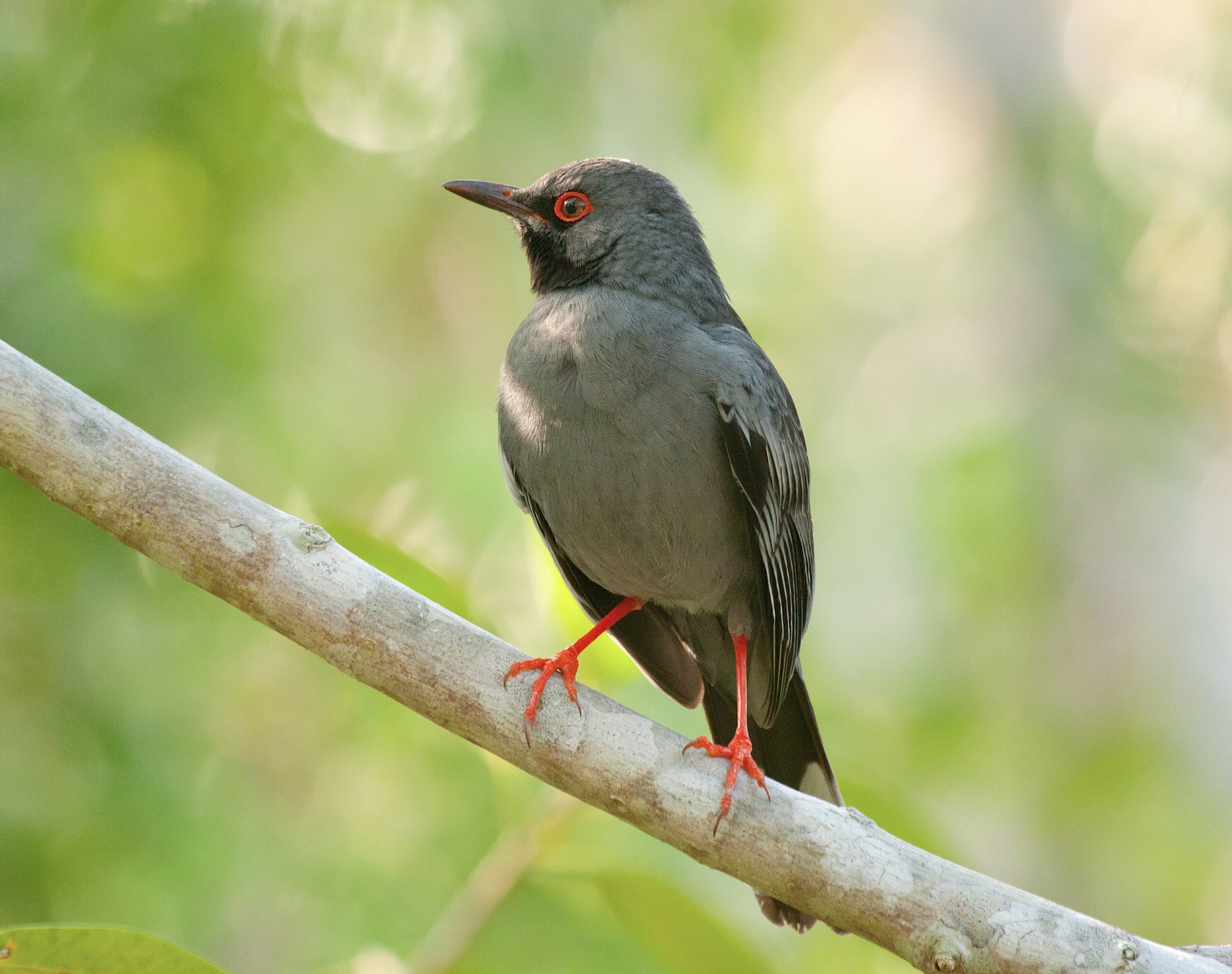
The eyes of the RLT are at least as prominent a feature as their legs. Lots of birds have red legs. Very few have such remarkable bright, fiery eye-rings, even in a youngster.
This photo from birdman Tom Sheley is my favourite – a perfect composition
Photo Credits: Tom Sheley (1, 11); Peter Mantle (2, 4); Gerlinde Taurer (3); Mr & Mrs Harbour (5, 6, 7); Charles Skinner (8, 9); Erik Gauger (10). Lo-fi audio recording: RH
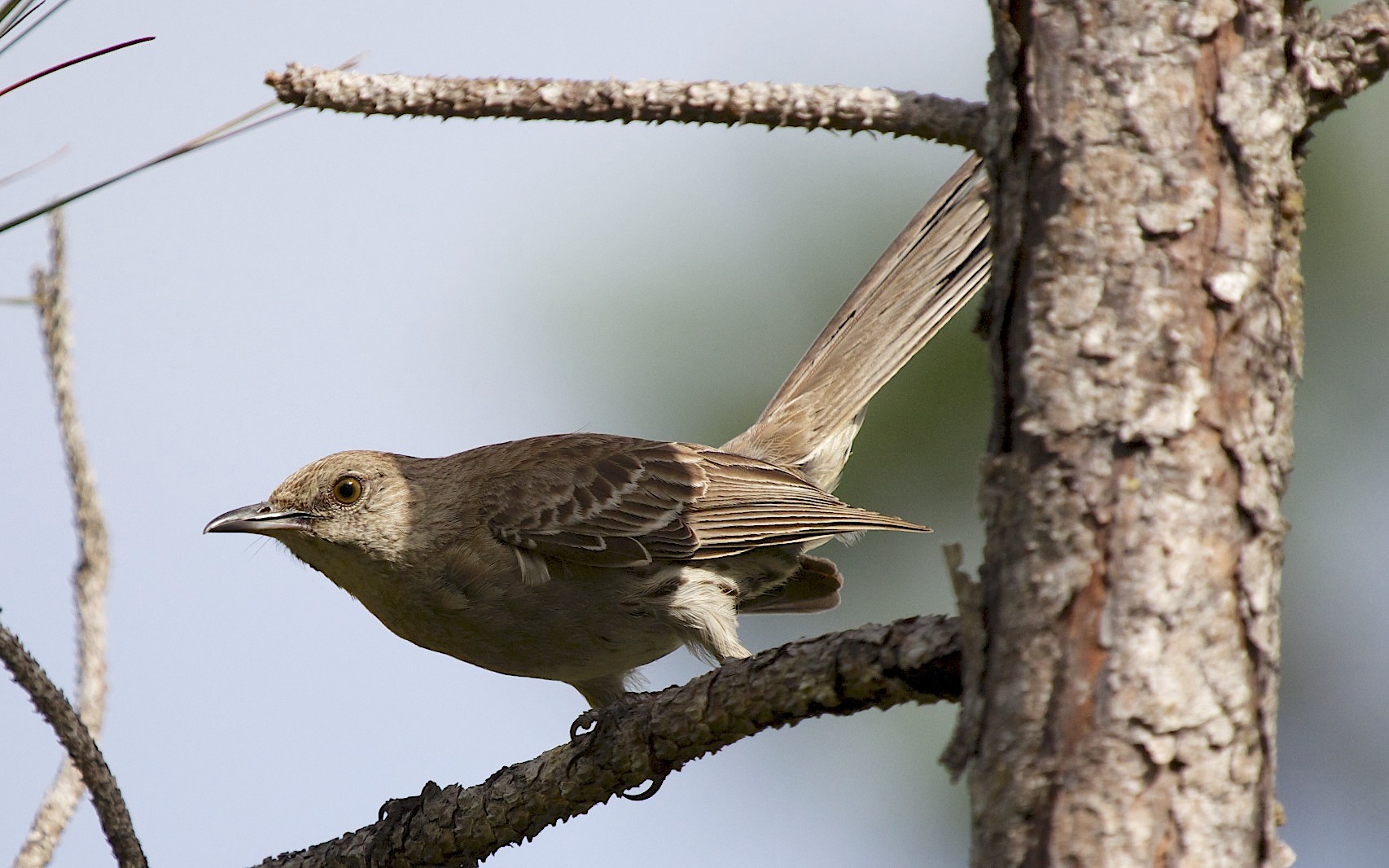
The Bahama Mockingbird Mimus gundlachii is similar to its slightly smaller cousin, the widespread Northern Mockingbird Mimus polyglottis. The range of Bahama Mockingbirds is not restricted to the Bahamas themselves, and includes areas of Cuba, Jamaica and TCI, so despite the name they are not an endemic species to the Bahamas. They are also occasional vagrants to the United States, especially – for reasons of proximity – southeastern Florida.
The Bahama Mockingbird is browner than the greyish Northern Mockingbird, and has distinctive streaking and spotting to its breast and undercarriage. This may extend to what you might describe as the bird’s ‘trouser legs’, though I’m sure there’s a more technically correct term.
Both mockingbird species are found on Abaco. The NMs are ubiquitous in towns, settlements, gardens, coppice and pine forest, whereas BMs are shyer and tend to be found in the pine forest and well away from humans and their operations.
I am astounded by the beauty and variety of their song. It consists of very varied notes and phrases, each repeated 3 or 4 times before moving on to the next sounds in the repertoire. Here is a short 18 second example I recorded, using my unpatented iPhone method, for which seeHERE.
For those with interest in birdsong, here is a longer 1:13 minute song from the same bird, with largely different sounds from the first recording made minutes earlier. There’s even a decent stab at imitation of a 1960s Trimphone™. I could have stayed listening for far longer.
An apparently new subspecies, the scarlet-faced mockingbird. In fact the bird had been feeding on red berries, and had managed to collect plenty of the juice round the base of its beak.
Range maps show the stark contrast between the very limited range of the Bahama Mockingbird and the vast distribution of the Northern Mockingbird. An example is below, for comparison.
Photos Credits: Tom Sheley (1, 6); Peter Mantle (2); Charlie Skinner (3); Keith Salvesen (4, 7, 8, 9); Alex Hughes (5); Susan Daughtrey (10). Range maps eBird & wiki.










 THE BIRDS OF ABACO