The Antillean Nighthawk Chordeiles gundlachii has several local names such as ‘killakadick’ and ‘pi-di-mi-dix’, and variations on the theme – presumably onomatopoeic. The photos below illustrate these wonderful birds in flight and on the ground.
Paul Marvin / Xeno-Canto
The speed of flight and the jagging paths make the nighthawks extremely hard to photograph. It’s far easier when they are on the ground…
Credits: Woody Bracey (1, 4); Tom Sheley (2); Sandy Walker (3); Birds Caribbean (5), Susan Daughtrey (6); Paul Marvin at Xeno-Canto for the sound recording
A small New World songbird of the cardinal subfamily
Flags and other colourful festive decorations
PAINTED BUNTING
Few birds radiate Yuletide vibes better than Painted Buntings, with their perfect festive colours. Here is a seasonal flock of them to enjoy. A very happy Christmas to those who kindly continue to visit Rolling Harbour.
The Greater Antillean Bullfinch Loxigilla violacea is a pretty bird, easy to find and to identify. They love feeders, and they are responsive to ‘pishing’, that irritating (?) noise that birders make to unseen avians in the coppice to persuade them to reveal themselves. Adult males are black with bright red accessories (hence “police bird”); females are paler with orangey accessories; and juveniles look a bit scruffy and patchy. Here’s a GAB gallery to enjoy.
Credits: Erik Gauger (1); Alex Hughes (2, 3); Tom Sheley (4, 6); Keith Salvesen (5); Charles Skinner (7); Gerlinde Taurer (8); Bruce Hallett (9)
Bananaquits (Coereba flaveola) are small, colourful, and delightful birds of the coppice and garden. Besides their obvious attractiveness, the birds have in recent years enjoyed a status upgrade to being the sole species in the family Coerebidae.
However this singular status has really been a kind of avian parking place due to past, present (and doubtless future) uncertainty of the right category for these birds. Like so many avian species these days, they are subject to the rigours and vagaries of continual reclassification by the ornithological powers-that-be.
Bananaquits are, broadly speaking, passerines – essentially birds that perch. The nominal ‘passer’ was specifically awarded to sparrows by BRISSON, a contemporary of Linnaeus. Recently, bananaquits have suffered mysterious migrations of their classification ranging from the generalised ‘passerine‘ to the vague incertae sedis (= ‘uncertain group‘) to uncomfortable inclusion with tanagers / emberizids.
The debate over the appropriate classification for this pretty little bird (of which there are many subspecies in the broad Caribbean region) – rumbles on. A new way to confuse the issue is the suggestion that the bananaquit should be split into 3 species. In some areas, I believe this has happened at least informally.
Elsewhere there are doubters, sceptics, and champions of other group inclusions. The most obvious beneficiaries of all this will be dedicated birders, who may end up with two extra species to add to their ‘Lifer’ lists. Personally I’d like to think that the birds themselves will stay ahead of the curve in their own category, maintaining the mystery of their precise status while humans argue about what to call them.
CREDITS: Keith Salvesen / Rolling Harbour (1); Gerlinde Taurer (2); Craig Nash (3, 7); Tom Sheley (4, 5); Erik Gauger (6). All birds photographed on Abaco, Bahamas
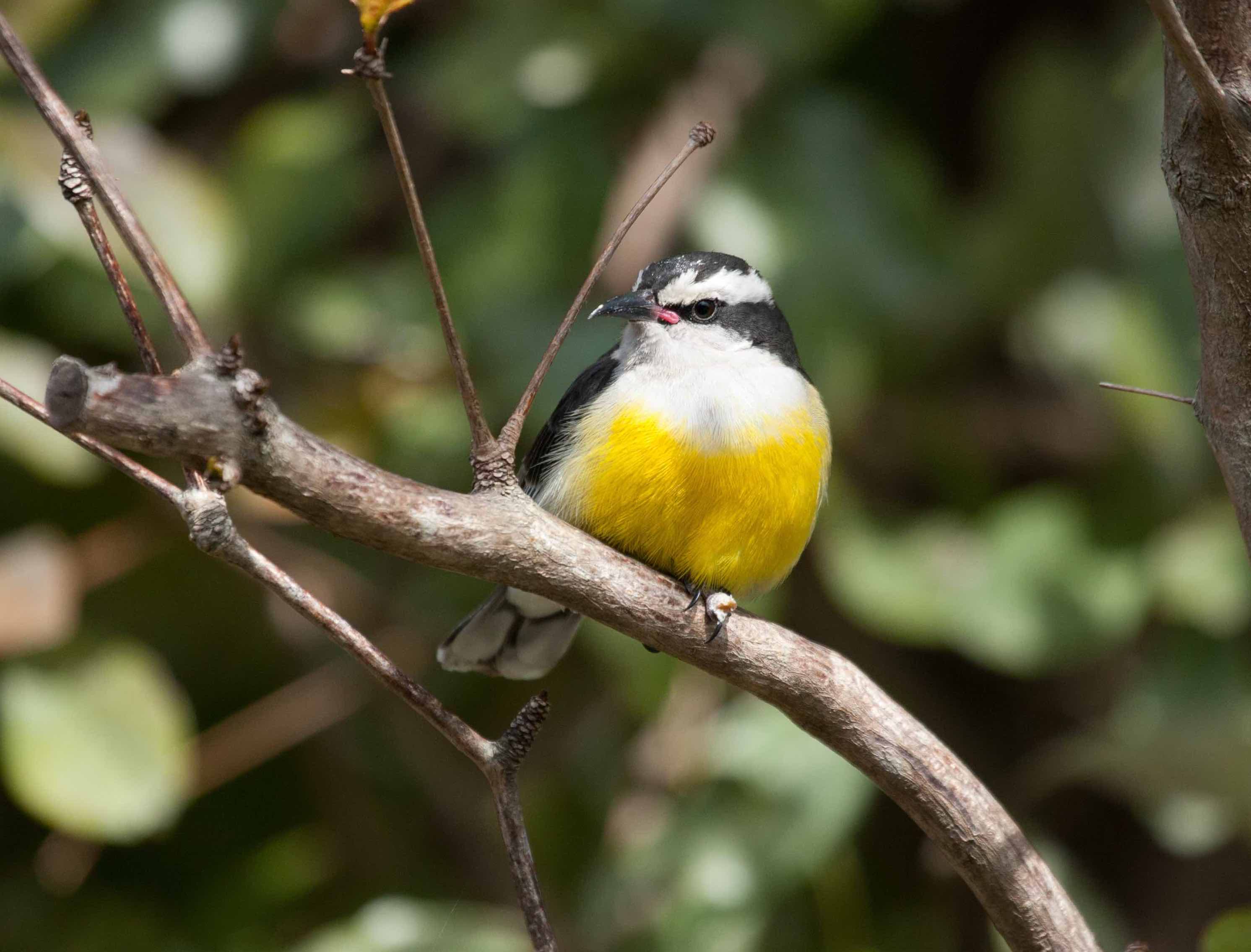
Bananaquit perched on yellow elder, the National flower of the Bahamas
The Tricolored Heron Egretta tricolor is one of 6 heron species found on Abaco, and is a permanent breeding resident. To which can be added 4 sorts of egret to complete a line up of expert fishers, all equally at home hunting in the water or from the shore, or surveying the scene from nearby vantage points like bushes and trees. A long neck, a long bill and long legs make this heron species ideally adapted for wading. Like other herons and egrets, it will stand stock-still waiting for the perfect fish to swim into range. However they are also active hunters, and will stalk prey or chase it by striding quickly through the water in pursuit. They eat fish, crustaceans, reptiles, and insects.
The heron and egret species of Abaco
Breeding plumage: smart blue bill and a fish to put in it
Credits: Phil Lanoue (1, 7); Dan Pancamo (2); Keith Salvesen (3); Woody Bracey (4); Bruce Hallett (5)
The American Redstart Setophaga ruticilla is a distinctive bird, males being orange and black, and females yellow and black. The dissimilar colouring between the sexes of these little warblers is due to differing carotin levels in each. These unmistakeable winter residents are common on Abaco and in the Northern Bahamas generally. They are an easy warbler for new birders look out for, being unlike any other small warblerish-looking bird. All the birds here were photographed on Abaco.
TEN REDSTARTLING FACTS (& a comment)
The Latin name means moth-eating red-tail (‘start’ is an archaic word for tail)
AMRE are among the most common New World warblers
Occasionally they are found as far afield as Europe
They are almost entirely insect-eaters, with occasional berries or seeds for variety
Males are late developers, tending to skew the sex ratio: too many of them
They are inclined to monogamy, but only to an extent. Two-or-more-timing goes on
The most aggressive males get the pick of the habitats
This all begins to sound like human behaviour (not strictly a fact, so it doesn’t count)
Their fanned tails are for display, and maybe to surprise insects into breaking cover
Redstarts suffer badly from predators, especially in the breeding season
They are popular with coffee farmers for keeping insect numbers down
The American Redstart (f & m) as depicted by JJ Audubon
There are twelve species of tern – ‘swallows of the sea’ – that to a greater or lesser extent may be found on Abaco. Whether they will actually be visible at any given time is less certain, though. For a start, the only resident species is the lovely Royal Tern, available at many locations on Abaco and the cays throughout the year. The rest are migratory or just passing through.
PERMANENT RESIDENTS
ROYAL TERNS Thalasseus maximus PR1
MIGRATORY TERNS: SUMMER
In the slightly less commonly-found category are the summer migrant terns that, by definition, are only in residence for around half the year. Four of these are fairly common in certain areas, and actually breed on Abaco; these include arguably the prettiest of all, the bridled tern. The other two tern species (gull-billed and sandwich) are more rare and as far as I can make out do not breed locally; or perhaps only rarely.
LEAST TERN Sternula antillarum SR B 1
BRIDLED TERN Onychoprion anaethetus SR B 2
ROSEATE TERN Sterna Dougallii SR B 2
SOOTY TERN Onychoprion anaethetus SR B 2
GULL-BILLED TERN Gelochelidon nilotica SR 3
SANDWICH TERN Thalasseus sandvicensis SR 4
MIGRATORY TERNS: WINTER
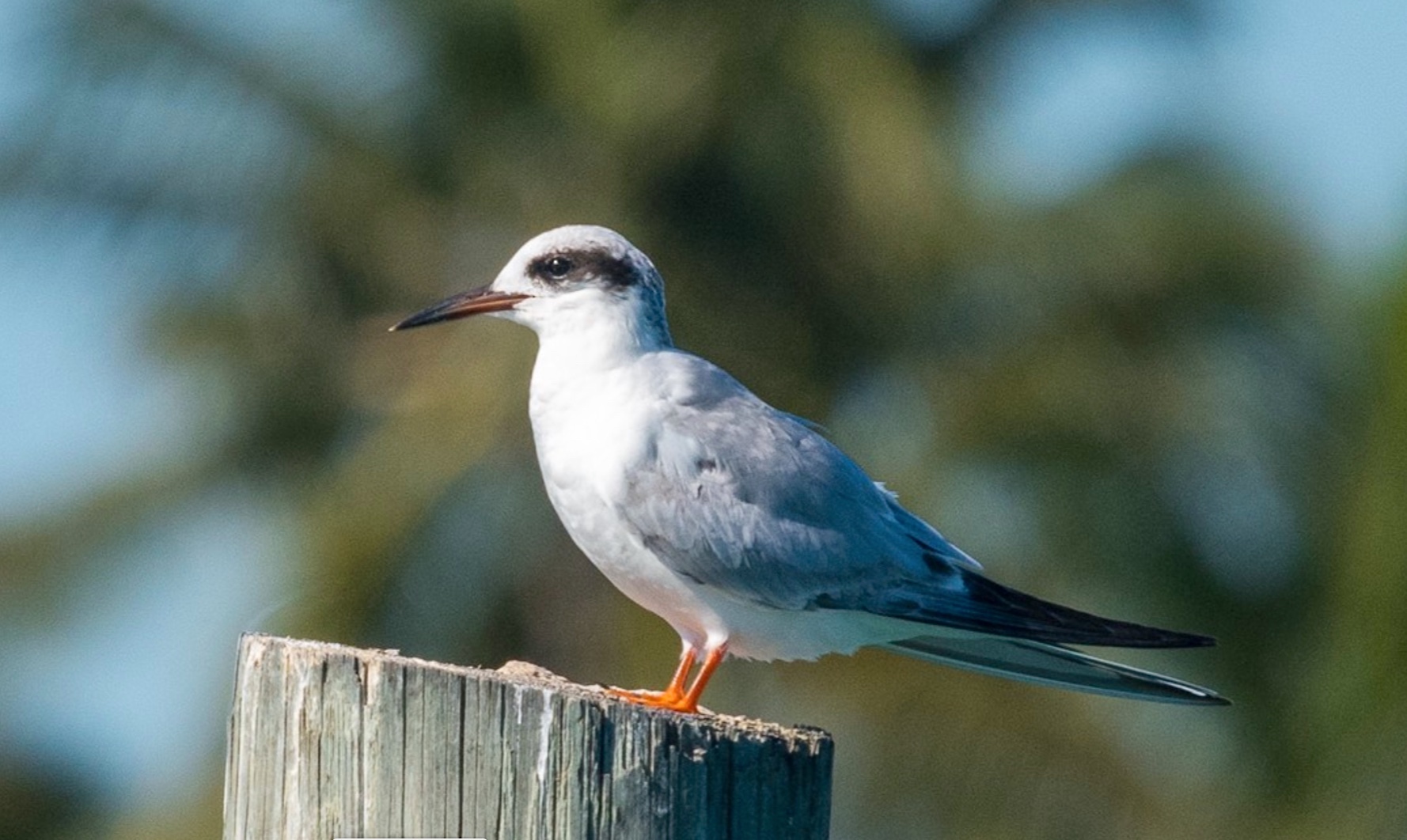
There is one very rare winter resident migratory tern species, with few records of sightings for Bahamas and until early 2019, no photographic record for Abaco until Sally Chisholm saw one at Treasure Cay and managed to capture it for posterity.
FORSTER’S TERN Sterna forsteri WR 4
OCCASIONAL & RARE VISITORS
A further four tern species are very much occasionals that drop by. Three of them pass over the Bahamas on their longer migration, but may make a pit-stop around Abaco to take on fuel. Likelihood of sighting one? Slender but not impossible… the Caspian tern below was photographed on Abaco. The fourth, the Arctic Tern, is a very rare vagrant, a bird well away from its usual home or migration route as the result of storms or faulty satnav or sheer happenstance. Don’t travel to the Bahamas intent on seeing one.
CASPIAN TERN Hydroprogne caspia TR 4
The remaining species are the transient black tern and common tern; and the vanishingly rare vagrant Arctic tern. No photos of any of these I’m afraid. Here’s a handy checklist of all the tern species.
ELECTIVE MUSICAL DIGRESSION
Written by Pete Seeger, Turn x 3 was released in 1965, the title track on the second album by The Byrds. At a rather febrile time in US history (Vietnam, draft riots, civil rightists v cops and so on), this unusually palliative and thoughtful song with its religious connotations to some extent stood for peace and hope in a time of turmoil.
PS the somewhat laboured title of this post shoehorns in the name of another Byrds album, ‘The Notorious Byrd Brothers’
Photo credits: Keith Salvesen (1, 2, 3, 5, 18); Tony Hepburn (4); Alex Hughes (10, 11); Bruce Hallett (6, 7, 12); Woody Bracey (8, 13, 16); Duncan Wright (9); Dick Daniels (14); Sally Chisholm (15); Keith Kemp (17)
West Indian Woodpecker . Abaco . Bahamas (π Keith Salvesen)
The WEST INDIAN WOODPECKER Melanerpes superciliaris is one of Abaco’s specialist birds. Islanders and regular visitors will be familiar with the sight – and indeed the raucous sound – of these beautiful birds. They are commonly found throughout Abaco and the cays. Possibly their rarity across the wider Bahamas is underestimated. The only other island where these birds are found is San Salvador. Formerly resident on Grand Bahama, they are believed to be extirpated there. Abaco is very fortunate to enjoy their noisy company.