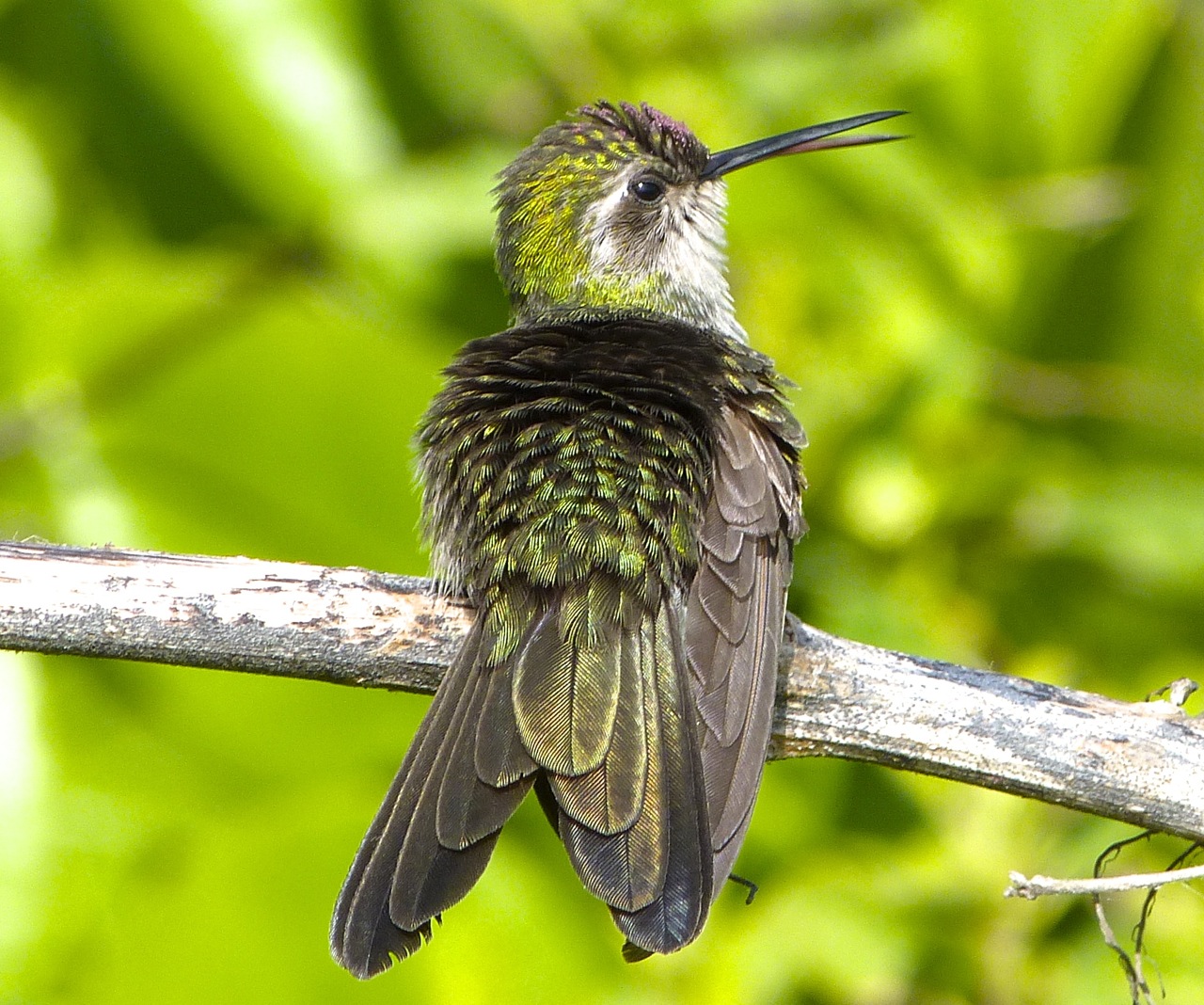
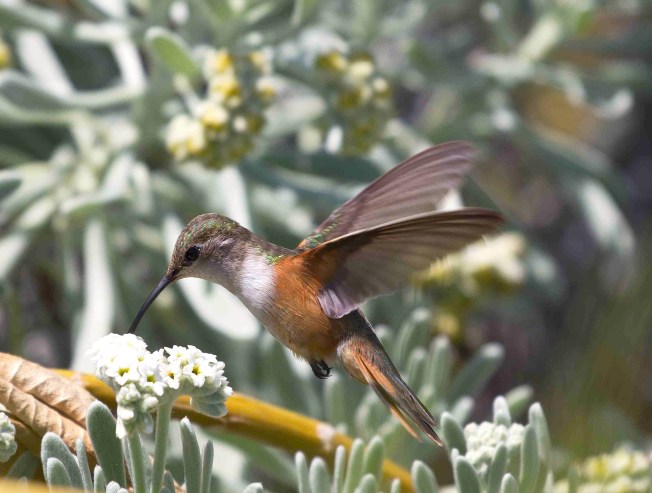
The drastic effects of Hurricane Dorian on Abaco’s birdlife continue, with recent reports suggesting that all species remain affected, and some severely so. However there are signs of a slow improvement, and this good news includes the two hummingbird species, the endemic Bahama Woodstar and the Cuban Emerald. A couple of recent posts on FB indicate that sightings of both these species have been a very welcome surprise. So, a good time to write about them and to show their beauty.
Cuban Emerald (male) Abaco (Charlie Skinner)
The subject matter of this post is not as indelicate as the title might imply; nor is it a ‘hands-on’ practical guide for intimate examinations of tiny birds. In particular it does not publicise some recently discovered louche activity involving unfeasibly large motor vehicles. It’s all about plumage and recognition. And there are only two species – and two genders for each one – to wrestle with.So here are the adult male and female Bahama Woodstars and Cuban Emeralds in all their glory…
And finally, a brilliant Woodstar photo taken by Tom Sheley, birdman and generous fishing partner, that I spans the boundary between wildlife photography and art.
Bahama Woodstar female. Abaco Bahamas . Tom Sheley
FIVE STARS: BAHAMAS ENDEMIC BIRDS (FOUR FROM ABACO)
It’s December 2020, and Caribbean endemic birds are, deservedly, being given more time in the sun. Right now they are being featured by BNT (Bahamas National Trust); BirdsCaribbean; and (in an excellent Zoom presentation) the august Linnean Society in Burlington House, London. So I am chiming in with slightly updated post on the topic, a reminder both of the beauty of the endemics and of their struggle for survival.
ABACO is fortunate to be home to 4 of the 5 endemic Bahamas species. The fifth, the beautiful BAHAMA ORIOLE Icterus northropi, was found on both Abaco and Andros until the 1990s, when it sadly became extirpated from Abaco. Now found only on Andros, until quite recently there were thought to be fewer than 300 Orioles left – a barely sustainable number. The species is unsurprisingly IUCN listed as critically endangered. However, there are signs that an intensive conservation program is working, with an increase in individuals and some new local populations found. Here’s a picture of one as a reminder of what Abaco is now missing…
Bahama Oriole – Daniel Belasco
Abaco’s four endemic species are the tiny Bahama Woodstar hummingbird, the Bahama Yellowthroat, the Bahama Warbler (since 2011), and the Bahama Swallow. All are of course permanent breeding residents on Abaco and its outer Cays. None is exclusive to Abaco; all are relatively plentiful. The Woodstar is perhaps the hardest to find, not least because it competes territorially with the Cuban Emerald hummingbird. Here are some striking images of these four endemic bird species taken from the archives for (and starring in) ‘The Birds of Abaco’, published in 2014.
BAHAMA WOODSTAR Calliphlox evelynae
Bahama Woodstar (m) (Tom Sheley)
Bahama Woodstar (f) Tara Lavallee
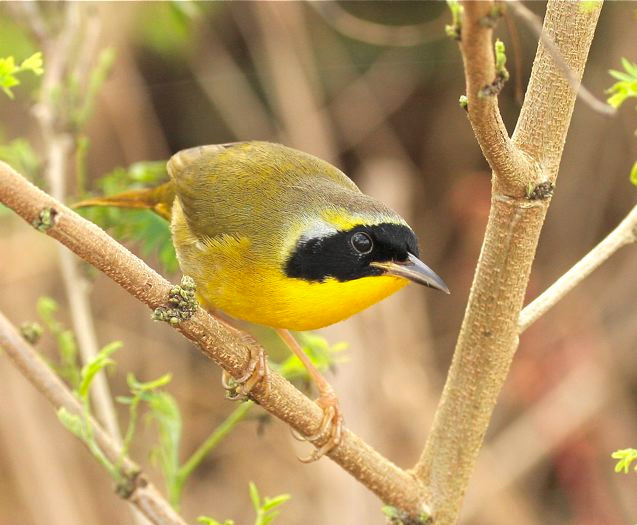
BAHAMA YELLOWTHROAT Geothlypis rostrata
Bahama Yellowthroat (Tom Sheley)
Bahama Yellowthroat (Bruce Hallett)
BAHAMA WARBLERSetophaga flavescens
Bahama Warbler (Bruce Hallett)
Bahama Warbler (Woody Bracey)
BAHAMA SWALLOW Tachycineta cyaneoviridis
Bahama Swallow (Craig Nash)
Bahama Swallow (Erik Gauger)
‘The Birds of Abaco’ was published in a limited edition in 2014. Many additional copies were donated to all the schools and relevant education departments on Abaco; and to the local Bahamian conservation organisations. This tied in with the excellent policy of teaching children from a very early age the value of the natural world around them, the importance of its ecology, and the need for its conservation. The cover bird for the book was easy to choose – it just had to be a male Woodstar in all his glory with his splendid purple ‘gorget’.
Image credits as shown; otherwise, ‘cover bird’ by Tom Sheley, Bahama Oriole, Daniel Belasco
There are twelve (12!) species of tern – ‘swallows of the sea’ – that to a greater or lesser extent may be found on Abaco. Whether they will actually be visible at any given time is less certain, though. For a start, the only resident species is the lovely Royal Tern, available at many locations on Abaco and the cays throughout the year.
ROYAL TERNS Thalasseus maximus PR1
In the slightly less commonly-found category are the summer migrant terns that, by definition, are only in residence for around half the year. Four of these are fairly common in certain areas, and actually breed on Abaco; these include arguably the prettiest of all, the bridled tern. The other two tern species (gull-billed and sandwich) are more rare and as far as I can make out do not breed locally; or perhaps only rarely.
LEAST TERN Sternula antillarum SR B 1
BRIDLED TERN Onychoprion anaethetus SR B 2
ROSEATE TERN Sterna Dougallii SR B 2
SOOTY TERN Onychoprion anaethetus SR B 2
GULL-BILLED TERN Gelochelidon nilotica SR 3
SANDWICH TERN Thalasseus sandvicensis SR 4
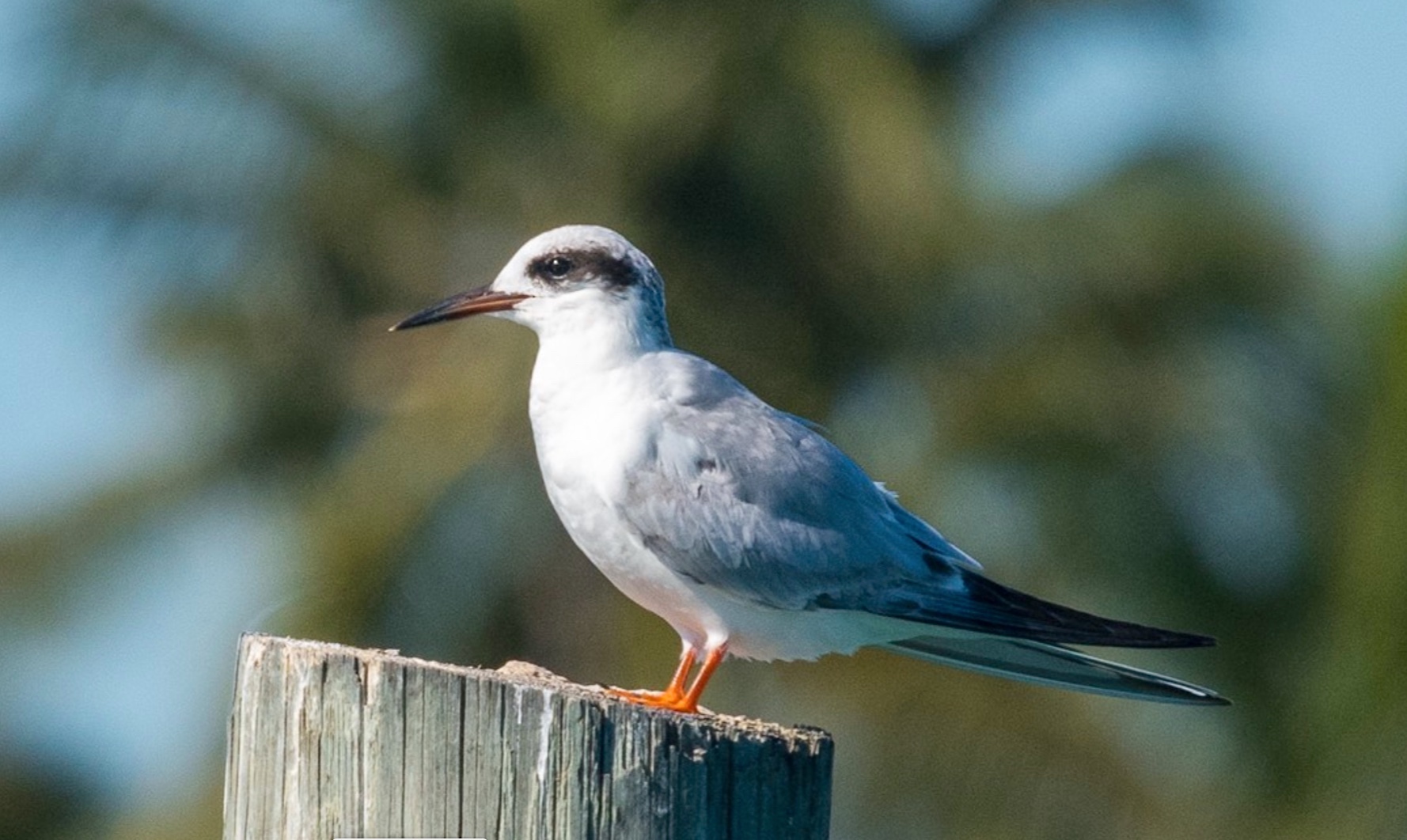
There is one rare winter resident migratory tern species. I had to check when the last one was recorded for Abaco. It was of course only in January this year, when ace birder-photographer Sally Chisholm saw one at Treasure Cay and managed to photograph it for posterity.
FORSTER’S TERN Sterna forsteri WR 4
The final four ‘Abaco’ terns are very much the occasional visitors. Three of them pass over the Bahamas on their longer migration, but may make a pit-stop around Abaco to take on fuel. Likelihood of sighting one? Slender but not impossible… The fourth, the Arctic Tern, is a very rare vagrant, a bird well away from its usual home or migration route as the result of storms or faulty satnav or sheer happenstance. Don’t travel to the Bahamas intent on seeing one.
CASPIAN TERN Hydroprogne caspia TR 4
As for the remaining three species, they are the transient black tern and common tern; and the vanishingly rare vagrant Arctic tern (the clue is in the name). No photos of any of these I’m afraid, so here’s a handy checklist instead.
ELECTIVE MUSICAL DIGRESSION
Written by Peter Seeger a few years earlier, Turn x 3 was released in 1965, the title track on the second album from the Byrds. At a rather febrile time in US history (Vietnam, draft riots, black civil rightists v cops and so on), this unusually palliative and thoughtful song with its religious connotations to some extent stood for peace and hope in a time of turmoil.
PS the somewhat laboured title of this post shoehorns in the name of another Byrds album, ‘The Notorious Byrd Brothers’
Photo credits: Keith Salvesen (1, 2, 3, 5, 18); Tony Hepburn (4); Alex Hughes (10, 11); Bruce Hallett (6, 7, 12); Woody Bracey (8, 13, 16); Duncan Wright (9); Dick Daniels (14); Sally Chisholm (15); Keith Kemp (17)
In mid-December, Kaderin Mills of the Bahamas National Trust saw Abaco’s first-ever reported Sandhill Crane (Antigone canadensis) in the Fox Town area of North Abaco. Woody Bracey was quickly onto the news and in the afternoon he took photos of the bird. I posted about this exciting (because a new species is always exciting) event, with details about its significance plus facts, maps etcHERE
Six weeks later, the crane is still in residence. In the meantime a number of birders have been to see the new novelty bird for Abaco in what has become a small but significant birding hotspot right at the top end of the island, in area round the Church, the Primary School, and the Clinic. The crane is now firmly on the eBird map for the Bahamas.
This elegant visitor seems to be quite tame and unfazed by its new fame. People watch while it forages for invertebrates in the grass, pausing to check on bystanders before resuming its feeding. It tolerates the presence of humans without showing fear, let alone flying away.
The call of the Sandhill Crane sounds like this:
To test its reaction, a recording was played and immediately the crane responded and called out to the (apparent) co-crane. The bird has also (rather sadly?) been seen by locals by the door of the Church, looking at its reflection and even making pecking motions at it. A lonely crane, maybe.
This bird is likely to remain disappointed by any expectation or hope of company. With any luck in the Spring, the instinctive call to the north (Canada and nearby US) will persuade it to migrate back to sandhill habitat to join a flock in the summer breeding grounds.
It is always a somewhat melancholy occurrence when a fine bird like this – or like last season’s lone BALD EAGLE– takes a wrong turn on their migration or perhaps get blown off course and finds itself on its own, species-wise. This bird seems to be taking it in its (longish) stride, however, and it has become something of a celebrity avian for the local folk. It will be interesting to find out when the migration urge finally encourages its flight away from its unusual overwintering habitat.
Credits: Chris Johnson (1); Erika Gates / Martha Cartwright (2, 4); Elwood ‘Woody’ Bracey (3, 5, 6); Audubon (7); Ian Cruickshank / Xeno Canto (audio); Birdorable (cartoon); and a tip of the hat to the School Principal, to Kadie Mills, and to Uli Nowlan who uploaded her sighting to eBird.
The Kirtland’s Warbler (Setophaga kirtlandii): there are probably more dedicated KIWA experts out there than there are birds of this scarce species. Estimates of bird numbers vary wildly, but if I take a consensus of the mean of an approximate average of the median as ± 5000 individuals, I’d probably be in the ballpark named “Current Thinking“.
THAT SOUNDS QUITE RARE, RIGHT?
Around 50 years ago, the species was all but extinct – perhaps fewer than 500 birds in total, a barely sustainable population. In 1975, Brudenell-Bruce estimated 1000. I’ll mention some of the reasons later. In the 1970s, the Kirtland’s Warbler Recovery Plan was instituted with the twin objectives of protecting the vulnerable breeding habitat – basically large areas of jack pine; and of monitoring and management aimed at encouraging an increase in numbers. Around that time, they became IUCN listed as vulnerable, but more recently, population growth has resulted in a recategorisation to the more optimistic near-threatened category.
AND THEY LIVE WHERE, EXACTLY?
In spring and summer almost the entire KIWA population lives and breeds in very specific areas of Michigan and Ontario, where jack pines are found. There are signs that the range has expanded slightly in Michigan and more widely into Wisconsin and Ohio as the numbers have increased.
A Kirtland’s Warbler in the jack pines of Michigan (Vince Cavalieri)
In the fall and winter the population migrates to the Bahamas & TCI, where they tend to choose remote scrub and coppice areas to live until the spring when they return north in April. This range map shows the extremely specialist habitat choices of these migratory birds.
A Kirtland’s Warbler in Ohio
SO THEY ARE REALLY FOUND ON ABACO?
Yes – but they are notoriously hard to find. To give you an idea, I checked the eBird stats for Abaco sightings over the last 10 years: 9 successful trips reported, with 18 birds seen in all**. There were 3 groups comprising 6, 4, and 2 birds; and the rest were single birds. Abaco ornithologist and guide Woody Bracey is the go-to man for finding these little birds. Two years ago we were in his party that saw 4 in the space of a couple of hours. I was supposedly the photographer, but unaccountably found myself in completely the wrong place for the first 3. The 4th flew off a branch and straight at my head as I raised the camera… I felt the wind as it passed on its way deep into the coppice. I’m not proud of my effort; the fuzzy lemon item beyond the twigs and leaves is a KIWA (you’ll have to take my word for it…).
HAVE ANY BEEN SEEN ON ABACO THIS YEAR?
Last week, Woody took another party to the main hotspot in the Abaco National Park, a protected area at the southern end of the island. The park is huge, covering more than 20,000 acres of (mostly) pine forest. These birds are tiny, about 14 cms long and weighing 14 gms. Despite which they found a female and then a male KIWA in their favoured habitat beyond the pine forest. Those are the only 2 I’ve heard about this winter season.
Kirtland’s Warbler, Abaco Bahamas, 12 April 2018
WHAT DO I LOOK OUT FOR?
Gray head with a blueish tinge, gray-brown back
Yellow throat & underside, with some dark streaking
Females are paler and more streaked
Split eye rings – white crescents above and below eyes
Frequent tail pumping and bobbing (‘tail-wagging’ J. Bond)
WHAT DO THEY SOUND LIKE?
Some would say ‘chip-chip-chip-too-too-weet-weet’. Elsewhere I have found they produce ‘a loud tchip, song an emphatic flip lip lip-lip-lip-tip-tip CHIDIP‘ (Arnott). You be the judge!
Ross Gallardy / Xeno-Canto
WHAT ARE THE MAIN THREATS TO THE SPECIES?
Mankind is the primary threat. The breeding areas are particularly vulnerable from deforestation and clearance of the jack pines that are essential for successful nesting and breeding – and therefore the survival of the species.
Encroachment of development is another threat, as with so many species.
There is a further threat of nest parasitism by brown-headed cowbirds, to which KIWAs are especially vulnerable.
In the winter grounds where the habitat is mostly remote or in protected areas, there is rather less of a problem from these factors – for now at least.
Overall, habitat degradation at one end of the migration – in particular the breeding grounds – poses a serious risk; at both ends, extinction could loom again.
WHO WAS MR KIRTLAND?
Jared Potter Kirtland (1793-1877)
Jared P. Kirtland (1793 – 1877) was an Ohio scholar, doctor, judge, politician and amateur naturalist. He was a man of many and varied interests and talents, not-untypical of his time. In the field of natural history, Kirtland’s name lives on in his warbler; and also in a couple of snake species.
**I realise eBird is not the be-all and end-all for sighting reports. It hasn’t been in existence for as long as 10 years, and not everyone uses it anyway. And awareness of the Bahamas as the winter home for KIWAs is a surprisingly recent development (as with piping plovers). As awareness increases, so do birder interest, habitat knowledge, and consequently reports of sightings.
Another example of the ‘twigs in the way’ problem for photographers
Credits: Bruce Hallett (1, 2, 3); Vince Cavalieri (4); Tom Sheley (5); Unattributable (me, in fact) 6; Woody Bracey (7, 9); Tony Hepburn (8); Lionel Levene (10); Birds of North America (range map); Ross Gallardy / Xeno-Canto (audio file); Birdorable (cartoon). Special thanks for all use permissions for images of this rare bird.
The LA SAGRA’S FLYCATCHER(Myiarchus sagrae) is a common resident breeding species of flycatcher on Abaco, and these very pretty small birds can be seen in many habitats – pine forest, scrubland, coppice and gardens, for example. They are insectivores, as the name suggests, but they also eat seeds and berries.
As a ‘tyrant flycatcher’, this little bird is a member of the largepasserineorder that includes kingbirds, pewees and phoebes, with which they are sometimes confused.
Unlike many bird species, adult LSFs are very similar in appearance in both sexes. Whatever the gender, they are sometimes confused with their cousins the Cuban Pewees, but those have a very distinctive eye-crescent.
Cuban Pewee – note eye-crescent, absent in the LSF
Both species have a tiny hook at the end of the (upper) beak – to help trap insects, I assume
Another thing to notice about LSFs is the amount of rufous brown in their plumage, particularly on the wings and tail – and even at the base of the beak. This coloration is absent from their larger cousin kingbirds, the loggerhead and the gray.
WHAT TO LISTEN OUT FOR
Hans Matheve @ Xeno-Canto
A hint of a crest is visible in this photo
WHO WAS ‘LA SAGRA’?
La Sagra was a multi-talented Spanish botanist. Ramón Dionisio José de la Sagra y Peris (1798–1871) was also a writer, economist, sociologist, politician, anarchist, and founder of the world’s first anarchist journal El Porvenir (‘The Future’). At one time he lived in Cuba and became director of Havana’s Botanical Garden. His name lives on more significantly in ornithological than in anarchist circles.
Ramón Dionisio José de la Sagra y Peris
Here are stamps from the Cayman Islands and Cuba featuring the La Sagra’s Flycatcher. The Cuban stamp commemorates the death of Juan Gundlach, the man who chose La Sagra’s name to bestow on this bird. And Gundlach’s name lives on in the Bahama Mockingbird Mimus gundlachii…
Photo Credits: Gerlinde Taurer (1, 4); Tom Reed (2, 6); Keith Salvesen (3, 5, 11); Charles Skinner (7, 8); Peter Mantle (9); Tom Sheley (10); Ramon and stamps, open source
You can read about Fregata magnificens and their courtship displays, gular pouches, nesting habits, names, uses to mankind (if any), and 10 magnificent facts about them at my Rolling Harbour site HERE. These birds are sky-pirates, stealing fish in the air from other birds. Tropicbirds are a particular target. They catch fish and keep them in their gullets as they fly back to the nest to feed their young. The frigatebirds will swoop on them, catch them by the leg and hold them upside-down until they regurgitate the fish. Often the frigate bird will manage to release the tropicbird and dive to catch the fish before it hits the water.
CLICK LOGO TO VIEW A BBC / DAVID ATTENBOROUGH CLIP OF AN AERIAL ROBBERY
Film clip: Female FB has TB by the leg & shakes it until the fish (circled) drops out
A MAN-O-WAR GALLERY
A male in flight (a most unusual shot, taken from above)
Juveniles being delinquent
A female in flight: the white front is the invariable distinguishing feature
10 FACTS ABOUT FRIGATEBIRDS
The largest of several frigatebird species around the world
Found in tropical and subtropical waters
Females have white fronts – easily distinguishable from males in flight
Adult wingspan is 7+ feet = largest wing-area / bodyweight ratio of any bird
Can remain in flight and far out to sea for many days
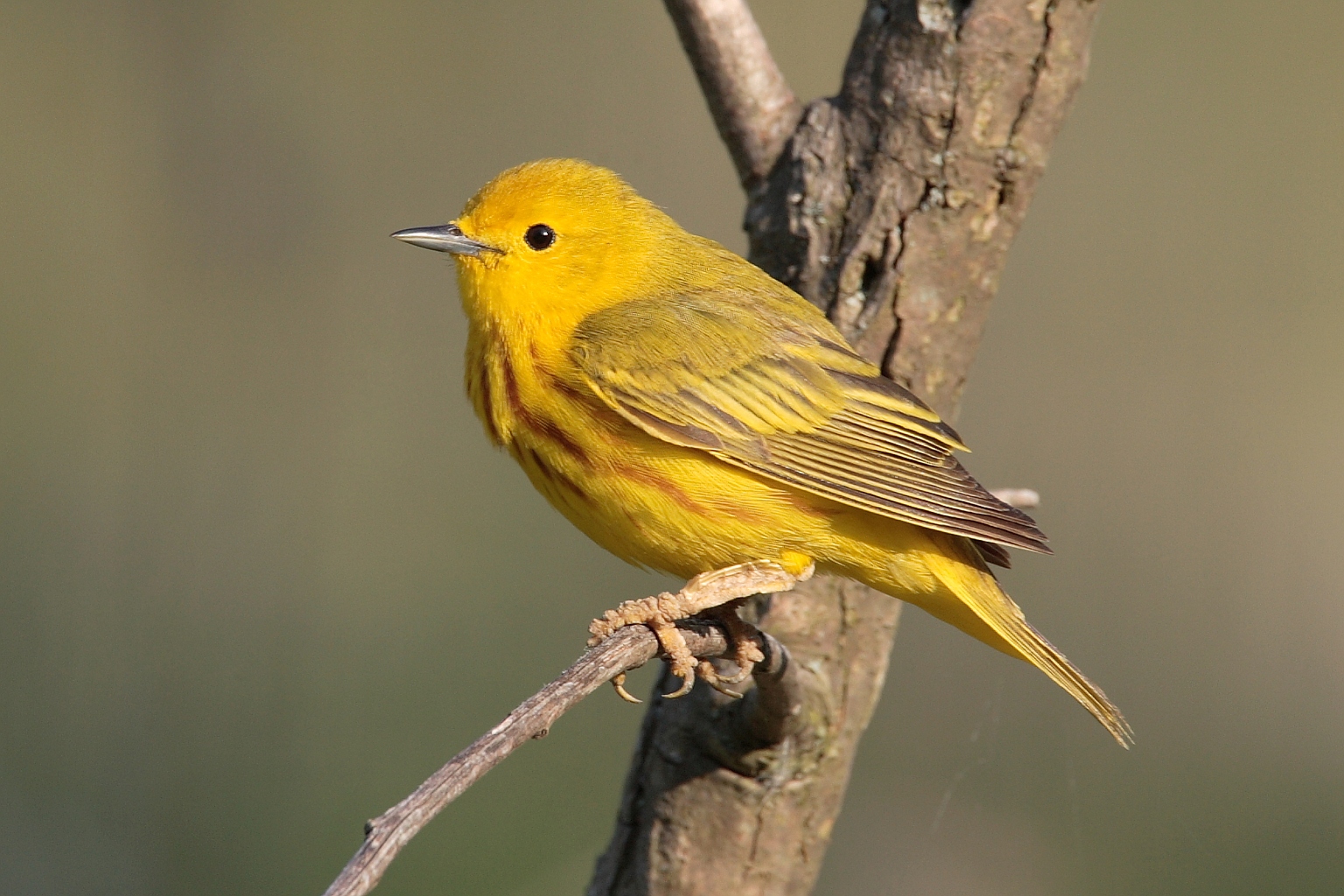
Of the37 WARBLER SPECIESrecorded for Abaco, 25 are mainly or partly yellow. So talk of a ‘yellow warbler’ can as easily be a general description matching any one of a number of species, as a particular description of the one and only Yellow Warbler Setophaga petechia. This small sunny bird is a common permanent resident on Abaco, one of only 5 resident warblers. The other 4 don’t help the situation much, by dint of all being yellow to a greater or lesser extent.
My general rule of thumb is that the Yellow Warbler out-yellows all the rest (though the winter-resident PROTHONOTARYgives it a run for its money), with the adult males bright and cheerful all over and the females rather less glaring but still demonstrably yellow from beak to tail tip.
Q. ARE THEY ALWAYS EASY TO SEE? A. SEE BELOW, GO FIGURE
Q. CAN YOU SHOW MORE PRETTY FEMALES? A. BY ALL MEANS
Q. SO YEWAs ARE COMMON? HAVE YOU EVER PHOTOGRAPHED ONE? A. ONLY HOPELESSLY
Q. DO THEY HAVE AN ATTITUDE PROBLEM? A. ONLY VERY RARELY
A THREAT TO THE SPECIES Shiny Cowbirds, luckily still rare on Abaco, favour yellow warbler nests for their parasitic egg-laying, with sadly predictable results. These cowbirds properly belong in South America, but they are gradually spreading north through the Caribbean, and have now reached Florida. I’m beginning to take a (purely personal) hard line on invasive species where they diminish and destroy indigenous species: eradication. The feral peacocks of Casuarina, now several generations down the line from their original introduction as exotic pets, do no harm and are undeniably decorative. But would you prefer the pretty yellow warbler and its fledglings in your garden, or the shiny cowbird that displaced them?
Abaco has a recorded 37 warbler species. Of these, most are winter residents and some are rarer migratory transients. Only 5 are permanently resident on Abaco: the Bahama Warbler, Bahama Yellowthroat, Olive-capped Warbler, Pine Warbler and Yellow Warbler. You can read about all 5 HERE
I realise that I haven’t posted about OCWs in their own right; and that as a species they have been unfairly lumped in (by me) with more general warbler posts. Time to put that right by showing some exclusively OCW photos.
OCWs have an unusually restricted range, despite which they remain IUCN-listed ‘Least Concern’. These pretty birds are native only to the western and eastern ends of Cuba, Grand Bahama, and Abaco. Their natural habitat is pine forests and to a lesser extent in mixed forest and coppice areas.
If you are lucky enough to see an OCW on Abaco, it’s worth thinking about the rich and unspoilt habitat that ensures its survival there. These little birds, along with other important bird species, enjoy a safe haven in the vast acres of pine forest.
Photo credits: Bruce Hallett (1, 2, 3, 6); Tom Sheley (4, 5); Tom Reed (7)