Abaco has two permanently resident woodpecker species, theWEST INDIAN WOODPECKERand theHAIRY WOODPECKER. There is a third, migratory woodpecker species that is a fairly common winter resident, the yellow-bellied sapsucker Sphyrapicus varius.
Like its woodpecker cousins, the sapsucker drills holes in trees (see below). The dual purpose is to release the sap, which it eats, and to attract insects that it also eats. A two-course meal, if you like. They’ll also eat insects on an undrilled tree, and even ‘hawk’ for them in flight. They balance their diet with fruit and berries.
The distinctive patterns of sapsucker holes may completely encircle the trunk of a tree with almost mathematical precision. This is sometimes described as ‘girdling’ and may have a damaging effect on a tree, sometimes even killing it if the bark is severely harmed. This may require preventive measures in orchards for example, though note that in the US Yellow-bellied Sapsuckers are listed and protected under the Migratory Bird Treaty Act so radical action is prohibited.
YELLOW-BELLIED SAPSUCKER SOUNDS
DRUMMING (Xeno-Canto / Richard Hoyer)
CALL (Xeno-Canto / Jonathon Jogsma)
On Abaco, palms are a favourite tree for the sapsuckers. There are several palms along the beach at Delphi. Below is a coconut palm that had seen plenty of sapsucker action, with the drill holes girdling the entire trunk from top to bottom.
In their breeding grounds yellow-bellied sapsuckers excavate a large cavity in a softwood tree as a nest. They mate for life, and often return to the same nest year every year, with the pair sharing nesting duties. I have no idea whether the pair migrate south for the winter together, or whether they agree to take a break from each other. I’d like to think it’s the former…
Credits: Photos Gerlinde Taurer, Tom Sheley, RH; Cornell Lab (Range Map) & Xeno-Canto (YBS recordings as credited above)
Species featured in ‘Guide to the Birds of Abaco’ by Keith Salvesen, pp 242-3
ENDANGERED SPECIES ON ABACO, BAHAMAS (2): KIRTLAND’S WARBLER
2025 UPDATE: DRASTIC EFFECTS OF HURRICANE DORIAN ON THE ABACO POPULATION OF KIRTLAND’S WARBLERS
I wrote the post below in 2019, when the near annihilation of much of Abaco was some months away. I won’t dwell on the terrible effects on the main town, the settlements, and the communities. Even now, there remains plenty of evidence of the devastation.
Spring is approaching, and I have recently had several inquiries from people planning a visit to Abaco about the best locations for finding birds – parrots being the most sought after. It’s not easy these days. The bird population has been significantly depleted. The wonderful endemic Bahama Warbler has hardly been seen, and it may take several seasons before the population reaches a viable state.
I’ve had two specific requests for advice about finding the rare Kirtland’s warblers that overwinter on Abaco. Time was that with Woody Bracey we would drive down the track in the National Park towards the lighthouse, and stop at the edge of the scrub. Once we had a group of four almost in touching distance – though I, as photographer, managed only a shot of a small lemon with a branch in front of it.
And now? I’ve just been in touch with Abaco bird expert and guide, Reg Patterson. He saw one in Spring 2021; and another early this year.
The rare Kirtland’s warbler (Setophaga kirtlandii) is rightly prized both in its very specific breeding grounds and in its winter migration locations. Abaco is fortunate to be one of these, but they are extremely difficult to find, even with local knowledge. The latest IUCN Red List assessment of numbers of adult warblers (2018) gives a figure of 4,500 – 5,000. The species is categorised as ‘near-threatened’. Numbers are gradually increasing, thanks to a major recovery plan and intensive conservation measures in areas where they nest.
WHERE THEY LIVE
SPRING & SUMMER Mostly, the KIWA population lives and breeds in very specific areas of Michigan and Ontario, where jack pines are found. As numbers have increased, the range has expanded more widely into Wisconsin and Ohio.
A Kirtland’s Warbler in the jack pines of Michigan (Vince Cavalieri)
FALL & WINTER the population migrates to the Bahamas & TCI, where they tend to choose remote scrub and coppice areas to live until the spring when they return north in April. This range map shows the extremely specialist habitat choices of these migratory birds.
THE MAIN THREATS TO THE SPECIES
Mankind is the primary threat. The breeding areas are particularly vulnerable from deforestation and clearance of the jack pines that are essential for successful nesting and breeding – and therefore the survival – of the species
Encroachment by development is a major concern (as with so many species everywhere)
KIWAs are vulnerable to nest parasitism by brown-headed cowbirds in the breeding areas
Their winter habitat is mostly in remote or protected areas, but on Abaco a proposed development in the National Park where they live will probably wipe them out, if built
Overall, habitat degradation at one end of the migration – in particular the breeding grounds – poses a serious risk to the species; at both ends, extinction could loom again
WHAT TO LOOK OUT FOR?

Gray head with a blueish tinge, gray-brown back
Yellow throat & underside, with some dark streaking
Females are paler and more streaked
Split eye rings – white crescents above and below eyes
Frequent tail pumping and bobbing
WHAT DO THEY SOUND LIKE?
Some say ‘chip-chip-chip-too-too-weet-weet’. Elsewhere I have found it claimed that they produce ‘a loud tchip, with song an emphatic flip lip lip-lip-lip-tip-tip CHIDIP‘ (Arnott). I’m not a big fan of phonetic spelling for bird sounds. Here’s a sample for you to assess:
Ross Gallardy / Xeno-Canto
WHO WAS MR KIRTLAND?
Jared Potter Kirtland (1793-1877)
Jared P. Kirtland (1793 – 1877) was an Ohio scholar, doctor, judge, politician & amateur naturalist. He was a man of many and varied interests and talents, not-untypical of his time. In the field of natural history, Kirtland’s name lives on in his warbler & also in a couple of snake species.
The Bahamas Postal Service is commendably active in producing wildlife stamps
Credits: Bruce Hallett (1, 5, 6); Vince Cavalieri (2); Tom Sheley (3); Tony Hepburn (4); Birds of North America (range map); Ross Gallardy / Xeno-Canto (audio file); Birdorable (cartoon); BPS (KIWA stamp). Special thanks for all use permissions for images of this rare bird. Image 2 in this revised post: ABC American Bird Conservancy
Four principal so-called ‘tyrant flycatchers’ (Tyrannidae) are found on Abaco: the loggerhead kingbird, the gray kingbird, theLa Sagra’s flycatcher and the Cuban pewee. These are common permanent residents, except for the gray kingbird which is a summer resident only. Several other flycatcher species are found on Abaco, but they are very uncommon winter residents, rare transients, or vagrants.
Loggerheads seem to have two methods of observing humans and their mysteries. One is by perching on a branch or in a shrub, watching intently. They stay quite still… until suddenly launching into the air to intercept some passing insect with their hooked beaks (so-called ‘hawking’), before returning to their perch. And staring at you again. The other method is to follow you round, either flying slightly ahead as you progress; or fluttering in the coppice alongside you; or playing catch-up from behind.
A typical quizzical loggerhead sideways look… all flycatchers do this
The collective names for a group of kingbirds are: a Court, a Coronation, or a Tyranny
Photo Credits: Keith Salvesen at Sandy Point, Abaco Bahamas
A small New World songbird of the cardinal subfamily
Flags and other colourful festive decorations
PAINTED BUNTING
Few birds radiate Yuletide vibes better than Painted Buntings, with their perfect festive colours. Here is a seasonal flock of them to enjoy. A very happy Christmas to those who kindly continue to visit Rolling Harbour.
The MANGROVE CUCKOO (Coccyzus minor) is one of three cuckoo species found on Abaco and in the wider Bahamas. The yellow-billed cuckoo is another; and the noisy black smooth-billed anis are cuckoos by species though not in appearance.
You will notice that some of the birds shown have got fat insects in their beaks. Their preference is for caterpillars and grasshoppers, but they are happy to eat other insects, spiders, snails, lizards and (with a nod to an all-round healthy diet) fruit.
These cuckoos are shy birds and fairly hard to spot in the coppice unless they are on the move. You may see one flying across a track ahead of a vehicle, flashing its distinctive tail. Here are a couple of recordings of their call, described in various ways, for example as “gawk gawk gawk gawk” or “gauk gauk”. I’m not sure I hear it quite like that but I can’t think of a sensible way to write it out phonetically…
Credits: Bruce Hallett, Alex Hughes, Tom Sheley, Gerlinde Taurer and the late Tony Hepburn; Audio – Xeno-Canto & Cornell Lab. All photos taken on Abaco!
The Smooth-billed Ani (Crotophaga ani) – aka Cemetery Bird – is the third member of the cuckoo family found on Abaco, the others being the MANGROVE CUCKOOand theYELLOW-BILLED CUCKOO. You can (it’s voluntary) find out more about them in an earlier article HERE.
I have returned to these engagingly gregarious birds and their raucous ways because Paul Harding has recently captured a sequence of a small group of anis behaving so endearingly that they are irresistible. Not for them the oddly incompetent fluttering flight, nor the disorganised, unbalanced landing technique. It’s simply a matter of getting settled on a branch, and then making room for one more in the middle (or perhaps resisting it…).
There were 4 on the branch…
Hey – make room for another one…
Budge up, guys, I mean C’mon…
Yay, I’m in… a bit squished but…
Um… guys, I can’t breathe…
That’s better… all settled now….
Let the racket begin!
Credits: all terrific pics, Paul Harding; sound files, Xeno Canto
A few years ago Black-faced Grassquits Tiaris bicolor were honoured by the American Ornithological Union with a classification change from emberizid to tanager. For the reasons that follow, the species regarded this both as scientific promotion and as merited status elevation. At the time I invited an authoritative Spokesquit to explain why.
*******************
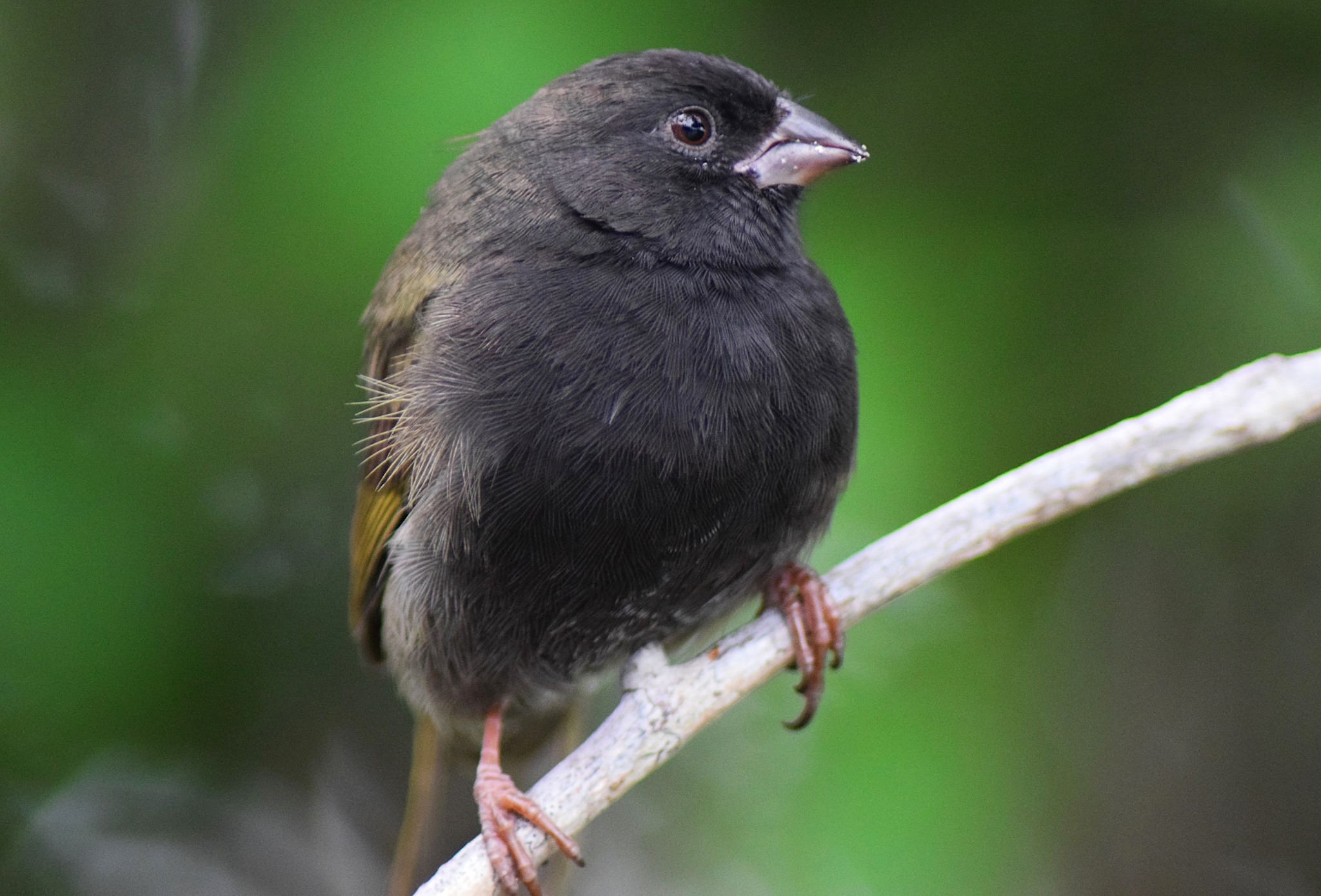
Hi, human friends, I’m a black-faced grassquit and I have a couple of observations to make on behalf of BFGs, if I may. First, we seem to be universally described by you as ‘common’, whereas we are actually quite refined in our behaviour. Secondly, the words most used to portray us are ‘dull’ and ‘drab’. And ‘stubby’. Well, excuse me… I – we – ask you to give us a second look. Maybe check out these images for a start.
Unsurprisingly we were very excited when the perceptive classifications committee of the American Ornithological Union gave us an upgrade. That’s the way we saw it anyway. For many years we were classified under the heading emberizidae.
We kept company with some buddies like the handsome Greater Antillean Bullfinches, but also with a lot of New World sparrows, with whom we (frankly) never felt entirely comfortable. Annoyingly chirpy, for a start.
And so we officially became a type of tanager. They even reckon (rather late in the day, in my view) that we are closely related toDarwin’s finches. So, we are “common”, huh? Now we get to be with other birds that are dome-nesters like us. And how about this – we’ll be in the same list as some really cool birds…
How’s this for a colourful gang to be joining: scarlet tanager, summer tanager, rose-breasted grosbeak, indigo bunting, painted bunting – these are our new cousins. BFGs “dull” and “drab”? I don’t think so.
6 UNDULL FACTS ABOUT BFGS
Make grassy dome-nests (like Bananaquits) and line them with soft grasses
Both sexes build the nest together
Both share egg-sitting duties and later chick-feeding & maintenance
Though quite gregarious by day, for some reason they tend to roost alone
They have a short ‘display’ flight with vibrating wings and a strange buzzing call
Otherwise, their flight is ‘weak, bouncy & fluttering’ (Whatbird assessment)
THE EVERYDAY TWITTERING SONG
THE DISPLAY BUZZING SONG
Photo Credits: Alex Hughes (1, 10); Tom Sheley (2, 3); Bruce Hallett (4, 9); Tom Reed (5, 11); Becky Marvil (6); Peter Mantle (7); Gerlinde Taurer (8); Keith Salvesen (12); Larry Towning (13). Other Credits: ABA, AOU, Whatbird? (sound files)
FIVE STARS: BAHAMAS ENDEMIC BIRDS (FOUR FROM ABACO)
Abaco is fortunate to be home to 4 of the 5 endemic Bahamas species. The fifth, the beautiful BAHAMA ORIOLE Icterus northropi, was found on both Abaco and Andros until the 1990s, when it sadly became extirpated from Abaco. Now found only on Andros, there are thought to be fewer than 300 Orioles left – a barely sustainable number. The species is unsurprisingly IUCN listed as critically endangered. Here’s a picture of one as a reminder of what Abaco is now missing…
Bahama Oriole
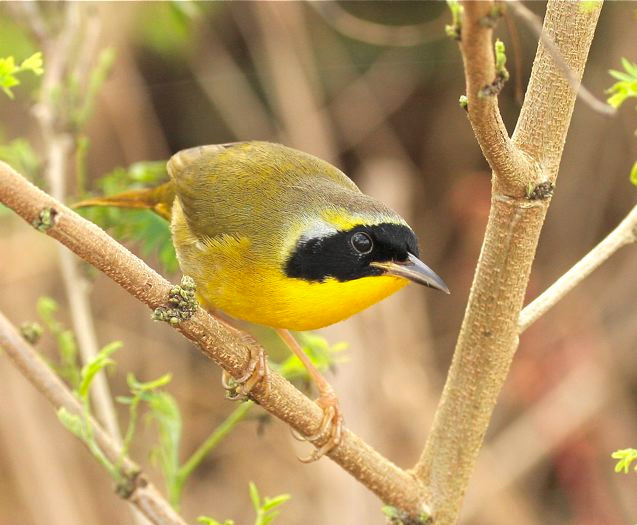
Abaco’s four endemic species are the tiny Bahama Woodstar hummingbird, the Bahama Yellowthroat, the Bahama Warbler (since 2011), and the Bahama Swallow. All are of course permanent breeding residents on Abaco and its outer Cays. None is exclusive to Abaco; all are relatively plentiful. The Woodstar is perhaps the hardest to find, not least because it competes territorially with the Cuban Emerald hummingbird. Even Woodstars can be found easily in some areas – Man-o-War Cay is a good place for them, for example. Here are some striking images of these four endemic bird species taken from the archives for “The Birds of Abaco” published last month.
BAHAMA WOODSTARCalliphlox evelynae
Bahama Woodstar (m) (Tom Sheley)
Bahama Woodstar (f) Tara Lavallee
BAHAMA YELLOWTHROAT Geothlypis rostrata
Bahama Yellowthroat (Tom Sheley)
Bahama Yellowthroat (Bruce Hallett)
BAHAMA WARBLERSetophaga flavescens
Bahama Warbler (Bruce Hallett)
Bahama Warbler (Woody Bracey)
BAHAMA SWALLOW Tachycineta cyaneoviridis
Bahama Swallow (Craig Nash)
Bahama Swallow (Erik Gauger)
“The Delphi Club Guide to the Birds of Abaco” was published as limited edition of 500 and has only been for sale for 8 weeks or so exclusively through the Delphi Club. Yesterday, we passed a happy milestone in that short time as the 250th copy was sold. Complimentary copies have also been donated to every school and relevant education department on Abaco to tie in with the excellent policy of teaching children from an early age the value of the natural world around them, the importance of its ecology, and the need for its conservation. The cover bird for the book was easy to choose – it just had to be a male Woodstar in all his glory with his splendid purple ‘gorget’.
Bahama Woodstar (m) Bruce Hallett
Image credits as shown; otherwise, ‘cover bird’ by Tom Sheley, Bahama Oriole – Andros Project / Wiki













 THE BIRDS OF ABACO