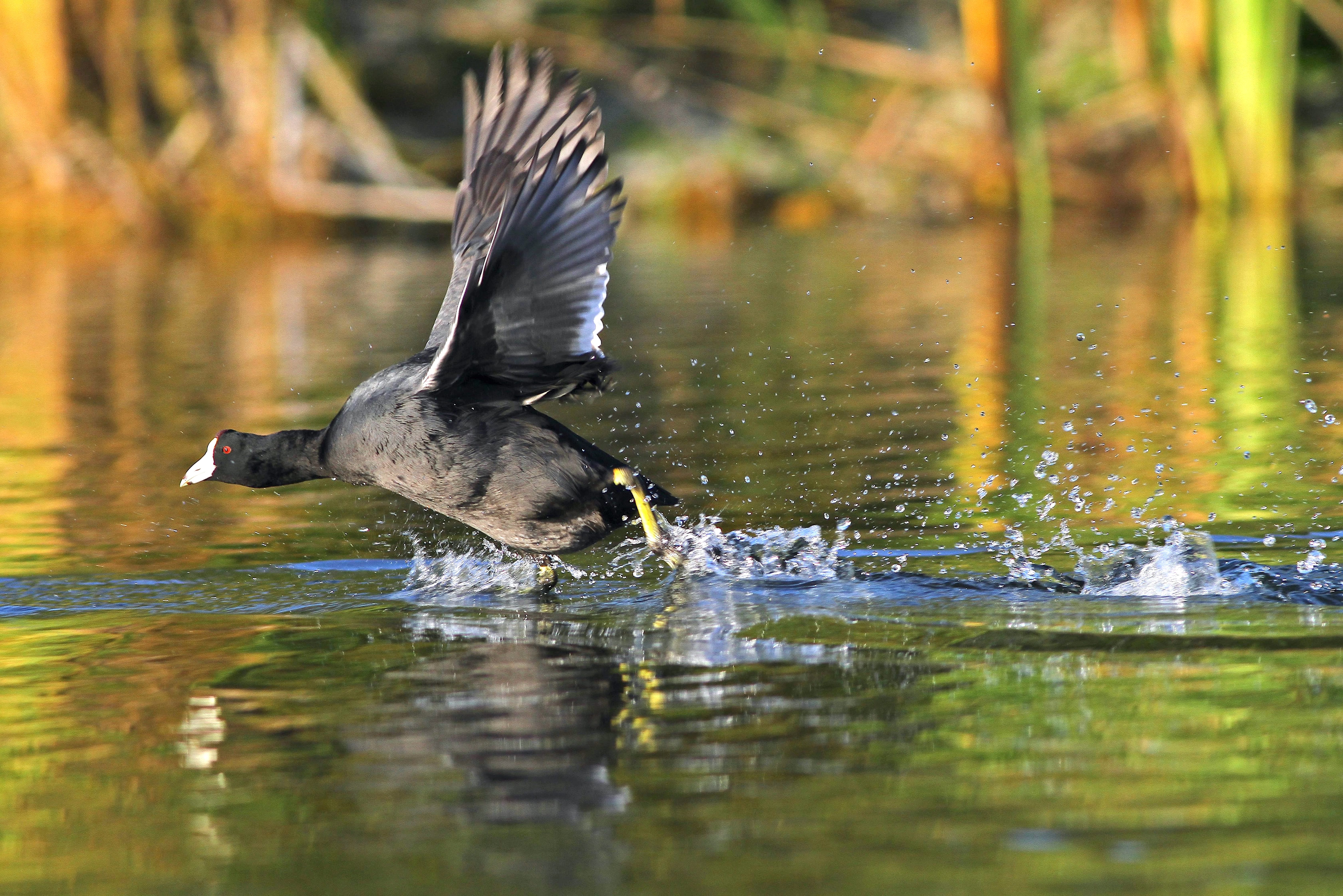
Coots and gallinules (moorhens) tend to get overlooked as birds of interest, being familiar to all and far from unusual in many locations. However, it is hard to imagine a more dramatic waterfowl image than this coot on the point of lift-off. Gerlinde Taurer, a significant contributor to BIRDS OF ABACO, captured this moment – a split second with the bird’s wings raised and the frantic paddle as the bird takes off.
WHAT DO LAUGHING GULLS SOUND LIKE? ARE YOU OVERSENSITIVE?
I made a couple of short recordings of the gulls in full humour mode; also a short video of the breeding pair above. If you have never heard them before, you might want to listen to the full 30 seconds. For anyone else there’s a convenient lull at around 15 secs before they kick off again.
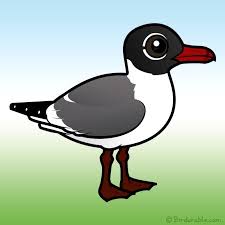
Breeding adult (Birdorable)
All photos, audio clip, video: Keith Salvesen / Rolling Harbour
The Tricolored Heron Egretta tricolor is one of 6 heron species found on Abaco, and is a permanent breeding resident. To which can be added 4 sorts of egret to complete a line up of expert fishers, all equally at home hunting in the water or from the shore, or surveying the scene from nearby vantage points like bushes and trees. A long neck, a long bill and long legs make this heron species ideally adapted for wading. Like other herons and egrets, it will stand stock-still waiting for the perfect fish to swim into range. However they are also active hunters, and will stalk prey or chase it by striding quickly through the water in pursuit. They eat fish, crustaceans, reptiles, and insects.
The heron and egret species of Abaco
Breeding plumage: smart blue bill and a fish to put in it
Credits: Phil Lanoue (1, 7); Dan Pancamo (2); Keith Salvesen (3); Woody Bracey (4); Bruce Hallett (5)
The Bahama warbler is a significant species with a near-unique status in the Bahamas:
Found only on Abaco and Grand Bahama
One of only 5 bird species endemic to the Bahamas
One of only 2 endemic warbler species on Abaco (with theBAHAMA YELLOWTHROAT)
One of only 5 permanent year-round resident warblers (33 others are migratory), the other 3 being the OLIVE-CAPPED, YELLOW, and PINE warblers.
Until 2011, the BAWA was classified as a subspecies of the YELLOW-THROATED WARBLER. The ornithological powers-that-be then recognised that the two species were distinct in both appearance and in vocalisation, and split them into separate species (this splitting / amalgamating process occurs annually and plays havoc with the precious ‘Life Lists’ kept with such rigour by ardent birders**.
The BAWA has such a confined range that even the extensive reach of the wonderful Cornell Lab of Ornithology has not got as far as this bird. The info sections of the otherwise comprehensive website for Neotropical Birds are blank and waiting for someone to upload some details. Here are a few facts in one of a very good series of info-graphics produced by the BAHAMAS NATIONAL TRUST.
** I have never even started a Life List, which demonstrates just how lightweight I am as a bird person
Credits: Alex Hughes (1, 4); Bruce Hallett (2, 6); Woody Bracey (3); Tom Sheley (5); Range Map, Cornell; Info G, BNT
Abaco has two permanently resident woodpecker species, theWEST INDIAN WOODPECKERand theHAIRY WOODPECKER. There is a third, migratory woodpecker species that is a fairly common winter resident, the yellow-bellied sapsucker Sphyrapicus varius.
Like its woodpecker cousins, the sapsucker drills holes in trees (see below). The dual purpose is to release the sap, which it eats, and to attract insects that it also eats. A two-course meal, if you like. They’ll also eat insects on an undrilled tree, and even ‘hawk’ for them in flight. They balance their diet with fruit and berries.
The distinctive patterns of sapsucker holes may completely encircle the trunk of a tree with almost mathematical precision. This is sometimes described as ‘girdling’ and may have a damaging effect on a tree, sometimes even killing it if the bark is severely harmed. This may require preventive measures in orchards for example, though note that in the US Yellow-bellied Sapsuckers are listed and protected under the Migratory Bird Treaty Act so radical action is prohibited.
YELLOW-BELLIED SAPSUCKER SOUNDS
DRUMMING (Xeno-Canto / Richard Hoyer)
CALL (Xeno-Canto / Jonathon Jogsma)
On Abaco, palms are a favourite tree for the sapsuckers. There are several palms along the beach at Delphi. Below is a coconut palm that had seen plenty of sapsucker action, with the drill holes girdling the entire trunk from top to bottom.
In their breeding grounds yellow-bellied sapsuckers excavate a large cavity in a softwood tree as a nest. They mate for life, and often return to the same nest year every year, with the pair sharing nesting duties. I have no idea whether the pair migrate south for the winter together, or whether they agree to take a break from each other. I’d like to think it’s the former…
Credits: Photos Gerlinde Taurer, Tom Sheley, RH; Cornell Lab (Range Map) & Xeno-Canto (YBS recordings as credited above)
Species featured in ‘Guide to the Birds of Abaco’ by Keith Salvesen, pp 242-3
There are twelve (12!) species of tern – ‘swallows of the sea’ – that to a greater or lesser extent may be found on Abaco. Whether they will actually be visible at any given time is less certain, though. For a start, the only resident species is the lovely Royal Tern, available at many locations on Abaco and the cays throughout the year. Others are migratory or – rarest of all –
ROYAL TERNS Thalasseus maximus PR1
In the slightly less commonly-found category are the summer migrant terns that, by definition, are only in residence for around half the year. Four of these are fairly common in certain areas, and actually breed on Abaco; these include arguably the prettiest of all, the bridled tern. The other two tern species (gull-billed and sandwich) are more rare and as far as I can make out do not breed locally; or perhaps only rarely.
LEAST TERN Sternula antillarum SR B 1
BRIDLED TERN Onychoprion anaethetus SR B 2
ROSEATE TERN Sterna Dougallii SR B 2
SOOTY TERN Onychoprion anaethetus SR B 2
GULL-BILLED TERN Gelochelidon nilotica SR 3
SANDWICH TERN Thalasseus sandvicensis SR 4
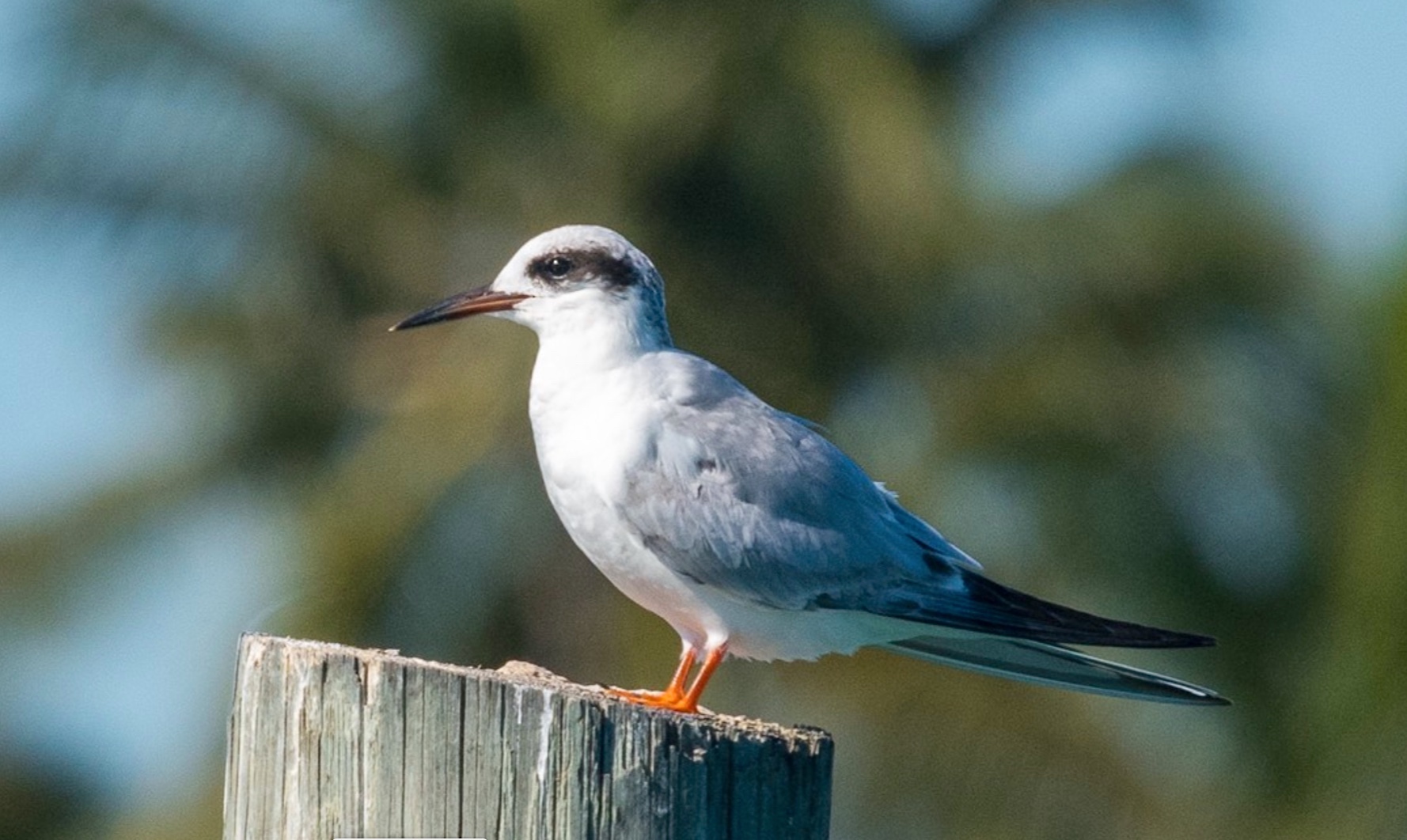
There is one rare winter resident migratory tern species. I had to check when the last one was recorded for Abaco. It was of course only in January this year, when ace birder-photographer Sally Chisholm saw one at Treasure Cay and managed to photograph it for posterity.
FORSTER’S TERN Sterna forsteri WR 4
The final four ‘Abaco’ terns are very much the occasional visitors. Three of them pass over the Bahamas on their longer migration, but may make a pit-stop around Abaco to take on fuel. Likelihood of sighting one? Slender but not impossible… The fourth, the Arctic Tern, is a very rare vagrant, a bird well away from its usual home or migration route as the result of storms or faulty satnav or sheer happenstance. Don’t travel to the Bahamas intent on seeing one.
CASPIAN TERN Hydroprogne caspia TR 4
As for the remaining three species, they are the transient black tern and common tern; and the vanishingly rare vagrant Arctic tern (the clue is in the name). No photos of any of these I’m afraid, so here’s a handy checklist instead.
ELECTIVE MUSICAL DIGRESSION
Written by Peter Seeger a few years earlier, Turn x 3 was released in 1965, the title track on the second album from the Byrds. At a rather febrile time in US history (Vietnam, draft riots, black civil rightists v cops and so on), this unusually palliative and thoughtful song with its religious connotations to some extent stood for peace and hope in a time of turmoil.
PS the somewhat laboured title of this post shoehorns in the name of another Byrds album, ‘The Notorious Byrd Brothers’
Photo credits: Keith Salvesen (1, 2, 3, 5, 18); Tony Hepburn (4); Alex Hughes (10, 11); Bruce Hallett (6, 7, 12); Woody Bracey (8, 13, 16); Duncan Wright (9); Dick Daniels (14); Sally Chisholm (15); Keith Kemp (17)
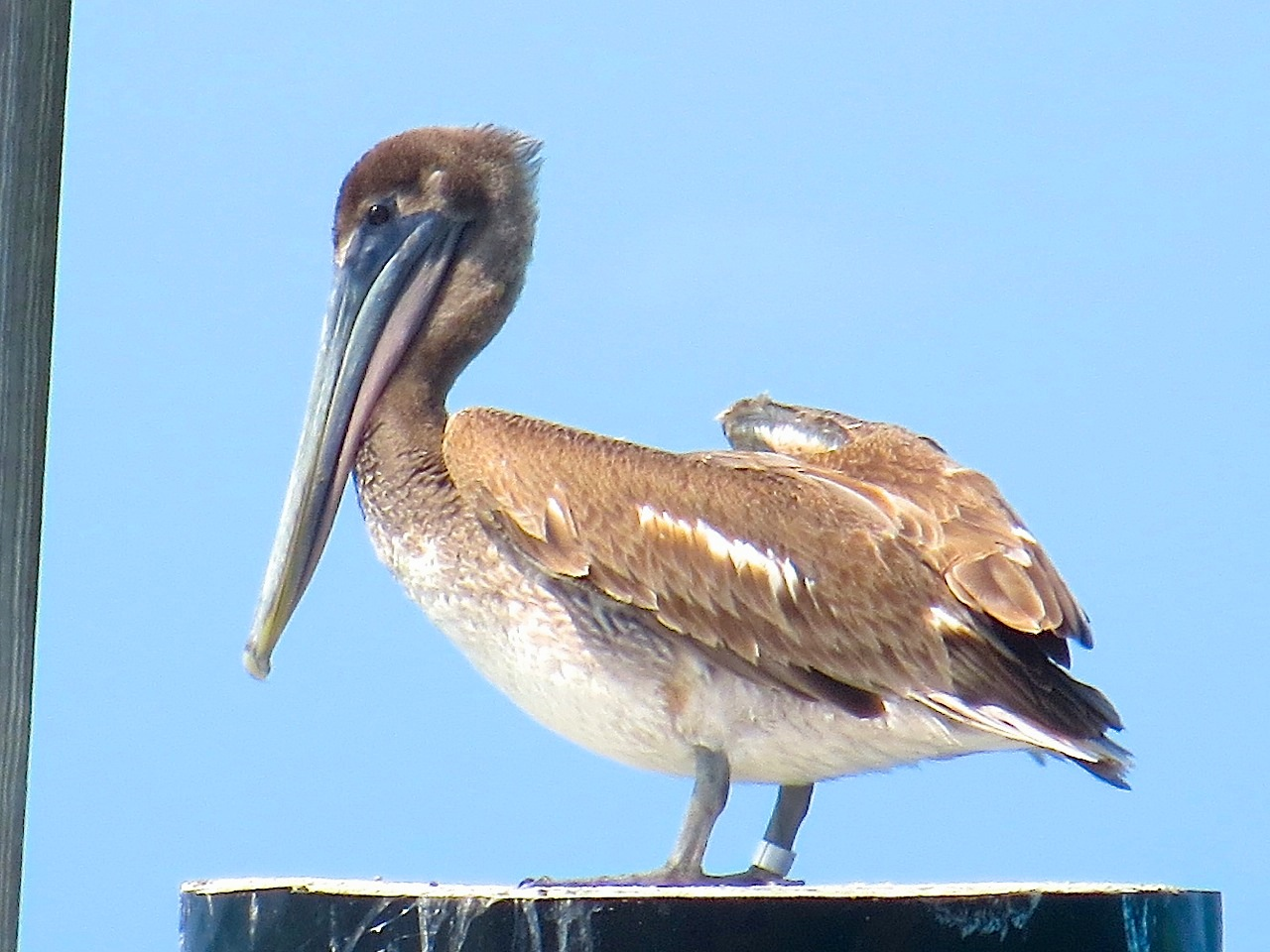
The best location on Abaco for watching brown pelicans is Sandy Point, the home of BMMRO(Bahamas Marine Mammal Research Organisation) and of course the legendary Nancy’s, the restaurant at the end of the road. It is a short step to the docks on which the pelicans gather and use as a launch pad for their fishing expeditions.
I photographed this bird at the end of the SP dock, looking rather bedraggled after a dive
Note the significant plumage differences between the male (above) & this female
The brown pelican is (or has become) quite uncommon in the Bahamas. On Abaco it is a permanent resident breeding species. A drop in numbers equals fewer nests, fewer chicks and… fewer numbers. It’s a classic cycle towards serious population decline and all that is implied.
The pelicans above were all photographed on Abaco. Two were not, but are both by exceptional photographers. One, Phil Lanoue, specialises in dramatic sequences, and his work features elsewhere in this blog. The final image was sportingly uploaded by Alan Schmierer from Flickr into the ‘public domain’.
Credits: Tom Sheley (1); Tony Hepburn (2); Keith Salvesen (3, 4, 6); Woody Bracey (5); Phil Lanoue (7); Alan Schmierer (8); Birdorable (cartoon)














 THE BIRDS OF ABACO


