Unknown's avatar

GREATER ANTILLEAN BULLFINCH (“POLICE BIRD”)

Greater Antillean Bullfinch, Abaco (Erik Gauger)

GREATER ANTILLEAN BULLFINCH: ABACO’S “POLICE BIRD”

The Greater Antillean Bullfinch Loxigilla violacea is a pretty bird, easy to find and to identify. They love feeders, and they are responsive to ‘pishing’, that irritating (?) noise that birders make to unseen avians in the coppice to persuade them to reveal themselves. Adult males are black with bright red accessories (hence “police bird”); females are paler with orangey accessories; and juveniles look a bit scruffy and patchy. Here’s a GAB gallery to enjoy.

Greater Antillean Bullfinch, Abaco (Alex Hughes) 4 Greater Antillean Bullfinch, Abaco (Alex Hughes) 5Greater Antillean Bullfinch immature with snail 2.Delphi Club.Abaco (Tom Sheley)Greater Antillean Bullfinch, Abaco (Keith Salvesen)Great Antillean Bullfinch, Abaco  (Tom Sheley) 1Great Antillean Bullfinch, Abaco (Charles Skinner)Great Antillean Bullfinch, Abaco (Gerlinde Taurer)GAB BH IMG_9208 copy 2

Credits: Erik Gauger (1); Alex Hughes (2, 3); Tom Sheley (4, 6); Keith Salvesen (5); Charles Skinner (7); Gerlinde Taurer (8); Bruce Hallett (9)

Unknown's avatar

MERLINS: FIERCE LITTLE FALCONS

Merlin, Abaco (Becky Marvil)

FIERCE LITTLE FALCONS: MERLINS ON ABACO

Merlins (Falco columbarius) are fierce small falcons that are fast and agile in flight. On Abaco, they are fairly common winter residents – though finding one and managing to photograph it may take a bit of doing. And maybe a dose of luck. The ‘columbarius‘ part of their taxonomy reflects their colloquial name ‘Pigeon Hawk’. Merlins are found throughout much of the northern hemisphere. They are classified as a New World species and an Old World / Eurasian subspecies, F c aesalon. Some argue for two distinct species, the gene pools of the two versions apparently having parted company ten of thousands of years ago. The birds aren’t overly bothered by the debate.

Merlin World Range Map: yellow = summer, blue = winter220px-Falco_columbarius_distribution_map

HOW DO MERLINS DIFFER FROM AMERICAN KESTRELS (AMKE)?

  • Slightly larger and notably heavier (thus having more speed and endurance in flight)
  • Different colouring, e.g. lacking the indicative reddish-browns of the AMKE
  • Distinctive tail-barring as against black ends to the tail feathers with a white fringe
  • Unlike the AMKE they don’t hover, but close in directly on the small birds that are the main prey, often flying very low to surprise the victim.

For comparison: Merlin in  South Abaco, American kestrel at Sandy PointMerlin, Abaco (Rhonda Pearce)American Kestrel, Abaco (Keith Salvesen)

 SO JUST HOW FIERCE ARE MERLINS?

Formidable! If you are a small or even medium-sized bird, you need to keep your wits about you. Merlins are largely ‘omni-habitat’ within their range, which includes open country, shrubland, light forest, and grasslands. They are fast, agile and strong. They can fly high, at medium height or at ground level, and are expert in surprise attack and rapid pursuit of prey. If you are a large bird of prey – a red-tailed hawk, perhaps – they may attack you with ferocity. They may not actually be trying to nail you, but to get you out of their territory and their catchment area.Merlin in flight, Abaco (Craig Nash)
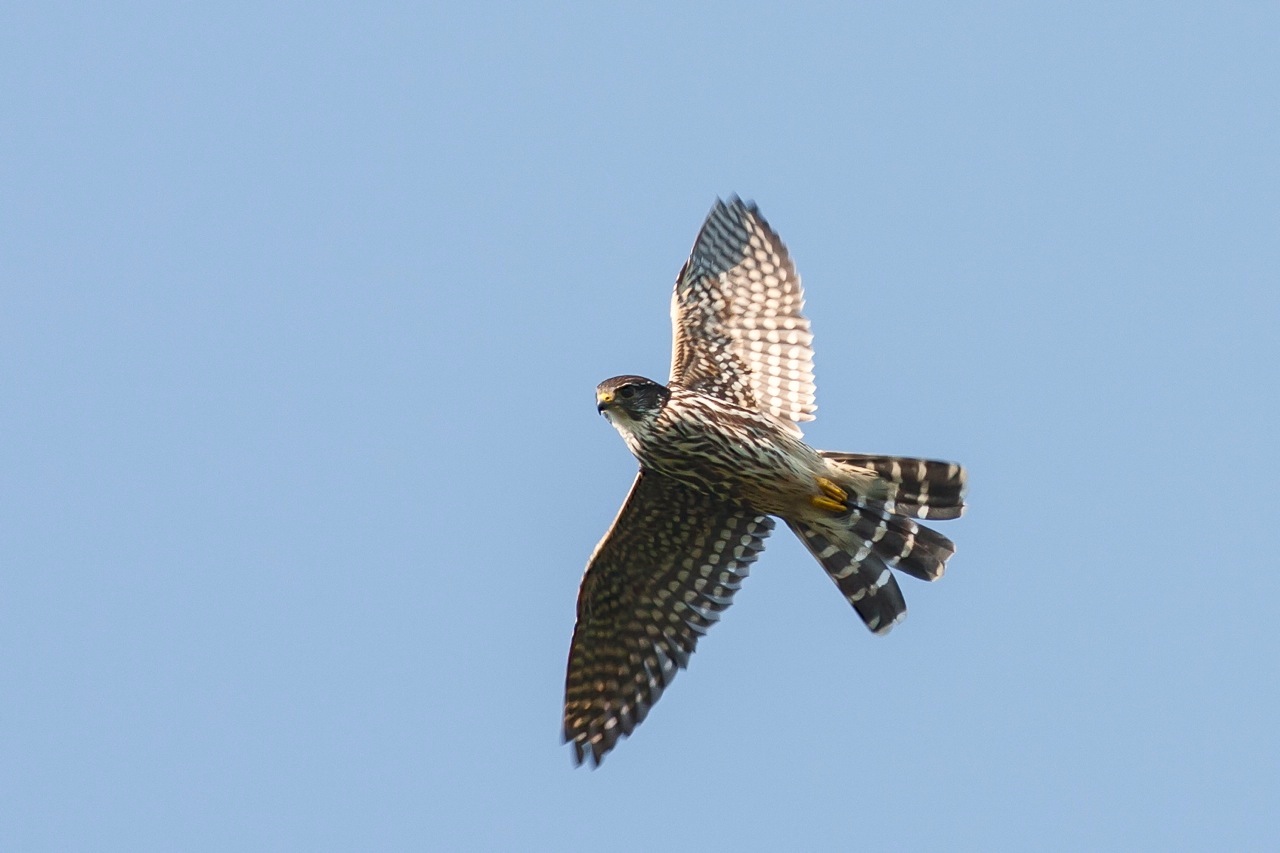
Most of a merlin’s prey is taken in flight, and their speciality is ‘tail-chasing’ terrified birds. Breeding pairs may hunt cooperatively, with one bird flushing prey from cover into the open for its mate to… well, you get the picture – they are clever too. They may even pursue birds that have been flushed out by another bird of prey in the vicinity.Merlin in flight, Abaco (Craig Nash)

MERLINS AND PHOTOGRAPHERS

This is a slightly fraught relationship, because Merlins do not always pose as one might wish. Sometimes they are hard to see, being fairly well camouflaged unless they choose to ‘go out on a limb’. Merlin, Abaco (Gerlinde Taurer)

And sometimes they don’t play by the rules relating to light and focus, making a clear shot difficultMerlin, Abaco (Becky Marvil)

FALCONRY AND MEDIEVAL HISTORY

Merlins were popular birds in medieval English falconry, and according to the 1486 Boke of Seynt Albans, the ‘Marlyon’ was considered the appropriate hunting bird for a lady. This book contained an essay on hunting attributed to Dame Juliana Berners, the prioress of a Priory near St Albans, who, game lady that she must have been, also contributed to one of the earliest treatises on fishing, ‘Fysshynge wyth an Angle‘ (hence, angling).

FURTHER HISTORICAL DIGRESSION (feel free to skip to final para)

While reading up further about Dame Juliana, I came across (wiki-tnx) a wonderful ranking for birds of prey matched to status that I hadn’t encountered before. Here’s the list, from Emperor to Knave / Servant. A Tercel was / is a male falcon, especially a Peregrine or Gyrfalcon. A Musket is a sparrowhawk. 

Falconry Table

The Boke of Seynt Albans also contains list of collective nouns for animals and birds, many familiar today such as “gaggle of geese”. There are also humorous collective nouns for different professions, such as a “diligence of messengers”, a “melody of harpers”, a “blast of hunters”, “a subtlety of sergeants”, and a “superfluity of nuns”…

Merlins are still trained for hunting smaller birds; and because of their speed and agility they are used in falconry displays. Despite changing habitat, and a perceptible dip in population from the use of pesticides now banned (such as DDT), the Merlin seems to be holding its own very well 5 centuries after the Boke was written.

Merlin & Prey - Just a Prairie Boy, Calgary

AND FINALLY… AUDUBON’S HANDSOME MERLINS

audubon-iii-scavengers-and-birds-of-prey-merlin-aka-le-petit-caporal audubon-iii-scavengers-and-birds-of-prey-merlin-aka-pigeon-hawk

Credits: Becky Marvil (1 & 7); RH (2); Rhonda Pearce (3); Craig Nash (4 & 5); Gerlinde Taurer (6); Prairie Boy (8) wiki – not taken on Abaco, but I liked it; Dame Juliana Berners (1486); Magpie Pickings

Unknown's avatar

BANANQUITS . ABACO . BAHAMAS

Bananaquit, Abaco Bahamas (Keith Salvesen / Rolling Harbour Abaco)

BANANAQUITS: A CURVE OF THE HEAD?

Bananaquits (Coereba flaveola) are small, colourful, and delightful birds of the coppice and garden. Besides their obvious attractiveness, the birds have in recent years enjoyed a status upgrade to being the sole species in the family Coerebidae.

Bananaquit, Abaco Bahamas (Gerlinde Taurer)

However this singular status has really been a kind of avian parking place due to past, present (and doubtless future) uncertainty of the right category for these birds. Like so many avian species these days, they are subject to the rigours and vagaries of continual reclassification by the ornithological powers-that-be.

Bananaquit, Abaco Bahamas (Craig Nash)

Bananaquits are, broadly speaking, passerines – essentially birds that perch. The nominal ‘passer’ was specifically awarded to sparrows by BRISSON, a contemporary of Linnaeus. Recently, bananaquits have suffered mysterious migrations of their classification ranging from the generalised ‘passerine‘ to the vague incertae sedis (=uncertain group‘) to uncomfortable inclusion with tanagers / emberizids. 

Bananaquit, Abaco Bahamas (Tom Sheley)

The debate over the appropriate classification for this pretty little bird (of which there are many subspecies in the broad Caribbean region) – rumbles on. A new way to confuse the issue is the suggestion that the bananaquit should be split into 3 species. In some areas, I believe this has happened at least informally.

Bananaquit, Abaco Bahamas (Tom Sheley)

Elsewhere there are doubters, sceptics, and champions of other group inclusions. The most obvious beneficiaries of all this will be dedicated birders, who may end up with two extra species to add to their ‘Lifer’ lists. Personally I’d like to think that the birds themselves will stay ahead of the curve in their own category, maintaining the mystery of their precise status while humans argue about what to call them. 

Bananaquit, Abaco Bahamas (Erik Gauger)

CREDITS: Keith Salvesen / Rolling Harbour (1); Gerlinde Taurer (2); Craig Nash (3, 7); Tom Sheley (4, 5); Erik Gauger (6). All birds photographed on Abaco, Bahamas

Bananaquit perched on yellow elder, the National flower of the BahamasBananaquit, Abaco Bahamas (Craig Nash)

Unknown's avatar

TRICOLORED HERONS

tricolored-heron-phil-lanoue-3

TRICOLORED HERON: AN ELEGANT & PATIENT FISHER

The Tricolored Heron Egretta tricolor is one of 6 heron species found on Abaco, and is a permanent breeding resident. To which can be added 4 sorts of egret to complete a line up of expert fishers, all equally at home hunting in the water or from the shore, or surveying the scene from nearby vantage points like bushes and trees. A long neck, a long bill and long legs make this heron species ideally adapted for wading. Like other herons and egrets, it will stand stock-still waiting for the perfect fish to swim into range. However they are also active hunters, and will stalk prey or chase it by striding quickly through the water in pursuit. They eat fish, crustaceans, reptiles, and insects.

tricolored_heron2_by_dan_pancamo (Wiki)
tricolored-heron-gilpin-point-abaco-keith-salvesen

The heron and egret species of Abacoherons-egrets-abaco

tricolored-heron-abaco-woody-braceytricolored-heron-abaco-bruce-hallet

Breeding plumage: smart blue bill and a fish to put in itTri-colored Heron with fish (Phil Lanoue)

Credits: Phil Lanoue (1, 7); Dan Pancamo (2); Keith Salvesen (3); Woody Bracey (4); Bruce Hallett (5)

Unknown's avatar

AMERICAN REDSTARTS ON ABACO: MALES IN FOCUS

american-redstart-male-abaco-bahamas-gerlinde-taurer-2

The American Redstart Setophaga ruticilla is a distinctive bird, males being orange and black, and females yellow and black. The dissimilar colouring between the sexes of these little warblers is due to differing carotin levels in each. These unmistakeable winter residents are common on Abaco and in the Northern Bahamas generally. They are an easy warbler for new birders look out for, being unlike any other small warblerish-looking bird. All the birds here were photographed on Abaco.

american-redstart-male-abaco-bahamas-gerlinde-taurer-1
american-redstart-copy

TEN REDSTARTLING FACTS  (& a comment)

  • The Latin name means moth-eating red-tail (‘start’ is an archaic word for tail)
  • AMRE are among the most common New World warblers
  • Occasionally they are found as far afield as Europe
  • They are almost entirely insect-eaters, with occasional berries or seeds for variety
  • Males are late developers, tending to skew the sex ratio: too many of them
  • They are inclined to monogamy, but only to an extent. Two-or-more-timing goes on
  • The most aggressive males get the pick of the habitats
  • This all begins to sound like human behaviour (not strictly a fact, so it doesn’t count)
  • Their fanned tails are for display, and maybe to surprise insects into breaking cover
  • Redstarts suffer badly from predators, especially in the breeding season
  • They are popular with coffee farmers for keeping insect numbers down

american-redstart-abaco-bahamas-gerlinde-taurer-3

american-redstart-male-bahama-palm-shores-abaco-bahamas-tom-sheley
american-redstart-copy
plate-40-american-redstart-final

The American Redstart (f  & m) as depicted by JJ Audubon

WHAT DO I LISTEN OUT FOR?

Jeff Dyck / Xeno Canto

american-redstart-male-wiki
american-redstart-mark-catesby-pinterest

AMRE by Mark Catesby, precursor of Audubon

Credits: Craig Nash (1); Gerlinde Taurer (2, 3, 4); Tom Sheley (5); Audubon Soc (6); Becky Marvil (7); ‘Scott’ wiki (8); Pinterest (9); Xeno-Canto / Jeff Dyck audio file; Birdorable (cute cartoon)

Unknown's avatar

WHITE-CHEEKED PINTAIL . ABACO . BAHAMAS

BAHAMA DUCKAnas bahamensis

White-cheeked pintail . Abaco . Bahamas (Gerlinde Taurer)

Photos taken on Abaco by Gerlinde Taurer, a major contributor to “Birds of Abaco”

Unknown's avatar

MANGROVE CUCKOO – ABACO, BAHAMAS

Mangrove Cuckoo, Abaco, Bahamas (Gerlinde Taurer)

MANGROVE CUCKOOS ON ABACO

The MANGROVE CUCKOO (Coccyzus minor) is one of three cuckoo species found on Abaco and in the wider Bahamas. The yellow-billed cuckoo is another; and the noisy black smooth-billed anis are cuckoos by species though not in appearance.

MANGROVE CUCKOO, Abaco (Alex Hughes)

You will notice that some of the birds shown have got fat insects in their beaks. Their preference is for caterpillars and grasshoppers, but they are happy to eat other insects, spiders, snails, lizards and (with a nod to an all-round healthy diet) fruit.

Mangrove Cuckoo, Abaco, Bahamas (Tony Hepburn)  copy

Mangrove Cuckoo, Abaco Alex Hughes

Mangrove Cuckoo, Abaco, Bahamas (Tony Hepburn) copy

These cuckoos are shy birds and fairly hard to spot in the coppice unless they are on the move. You may see one flying across a track ahead of a vehicle, flashing its distinctive tail. Here are a couple of recordings of their call, described in various ways, for example as “gawk gawk gawk gawk” or “gauk gauk”. I’m not sure I hear it quite like that but I can’t think of a sensible way to write it out phonetically…

Jesse Fagan / Xeno-Canto

 Cornell Lab / Allaboutbirds  

Mangrove Cuckoo with insect.Delphi Club, Abaco, Bahamas (Tom Sheley)

Credits: Bruce Hallett, Alex Hughes,  Tom Sheley, Gerlinde Taurer and the late Tony Hepburn; Audio – Xeno-Canto & Cornell Lab. All photos taken on Abaco!

Mangrove Cuckoo, Delphi Club, Abaco, Bahamas (Tom Sheley) copy