Unknown's avatar

THE PIGEON & DOVE SPECIES OF ABACO

The Columbidae of Abaco: all are permanent breeding residentsPigeons : Doves Abaco

White-crowned PigeonWhite-crowned Pigeon, Abaco, Bahamas (Gerlinde Taurer)White-crowned Pigeon, Abaco (Alex Hughes)

White-winged doveWhite-winged Dove, Abaco Bahamas - Tom SheleyWhite-winged Dove, Abaco - Tony Hepburn

Eurasian Collared DoveCollared Dove, Abaco - Keith Salvesen / Rolling HarbourEurasian Collared Dove, Abaco (Bruce Hallett)

Common Ground Dove (Tobacco Dove)Common Ground Dove, Abaco 1 (Tom Sheley)Common Ground Dove, Abaco (Keith Salvesen)

Zenaida DoveZenaida Dove, Abaco (Bruce Hallett)Zenaida Dove, Abaco (Bruce Hallett)

Key West Quail-DoveKey West Quail Dove, Nassau, Woody BraceyKey West Quail-Dove, Elbow Cay, Abaco (Milton Harris) 1a

Rock PigeonRock Pigeon, Sandy Point, Abaco Bahamas.Tom Sheley 2bRock Pigeon NYC (keith Salvesen)

Mourning DoveMourning Dove, Abaco (Charles Skinner)

The birds shown above represent the 8 species found on Abaco. However, in New Providence, there is a beautiful pigeon that has not yet made its way over to Abaco and has yet to be introduced there. 

Pied Imperial Pigeon (Nassau)Pied Imperial Pigeon 1, Nassau (Woody Bracey)Pied Imperial Pigeon 2, Nassau (Woody Bracey).JPG

Photo credits: Gerlinde Taurer (1); Alex Hughes (2); Tom Sheley (3, 7, 13); Tony Hepburn (4); Keith Salvesen (5, 8, 14); Bruce Hallett (6, 9, 10); Woody Bracey (11, 16, 17); Milton Harris (12); Charles Skinner (15)

Unknown's avatar

BLACK AND WHITE WARBLER

B & W Warbler (f) BH IMG_0482 copy

The Black-and-White Warbler Mniotilta varia is a fairly common winter resident on Abaco. They are the only birds of the genus Mniotilta (“moss-picker” gr.). Unlike most warblers these birds behave rather like nuthatches, creeping along the trunks and branches of trees grubbing insects out of the bark. Pine trees are ideal for this. I remain rather dim about the 37 species of warbler on Abaco. A lot of them are small and yellow. But as soon as I saw one of these for the first time, I was very relieved. I knew exactly what it was – the bird that has been described as ‘a flying humbug’. 

Black & White Warbler.Cross Harbor.Abaco Bahamas.Tom SheleyB & W Warbler BH IMG_9587 copyBlack & White Warbler TR jpg

SUMMER     WINTER
220px-Mniotilta_varia_map.svg

Finally, this is a great short video of this little bird in action. Even if you only watch the first 30 seconds, you will be enchanted…

Image Credits: Bruce Hallett, Tom Shelley, Tom Reed. All are contributors to “The Delphi Club Guide to the Birds of Abaco” (Publ. March 2014)

Unknown's avatar

AMERICAN COOTS


American Coot - Bahamas - Great Abaco - Gerlinde Taurer

AMERICAN COOTS: “WHAT’S AFOOT?”

The American Coot Fulica americana is similar in many respects to the COMMON GALLINULE (MOORHEN). Except for the beak colour, of course. And as you will see below, the feet.

American Coot.Abaco Bahamas (Tom Sheley)

Most people would give an off-the-cuff description of a coot as ‘a black duck with a white beak’. They might add ‘…and a red eye’. Or ‘…and a dark band at the tip of the beak’. Or even ‘…I think there’s a white bit at the back end’. The header image pretty much sums up the classic coot.

American Coot 2 (Keith Salvesen)

However, coots seem to take up or reflect other colours at times. The eyes remain a piercing red and the beak is white, but the body can range from black through slate-grey to pale grey, depending on the light. There may even be a tinge of brown or even orange.

American Coot - Bahamas - Great Abaco - Gerlinde Taurer

I always enjoy seeing coots and moorhens somewhere where the water ‘works’ with them and creates a dramatic image. I took the first photo below recently on the JKO reservoir in Central Park, New York, where the water looked weirdly like molten metal and some trick of the light made the bird seem as if is was in a shallow depression in the water.

American Coot (Keith Salvesen)

Tom Sheley took the photo below on a ‘green water’ day at the pond on Treasure Cay Golf Course. I have recommended it before as an excellent birding site for waterbirds – coots, moorhens, Bahama pintails, northern pintails, neotropic cormorants, blue-winged teal, least grebes, pied-billed grebes, green herons – I’ve even seen a reclusive least bittern there. There are plenty of ‘land’ birds on the course too.

American Coot.Treasure Cay, Abaco Bahamas.6.13.Tom Sheley copy 2

If you go to TCGC for the birding, you just need to clock in at the clubhouse in case it’s a match day; and so they know who is out and about on the course. And, as I wrote elsewhere, if you hear a loud yell of “Fore”, it probably won’t be someone counting the coots. Time to… er… duck.

Q: “WHAT’S AFOOT?” *

I mentioned that one of the differences between coots and moorhens is their feet. Gerlinde Taurer’s photo of a coot taking off suggests that something powerful is happening below the water to assist the wings to propel the bird into flight.American Coot - Bahamas - Great Abaco - Gerlinde Taurer

A coot’s feet are quite unlike the pedal extremities of any other birdCoot, showing feet (Keith Salvesen)Coot Feet Close-up Keith Salvesen copy

Moorhen’s feet for comparison – completely different structurallymoorhen_feet-mehmet-kartuk-wikijpg-copy* A: “A funny-shaped thing on the end of your leg”. How we laughed (aged 7)

Credits: Gerlinde Taurer (1, 4, 7); Tom Sheley (2, 6); Keith Salvesen (3, 5, 8, 9); Mehemet Kartuk (wiki) 10


Unknown's avatar

BANANAQUITS ON ABACO

Bananaquit, Abaco - Bruce Hallett

BANANAQUITS ON ABACO: CHEERY VANQUISHERS OF GLOOM

I’d been planning a post about marine debris and its dire effects on the natural world. Some images I proposed to use are distressing, and some simply suggest how futile it is to try to prevent mankind chucking harmful and semi-permanent rubbish into the sea. Depressing. A gyre of upset. Add in new military interventions without limitation and suddenly I longed for something more cheerful. Checking through a folder of photos of Bananaquits helped to stave of the gloom, so I picked out a few images of this lovely small bird taken by 9 photographers. 

Bananaquit, Abaco - Craig NashBananaquit & palm, Delphi, Abaco, Bahamas 2 (Keith Salvesen)Bananaquit, Treasure Cay, Abaco - Becky MarvilBananaquit, Bahamas, Great Abaco - Gerlinde TaurerBananaquit, Abaco - Bruce HallettBananaquit, Abaco - Charlie Skinner Bananaquit, Abaco - Erik GaugerBananaquit, Abaco - Tom ReedBananaquit, Abaco - Peter Mantle

Credits: Bruce Hallett, Craig Nash, Keith Salvesen, Becky Marvil, Gerlinde Taurer, Charlie Skinner, Erik Gauger, Tom Reed, Peter Mantle

Unknown's avatar

BLACK-WHISKERED VIREO

Black-whiskered Vireo, Abaco (Bruce Hallett)

BLACK-WHISKERED VIREO

There are 8 vireo species recorded for Abaco. The most common is the ubiquitous Thick-billed Vireo Vireo crassirostris – the only permanent resident vireo – whose cheery chirp is part of the background of bird song heard daily all over the island.  The only other species you are likely to encounter without going out of your way is the summer resident BLACK-WHISKERED VIREO Vireo altiloquus, which breeds on Abaco. The other 6 are the White-eyed, Yellow-throated, Blue-headed, Warbling, Philadelphia, and Red-eyed Vireo. Of these, the first 2 are quite rare winter residents; and the other 4 are considered to be transients. Black-whiskered Vireo, Abaco

The BWV’s song is similar to the Thick-billed Vireo, but (luckily) identifiably different. I’m not a great one for phonetic attempts at turning a bird call into a human sentence of the ‘Quick!-come-to-pick-up-a-brick’ and the ‘Skin-me-a-nice-bit-of-bonefish’ type. The Black-whiskered Vireo’s song has been described as sounding like ‘Whip, Tom Kelly’. But not to me. See what you make of it…

Brian Cox / Xeno-Canto

Black-whiskered Vireo, Abaco Bahamas 2 (Tom Sheley)

As with other vireo species, the BWV has a stout bill, a feature that helps to distinguish vireos from the many thin-billed warbler species on Abaco. The main signifiers are found on this bird’s head: the dark stripe right through the eye; the long white eyebrows; and the noticeable black lines – the ‘whiskers’ – on the sides of the neck. Other identification pointers are the pale underside with a yellow tinge to the flanks and undertail; and the red eyes (the red-eyed vireo, a very similar bird, lacks the whiskers).Black-whiskered Vireo, Abaco (Charmaine Albury)

Black-whiskered vireos feed mostly on insects in trees, bushes and undergrowth. They can sometimes be seen hovering while they forage. They also vary their diet with small quantities of berries. Here are two great shots of a mother BWV feeding a very large chick with a berry, followed by some vile insect.Black-whiskered Vireo, Abaco (Charlie Skinner)Black-whiskered Vireo, Abaco (Charlie Skinner)

Image Credits: Bruce Hallett, Tom Shelley, Charlie Skinner, Charmaine Albury, Erik Gaugerblack-whiskered-vireo, Abaco (Erik Gauger) 1

Unknown's avatar

CLAPPER RAILS ON ABACO, BAHAMAS

Clapper Rail on Abaco by Sandy Walker

ABACO BIRDS… THAT RUN LIKE THE CLAPPERS

That is, essentially, because they are indeed Clappers. Rallus longirostris to be precise, or Clapper Rails. There are 4  rail species on Abaco, the Clapper being a permanent resident and not particularly uncommon. The others are the Virginia Rail and the Sora, both winter residents and less common (or in the Sora’s case, perhaps more furtive and less easy to find); and the Black Rail, which is generally agreed to be a ‘hypothetical’ for Abaco. That means they are believed to exist on Abaco but there are no confirmed sightings let alone any photos of one. However, last summer while we were taking a truck into the backcountry of South Abaco to locate hard-to-find birds for “The Birds of Abaco” book, the distinctive call of a Black Rail call was heard independently by two people on two different days in two different locations. I’ve heard another report since then. So they are out there somewhere, but keeping their heads down. The first to find one will have a considerable avian scoop!

Let’s start with some fabulous photographs by Tom Sheley. We used the first one in the book. By being patient, Tom managed to capture this bird having a quality preening session. Here are 4 shots from the sequence, including a rare one of the bird calling. To get the full glory of the detail, click on each image twice.Clapper Rail stretching.Abaco Bahamas - Tom Sheley ("The Birds of Abaco" by Keith Salvesen, p80)Clapper Rail rousing.Abaco Bahamas.Tom SheleyClapper Rail preening 2.Abaco Bahamas.3.12.Tom Sheley copyClapper Rail preening.Abaco Bahamas.3.12.Tom Sheley copy

Clapper Rails are elusive birds of mangrove swamp and marsh, more frequently heard than seen. They tend to lurk around in foliage and are easy to overlook. You may come across one foraging secretively in the mud. Although they can both swim and fly, they prefer to keep both feet on the ground.When running, these rails look endearingly comical. 

Clapper Rail, Abaco Erik Gauger V2Clapper Rail Sandy Walker 1 - V2Clapper Rail, Abaco Bahamas - Becky Marvil

It almost goes without saying nowadays, but the biggest threat to these rather charming inoffensive birds is habitat loss. That is to say, mankind. Drive the bulldozers through the mangroves and marshland of sub-tropical coastal areas, chuck down a few acres of concrete… and the clappers will very soon become clapped out.
Clapper Rail Abaco, Bahamas - Becky Marvil

“TO RUN LIKE THE CLAPPERS”. This phrase seems to be fairly recent, probably dating from early in WW2. Some suggest it is a rhyming slam bowdlerisation of ‘run like hell’ with ‘clapper(s)’ standing for ‘bell’, along the lines of the Cockney “I bought a brand new whistle” (whistle and flute = suit). Almost all plausible explanations relate to bells, and some argue that it simply reflects the rapid speed of the clapper of a vigorously rung handbell.

STOP PRESS Uli Nowlan has sent her photo of a Clapper Rail, taken at the ponds north of Treasure Cay – a reminder that there is good birding to be done in that area of North Abaco – the bird action is not confined to South Abaco below MH…

Clapper Rail, Abaco (TC ponds) - Uli Nowlan

Photo credits:Tom Sheley, Sandy Walker, Erik Gauger and Becky Marvil – plus Uli Nowlan

The Clapper Rail features in “The Delphi Club Guide to the Birds of Abaco” by Keith Salvesen pp 80 – 81

Unknown's avatar

CUBAN PEWEE

Cuban Pewee Abaco 8

CUBAN PEWEE: NATURE’S LEAST SCARY TYRANT

Pasted Graphic
image.aspxThe CUBAN PEWEE Contopus caribaeus bahamensis, also known as the Crescent-eyed Pewee (see photos for details), is a tyrant. At 6″ long , the smallest tyrant you are likely to encounter in the Bahamas, but undoubtedly a member of the family Tyrranidae. These are the flycatchers, and include the larger LA SAGRA’S FLYCATCHER and the still larger Loggerhead and Gray Kingbirds. The Cuban Pewee is permanently resident on Abaco, and can be found in both pine woods and coppice. When returning to its perch after a flycatching sortie, this bird gives a characteristic flick of the tail.

The little bird below was in the edge of the coppice bordering the long sandy beach at Casuarina. Bruce Hallett, in his essential book  ‘Birds of the West Indies…’ notes that Cuban Pewees are ‘usually approachable’, so I decided to test this out. I was about 20 feet from the bird when I first saw it. By sliding one foot forward in the sand and pausing before moving the other foot, I got to within 5 feet of the bird, while it watched my approach with apparent indifference. Unlike some creatures, it did not seem discomfited by eye-contact. It responded when I made a faint clicking sound by rather sweetly putting its head on one side.  Then it began to fidget slightly – possibly feeling camera-shy. So I shuffled slowly back so as not to disturb it in its own territory.

The close-ups at the end clearly show the tiny hooked tip at the end of the upper beak – I imagine this somehow relates to the business of catching flies. Like other flycatchers, the Cuban Pewee has very distinctive whiskers around the base of the beak – again I presume this assists with feeding in some way, perhaps helping to sense the approach of an insect. Any expert views welcome via the comment box.

Cuban Pewee Abaco 1Cuban Pewee Abaco 7Cuban Pewee Abaco 6 Cuban Pewee Abaco 5 Cuban Pewee Abaco 4Cuban Pewee Abaco 9 Cuban Pewee Abaco 10It’s occasionally tempting to anthropomorphise such close encounters in terms of imputed human / creature empathy. Much best to resist that. But as I withdrew, leaving this little  bird undisturbed on its branch, I did experience a strange feeling of… [I must interrupt myself here. I’m a lawyer, so that’s quite enough of that sort of nonsense]

Unknown's avatar

SNOWY EGRETS ON ABACO

Snow Egret in Flight (Wiki)

‘REMARKABLE FEET’: SNOWY EGRETS ON ABACO

SNOWY EGRETS (Egretta thula) are small white herons of the Americas, similar to the European Little Egret. The first thing you may notice about them is that they have remarkable bright yellow feet. This distinguishes these birds from all other egret and heron species.Snowy Egret (Tony Hepburn)

Young Snowy Egrets often have yellow markings higher up on their legs.Snowy Egret, Gilpin Pond Abaco (Sandy walker)

The feet are so bright that they are often visible underwater.Snowy Egret, Abaco (Woody Bracey)

Snowy Egrets eat fish, crustaceans, insects and small reptiles. They have 3 main foraging tactics: (1) Standing still in or on the edge of water to ambush prey (2) Stalking prey in shallow water, often running or shuffling their feet to flush out prey  (3) “Dip-fishing” by flying low over water.

Snowy Egret (Wiki)

In breeding season, Snowy Egrets grow beautiful plumes – “bridal plumage”. At one time these were in great demand as adornments for women’s hats (as with flamingos, parrots and many other decorative species). This reduced the population of the birds to dangerously low levels, from which they have now recovered. Their IUCN rating is now ‘Least Concern’.

Snowy_Egret_-_full_breeding_plumage-1 wiki

Contemplating the next meal… one of Sandy Walker’s excellent Abaco photos taken this winterSnowy Egret, Abaco (Sandy Walker)Photo Credits: Sandy Walker, Woody Bracey, Tony Hepburn, Wiki

Unknown's avatar

CUBAN EMERALD HUMMINGBIRD

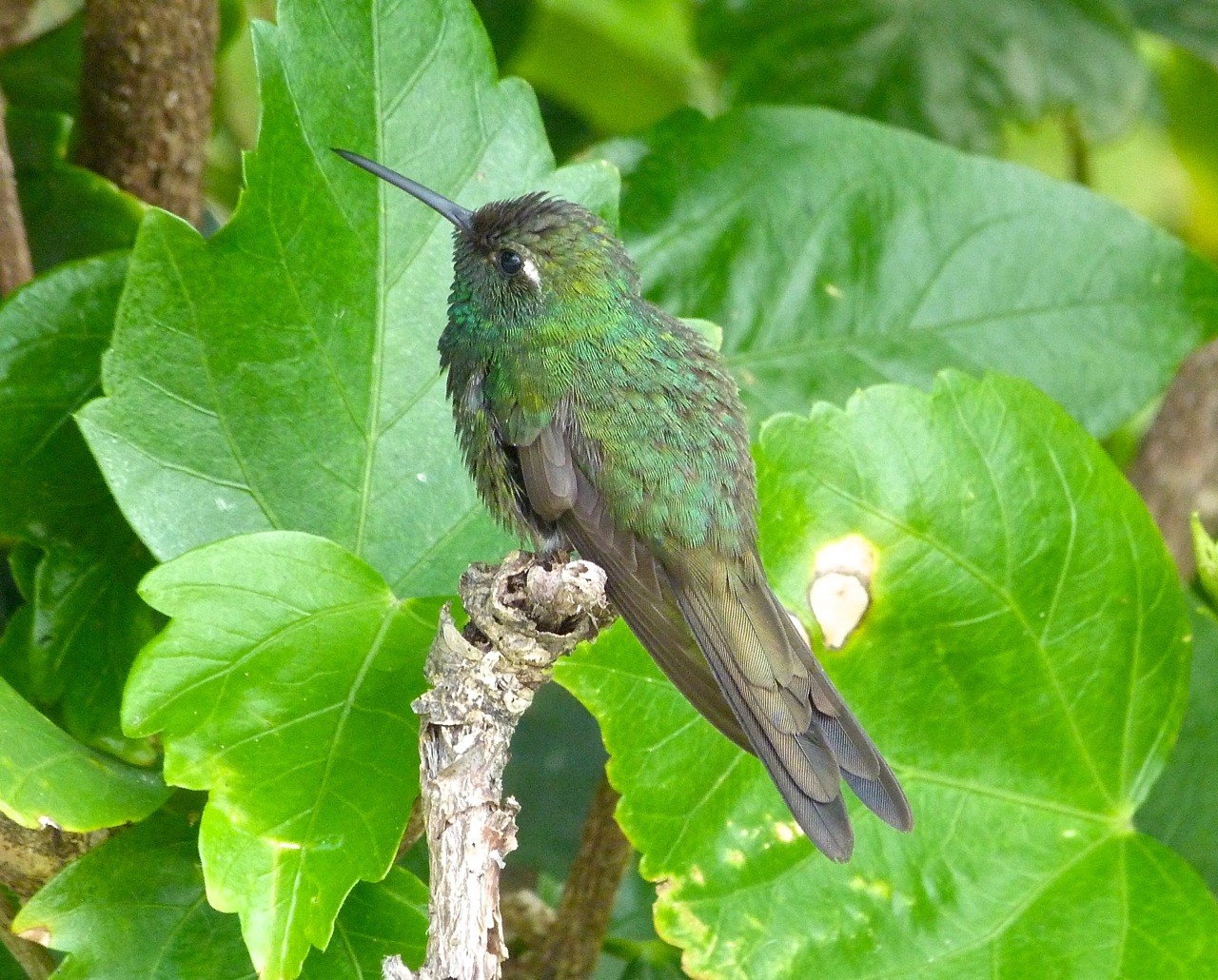
Cuban Emerald Delphi Abaco 4

A CUBAN EMERALD HUMMINGBIRD AT DELPHI, ABACO

Mostly, the Cuban Emeralds at Delphi spend their days perching briefly on twigs before zooming like tiny green rockets to their next appointment – an inviting sugar-water feeder, a promising flower or maybe yet another tempting twig. Sometimes, pairs will put on an acrobatic mid-air display, flitting around each other at high speed, chittering, before disappearing into the coppice together. Avian speed-dating. Occasionally, they are more contemplative. Emeralds may be quite hard to spot in amongst the green leaves, but often they are there, quietly watching you go by. Here is one that stayed put when I stopped to admire it.

I’m keeping an eye on you… Cuban Emerald Delphi Abaco 1

I’ll tuck my wing in neatly if you are going to take pics of meCuban Emerald Delphi Abaco 2

Uh-oh! Close-ups. This is my better side.
Cuban Emerald Delphi Abaco 3

That’s enough, human. I’ve stopped the posing. Now push off and leave me alone.Cuban Emerald Delphi Abaco 5

In close-up, the feathers look like tiny iridescent pine needle fansCuban Emerald Delphi Abaco 6

Unknown's avatar

SEMIPALMATED PLOVERS ON ABACO

Semi-Palmated Plover, Abaco (Alex Hughes)

‘CHECK OUT THE WEB’: SEMIPALMATED PLOVERS ON ABACO

“Semipalmated”. You what? Come again? Ehhhh? My reactions to the word until embarrassingly recently. In fact until the steep learning curve involved in writing a bird book made some all of the terminology clearer. Plovers and sandpipers both have semipalmated versions, and I’ll take the semipalmated plover (Charadrius semipalmatus) first.

Semipalmated Plover, Abaco (Woody Bracey)

WHAT SHOULD I LOOK FOR?

A small shorebird with a grey-brown back and wings, a white underside with a single black neck band, and orange legs. They have a brown cap, a white forehead, a black eye mask and a short black bill with an orange base to it. And feet to be discussed below.Semi-palmated Plover WB P1001211 copySemipalmated Plover, Abaco (Tony Hepburn)

WHERE DO THEY LIVE?

Their summer home and breeding habitat is on the beaches and flats of northern Canada and Alaska. They nest in scrapes on the ground right out in the open. In the Autumn these little birds set off on long journeys south to warmer climes until Spring: the coasts of the southern states, Caribbean and South America. On Abaco, they are fairly common in certain areas including the beach at Delphi. Like other plovers, these  birds are gregarious and will mix in with other shorebirds – which can make them hard to pick out in the crowd.Semipalmated Plover, Abaco (Charles Skinner)

GET ON WITH THE ‘SEMIPALMATED’ BIT, PLEASE

‘Semipalmated’ refers to the partial webbing between their toes. There are different degrees of palmation, as these handy graphics demonstrate:

Semipalmate: in practice, very hard so see in the field e.g. plovers & sandpipers semipalmate

Palmate: full webbing across the ‘front’ 3 toes, e.g. gulls

palmate

Totipalmate: all toes are fully webbed e.g. cormorants

totipalmate

Nonpalmate: please supply own imagination 

Gregarious flight: there are sandpipers in the mix (clue: long bills)Semipalmated Plover, Abaco (Alex Hughes)

WHAT DO THESE BIRDS EAT?

Semipalmated plovers are much like any other small shorebird foraging on beaches and foreshores. They eat insects, crustaceans and worms. Here is a bird in a promising place for its preferred diet.

Semipalmated Plover, Abaco (f, nb) Bruce Hallett FV

ANYTHING ELSE TO LOOK OUT FOR?

Like other plover species – Wilson’s and Killdeer for example – a semipalmated will  use the ‘broken wing’ ploy to lure a predator away from a nest and the eggs or chicks in it. As it flops about pathetically on the sand looking vulnerable, it actually moves gradually further away from the nest. If it comes to the crunch it is able to take wing rapidly, leaving a very puzzled predator behind.Semipalmated_Plover,_broken_wing_display (D Gordon E Robertson)

Semipalmated plovers flying with 2 sandpipersSemi-palmated Plover AH IMG_0612 jpg

Credits: Alex Hughes (1, 6, 9, 10); Woody Bracey (2, 3); Tony Hepburn (4); Charles Skinner (5); Bruce Hallett (7); D Gordon E Robertson (8);  Bird foot infographics people.eku.edu AH IMG_1637 copy