Unknown's avatar

CUBAN PEWEE

Cuban Pewee Abaco 8

CUBAN PEWEE: NATURE’S LEAST SCARY TYRANT

Pasted Graphic
image.aspxThe CUBAN PEWEE Contopus caribaeus bahamensis, also known as the Crescent-eyed Pewee (see photos for details), is a tyrant. At 6″ long , the smallest tyrant you are likely to encounter in the Bahamas, but undoubtedly a member of the family Tyrranidae. These are the flycatchers, and include the larger LA SAGRA’S FLYCATCHER and the still larger Loggerhead and Gray Kingbirds. The Cuban Pewee is permanently resident on Abaco, and can be found in both pine woods and coppice. When returning to its perch after a flycatching sortie, this bird gives a characteristic flick of the tail.

The little bird below was in the edge of the coppice bordering the long sandy beach at Casuarina. Bruce Hallett, in his essential book  ‘Birds of the West Indies…’ notes that Cuban Pewees are ‘usually approachable’, so I decided to test this out. I was about 20 feet from the bird when I first saw it. By sliding one foot forward in the sand and pausing before moving the other foot, I got to within 5 feet of the bird, while it watched my approach with apparent indifference. Unlike some creatures, it did not seem discomfited by eye-contact. It responded when I made a faint clicking sound by rather sweetly putting its head on one side.  Then it began to fidget slightly – possibly feeling camera-shy. So I shuffled slowly back so as not to disturb it in its own territory.

The close-ups at the end clearly show the tiny hooked tip at the end of the upper beak – I imagine this somehow relates to the business of catching flies. Like other flycatchers, the Cuban Pewee has very distinctive whiskers around the base of the beak – again I presume this assists with feeding in some way, perhaps helping to sense the approach of an insect. Any expert views welcome via the comment box.

Cuban Pewee Abaco 1Cuban Pewee Abaco 7Cuban Pewee Abaco 6 Cuban Pewee Abaco 5 Cuban Pewee Abaco 4Cuban Pewee Abaco 9 Cuban Pewee Abaco 10It’s occasionally tempting to anthropomorphise such close encounters in terms of imputed human / creature empathy. Much best to resist that. But as I withdrew, leaving this little  bird undisturbed on its branch, I did experience a strange feeling of… [I must interrupt myself here. I’m a lawyer, so that’s quite enough of that sort of nonsense]

Unknown's avatar

SNOWY EGRETS ON ABACO

Snow Egret in Flight (Wiki)

‘REMARKABLE FEET’: SNOWY EGRETS ON ABACO

SNOWY EGRETS (Egretta thula) are small white herons of the Americas, similar to the European Little Egret. The first thing you may notice about them is that they have remarkable bright yellow feet. This distinguishes these birds from all other egret and heron species.Snowy Egret (Tony Hepburn)

Young Snowy Egrets often have yellow markings higher up on their legs.Snowy Egret, Gilpin Pond Abaco (Sandy walker)

The feet are so bright that they are often visible underwater.Snowy Egret, Abaco (Woody Bracey)

Snowy Egrets eat fish, crustaceans, insects and small reptiles. They have 3 main foraging tactics: (1) Standing still in or on the edge of water to ambush prey (2) Stalking prey in shallow water, often running or shuffling their feet to flush out prey  (3) “Dip-fishing” by flying low over water.

Snowy Egret (Wiki)

In breeding season, Snowy Egrets grow beautiful plumes – “bridal plumage”. At one time these were in great demand as adornments for women’s hats (as with flamingos, parrots and many other decorative species). This reduced the population of the birds to dangerously low levels, from which they have now recovered. Their IUCN rating is now ‘Least Concern’.

Snowy_Egret_-_full_breeding_plumage-1 wiki

Contemplating the next meal… one of Sandy Walker’s excellent Abaco photos taken this winterSnowy Egret, Abaco (Sandy Walker)Photo Credits: Sandy Walker, Woody Bracey, Tony Hepburn, Wiki

Unknown's avatar

CUBAN EMERALD HUMMINGBIRD

Cuban Emerald Delphi Abaco 4

A CUBAN EMERALD HUMMINGBIRD AT DELPHI, ABACO

Mostly, the Cuban Emeralds at Delphi spend their days perching briefly on twigs before zooming like tiny green rockets to their next appointment – an inviting sugar-water feeder, a promising flower or maybe yet another tempting twig. Sometimes, pairs will put on an acrobatic mid-air display, flitting around each other at high speed, chittering, before disappearing into the coppice together. Avian speed-dating. Occasionally, they are more contemplative. Emeralds may be quite hard to spot in amongst the green leaves, but often they are there, quietly watching you go by. Here is one that stayed put when I stopped to admire it.

I’m keeping an eye on you… Cuban Emerald Delphi Abaco 1

I’ll tuck my wing in neatly if you are going to take pics of meCuban Emerald Delphi Abaco 2

Uh-oh! Close-ups. This is my better side.
Cuban Emerald Delphi Abaco 3

That’s enough, human. I’ve stopped the posing. Now push off and leave me alone.Cuban Emerald Delphi Abaco 5

In close-up, the feathers look like tiny iridescent pine needle fansCuban Emerald Delphi Abaco 6

Unknown's avatar

SEMIPALMATED PLOVERS ON ABACO

Semi-Palmated Plover, Abaco (Alex Hughes)

‘CHECK OUT THE WEB’: SEMIPALMATED PLOVERS ON ABACO

“Semipalmated”. You what? Come again? Ehhhh? My reactions to the word until embarrassingly recently. In fact until the steep learning curve involved in writing a bird book made some all of the terminology clearer. Plovers and sandpipers both have semipalmated versions, and I’ll take the semipalmated plover (Charadrius semipalmatus) first.

Semipalmated Plover, Abaco (Woody Bracey)

WHAT SHOULD I LOOK FOR?

A small shorebird with a grey-brown back and wings, a white underside with a single black neck band, and orange legs. They have a brown cap, a white forehead, a black eye mask and a short black bill with an orange base to it. And feet to be discussed below.Semi-palmated Plover WB P1001211 copySemipalmated Plover, Abaco (Tony Hepburn)

WHERE DO THEY LIVE?

Their summer home and breeding habitat is on the beaches and flats of northern Canada and Alaska. They nest in scrapes on the ground right out in the open. In the Autumn these little birds set off on long journeys south to warmer climes until Spring: the coasts of the southern states, Caribbean and South America. On Abaco, they are fairly common in certain areas including the beach at Delphi. Like other plovers, these  birds are gregarious and will mix in with other shorebirds – which can make them hard to pick out in the crowd.Semipalmated Plover, Abaco (Charles Skinner)

GET ON WITH THE ‘SEMIPALMATED’ BIT, PLEASE

‘Semipalmated’ refers to the partial webbing between their toes. There are different degrees of palmation, as these handy graphics demonstrate:

Semipalmate: in practice, very hard so see in the field e.g. plovers & sandpipers semipalmate

Palmate: full webbing across the ‘front’ 3 toes, e.g. gulls

palmate

Totipalmate: all toes are fully webbed e.g. cormorants

totipalmate

Nonpalmate: please supply own imagination 

Gregarious flight: there are sandpipers in the mix (clue: long bills)Semipalmated Plover, Abaco (Alex Hughes)

WHAT DO THESE BIRDS EAT?

Semipalmated plovers are much like any other small shorebird foraging on beaches and foreshores. They eat insects, crustaceans and worms. Here is a bird in a promising place for its preferred diet.

Semipalmated Plover, Abaco (f, nb) Bruce Hallett FV

ANYTHING ELSE TO LOOK OUT FOR?

Like other plover species – Wilson’s and Killdeer for example – a semipalmated will  use the ‘broken wing’ ploy to lure a predator away from a nest and the eggs or chicks in it. As it flops about pathetically on the sand looking vulnerable, it actually moves gradually further away from the nest. If it comes to the crunch it is able to take wing rapidly, leaving a very puzzled predator behind.Semipalmated_Plover,_broken_wing_display (D Gordon E Robertson)

Semipalmated plovers flying with 2 sandpipersSemi-palmated Plover AH IMG_0612 jpg

Credits: Alex Hughes (1, 6, 9, 10); Woody Bracey (2, 3); Tony Hepburn (4); Charles Skinner (5); Bruce Hallett (7); D Gordon E Robertson (8);  Bird foot infographics people.eku.edu AH IMG_1637 copy

Unknown's avatar

SEMIPALMATED SANDPIPERS ON ABACO

Semipalmated Sandpiper, Abaco (Bruce Hallett)

“CHECK OUT THE WEB” (2) SEMIPALMATED SANDPIPERS ON ABACO

Having recently headlined a post for SEMIPALMATED PLOVERS with a web-related title, I’m repeating it for Abaco’s other part-webbed shorebird, the semipalmated sandpiper. Either it’s so apposite that it doesn’t need changing; or else I lack the imagination to think up something new…

Semipalmated Sandpiper (juv), Abaco (Bruce Hallett)
semipalmateThis attractive little sandpiper Calidris pusilla has the partially webbed feet that give it its name. In spring and fall these ‘peeps’ are the most numerous shorebirds on Abaco but they are just passing through on their migration further south – so-called ‘transients’. Flocks of these birds may be arriving any moment now on a beach near you. The signifiers are black legs, a short, straight dark bill, and a body that is white underneath and brown /gray on top, tinged lighter on the head and neck. 

Semipalmated Sandpiper Calidris pusilla (MDF) 

SO THEY’RE EASY TO SPOT ON THE SHORELINE?

Not really, I’m afraid. This species is very easy to confuse with other small shorebirds (with which they happily mingle), especially the less common western sandpiper which has a slightly longer and downturned bill. It takes an experienced birder to tell them apart. The most reliable way – to see the feet to check for the partial webbing between the toes – is far from easy. A photograph of the bird as it picks its way across sand, tide margins or mud may be best, if you can zoom in on the feet. The webbing is just visible in both the images above and the one below. 

 Semipalmated sandpiper (Thomas W. Gorman : Conserve Wildlife NJ

WHERE DO SEMIPALMATED SANDPIPERS LIVE?

These are birds of the far north – Canada’s tundras and Alaska, close to water – where they breed and lay their eggs in scrapes. Rather sweetly, the male makes several prospective nests for the female to choose her favourite and furnish with grasses etc. Both adults share incubation duties. The chicks are independent almost as soon as they are hatched. Then in early fall they head many miles south to warmer places, of which Abaco is one of the most northerly, principally as a stopover for rest before continuing their journey to the coastal margins of South America. The migrating flocks may contain tens of thousands of birds. Of the many range maps around, this one from the excellent avibirds.com shows the marked contrast between the summer and winter habitats very clearly. 

Semipalmated Sandpiper distribution map (Avibirds.com)

Semipalmated Sandpiper (Dick Daniels Wiki)

HOW DO THEY COMPARE IN SIZE WITH OTHER SANDPIPERS?

The SPSP is one of the smallest shorebirds, the female being slightly larger than the male. This image shows 2 of them in the company of a much larger white-rumped sandpiper (also a transient on Abaco) for comparison.White-rumped Sandpiper + 2 semi-palmated(Woody Bracey)1 copy 2

Time now to get the binoculars out (now where on earth are they?) and patrol the beach to catch the first of these little birds as they begin to arrive in considerable numbers during their fall migration.Semi-palmated Sandpiper, Abaco (Alex Hughes)

ADDENDUM a recent SPSP from Bruce Hallett, in which the semipalmation can be seen Semipalmated Sandpiper (Bruce Hallett)

Credits: Bruce Hallett (1, 2), MDF (3), Thomas Gorman / Conserve Wildlife Foundation NJ (4), Avibirds (infographic), Dick Daniels (5), Woody Bracey (6) [& comments – cheers], Alex Hughes (7)

Unknown's avatar

REDDISH EGRET ON ABACO (1): HUNTER IN BREEDING COLOURS

Reddish Egret,  Abaco, Bahamas (Keith Salvesen)

“HANDSOME BIRD, BLUE EYES, LIKES FISH, SEEKS MATE…”

REDDISH EGRET ON ABACO (1)

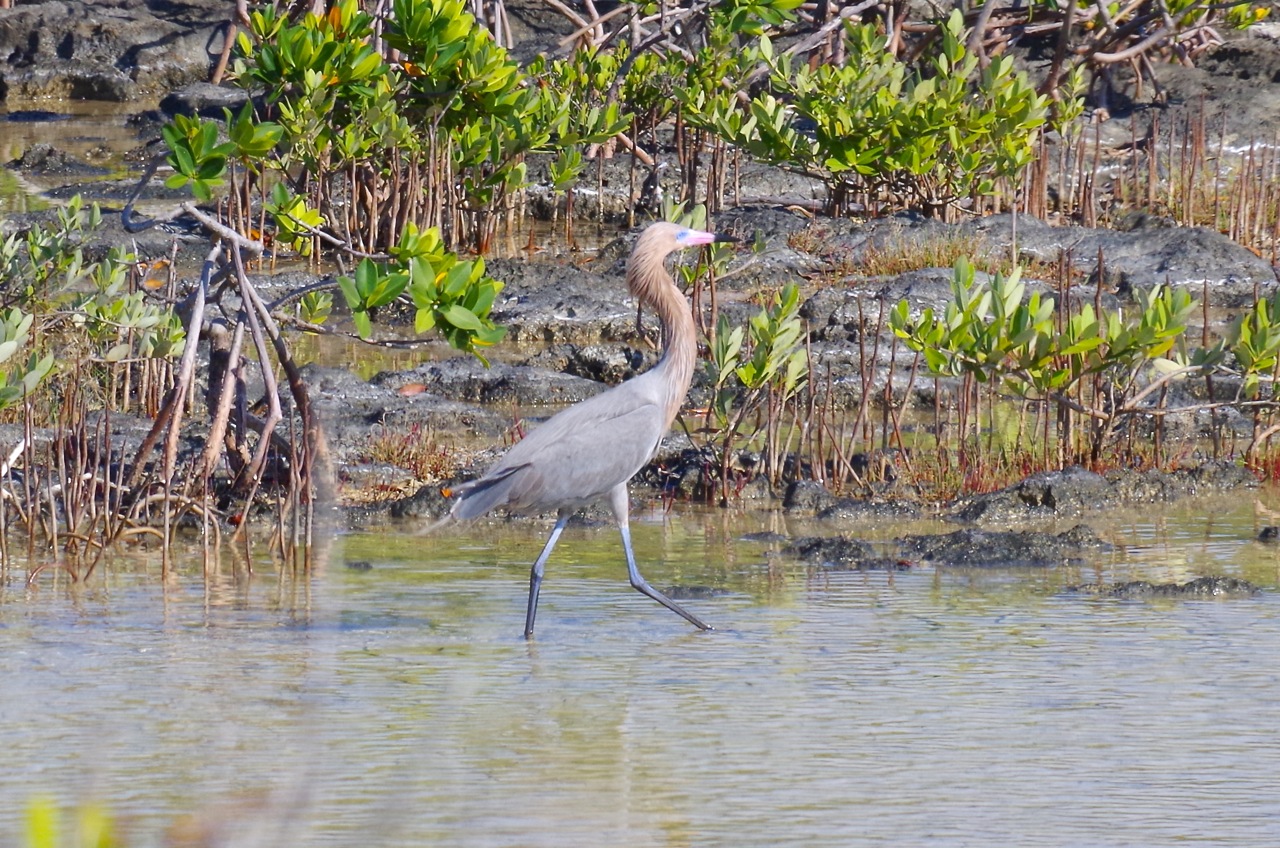
Reddish Egrets come in two colour schemes, reddish and pure white; and both are available on Abaco. ID hint – among the 10 heron and egret species found on Abaco, these are the only ones with a black tip to the beak. In March, these birds are thinking about fish. They do that every day of the year. But they are also thinking about finding a mate. The colouring of the males intensifies, and in particular the greyish-pinkish base of its beak turns a bright ‘hi babe, how are you doing’ pink. The male RE in this post is resplendent in his breeding plumage. We encountered this RE at Crossing Rocks in the brackish pond area on the opposite side of the highway to the bonefishing jetty. This in an excellent place to check out for herons, egrets and other wading birds such as yellowlegs. The island is at its thinnest point here, with the hard dry land over which the highway passes just a few yards across. On either side it’s basically water, mangroves, and other wetland plants. Reddish Egret,  Abaco, Bahamas (Keith Salvesen)The RE noticed us at the edge of the pond and put on a little display. This is unlikely to have been a ‘come on’… Conceivably, he wanted to show off his distinctive ‘bad hair day’ styling. More plausibly, he was probably put out by having his fishing disturbed. Reddish Egret,  Abaco, Bahamas (Keith Salvesen)Reddish Egret,  Abaco, Bahamas (Keith Salvesen)He wasn’t diverted for long, though, and soon got back to business hunting fish. Sometimes he would stand stock still, poised for a rapid strike into the water with that lethal beak. This is the RE’s classic fishing method, the static hunt. Reddish Egret,  Abaco, Bahamas (Keith Salvesen)However, there are times for being proactive and chasing down the prey. While bonefishing out on the Marls, I have seen this done from a distance, especially by the white RE morphs. They splash about near the edge of the mangroves, moving back and forth, lifting their long legs high in the vegetation as they hunt down their small silver snacks. Our Crossing Rocks RE was suddenly on a mission…Reddish Egret,  Abaco, Bahamas (Keith Salvesen)Reddish Egret,  Abaco, Bahamas (Keith Salvesen)Reddish Egret,  Abaco, Bahamas (Keith Salvesen)We had to tear ourselves away from this performance, grateful to have seen it at such close quarters. However we went back a few days later while on a birding trip to the pond at Gilpin Point. But that’s a post for another time…

RELATED POSTS

REDDISH EGRETS (WHITE MORPH)

GREAT EGRETS 

SNOWY EGRETS

GREAT BLUE HERON

GREEN HERON

CATTLE EGRET

All photos RH; cheers to Woody Bracey for stopping the truck here during our warbler expedition!

Unknown's avatar

DOWITCHERS FOR ABACO TWITCHERS

Short-billed Dowitcher, Abaco (Bruce Hallett) DOWITCHERS FOR ABACO TWITCHERS

(THE LONG AND THE SHORT OF IT…)

Long-billed (Limnodromus scolopaceus)? Or Short-billed (Limnodromus griseus)? Which one is that over there? No, not there. There! For Abaco, the answer is very easy. The SBD is a common winter resident, whereas the LBD is an occasional casual visitor, recorded rarely and irregularly in the Northern Bahamas. So if you are looking at a Dowitcher, it’s 98% certain that’s it’s an SBD. Which is lucky – they are so similar that telling them apart is a complex ID challenge, even if seen together! Until 60 years ago they happily existed as one species until the avian powers-that-be decided to prise them apart and award them separate species status. All the birds featured here are Abaco SDBs, with one exception… More on the comparisons and differences below.

The Dowitcher’s bill is an extremely effective instrument for probing deep into low water and mud. The rapid stabbing for concealed invertebrates has been vividly described as being ‘like a sewing-machine’. A ‘Dowitcher Stitcher’. So to speak.Short-billed Dowitcher, Abaco 2 (Bruce Hallett)

 HOW DID THE DOWITCHER GET ITS NAME?

I had assumed that the strange name for these birds was onomatopoeic, in the same way that a Killdeer is supposed to call “Kill…Deer”. And a Bobwhite, an interrogative “Bob…White?”. When I tried to check this online, I found that the usually valuable primary sources for bird info were silent on the topic. In the end, I tracked down a Merriam Webster entry that simply said “probably of Iroquoian origin; akin to Oneida tawístawis. First Known Use: 1841”. Which left me better informed, but no wiser…

Short-billed Dowitcher2.Abaco Bahamas.Tom Sheley

THERE’S A BUNCH OF SHOREBIRDS OVER THERE – WHAT DO SBDs SOUND LIKE?

 Phoenix Birder / Xeno Canto

In the header image, the bird is foraging in shallow water. In deeper water or with softer mud, SBDs will plunge their bills in to the hilt

Short-billed Dowitchers, Abaco -  Bruce Hallett

SHORT OR LONG – HOW ON EARTH DO I TELL? 

1. HELPFUL(ISH) WAYS

  • On Abaco, if you see a Dowitcher the overwhelming likelihood is that it’s a SBD
  • The species prefer different habitats, with the LBS preferring freshwater even in coastal regions
  • The SBD prefers coastal areas, shorelines and brackish / muddy ponds
  • The SBD’s call is said to be “mellower” than the LDB – though unless you have heard both for comparison, that’s not a very useful identifier.
  • The body shapes are apparently subtly different, in ways I personally can only begin to guess
  • In breeding plumage, the species have perceptible colour / pattern differences. (If you have binoculars?)
 2. CONFUSING FACTORS
  • LBDs may occasionally join SBDs that are foraging on open tidal flats
  • Actual bill length may not help, there’s an overlap – some SBDs may have longer bills and vice versa.
  • There are theories about bill-length / head size comparison as a field ID method. Do they work? As if!
  • Winter plumage of both species is very similar (grey). Both are only on Abaco in winter. Go figure.

Short-billed Dowitcher, Abaco 1 Bruce Hallett

DOES THE DOWITCHER HAVE ANY PRACTICAL APPLICATION?

Yes! In Scrabble you can form a stonking 315 words from those 9 letters, all permitted under Scrabble rules (though not my own house rules, which forbid ridiculous 2 and 3 letter words that sound invented for the purpose of winning Scrabble). Apart from the full 9 letter original, there’s one 8 letter word – ‘witherod’, a type of viburnum plant; and 13 words of 7 letters, of which I’d say 8 are in common though not everyday usage. I’ll leave you to work out the remaining 301 words…

Short-billed Dowitcher.Abaco Bahamas.Tom Sheley

DO YOU HAVE ANY LBD PHOTOS TAKEN ON ABACO?

I surely do. Woody Bracey photographed a pair of dowitchers together on Abaco, one SBD and one LBD. But even though this looks a pretty straightforward comparison of bill length, colouring and marking, by now I’m now so confused that I’m beginning to wish the two species could be happily reunited into one…Long & Short Billed Dowitchers, Abaco Woody Bracey

 Credits: Bruce Hallett, Tom Sheley, Woody Bracey, past researches, the usual bird info suspects

Unknown's avatar

MERLINS: FIERCE LITTLE FALCONS

Merlin, Abaco (Becky Marvil)FIERCE LITTLE FALCONS: MERLINS ON ABACO

Merlins (Falco columbarius) are fierce small falcons that are fast and agile in flight. On Abaco, they are fairly common winter residents – though finding one and managing to photograph it may take a bit of doing. And maybe a dose of luck. The ‘columbarius‘ part of their taxonomy reflects their colloquial name ‘Pigeon Hawk’. Merlins are found throughout much of the northern hemisphere. They are classified as a New World species and an Old World / Eurasian subspecies, F c aesalon. Some argue for two distinct species, the gene pools of the two versions apparently having parted company ten of thousands of years ago. The birds aren’t overly bothered by the debate.

Merlin World Range Map: yellow = summer, blue = winter220px-Falco_columbarius_distribution_map

HOW DO MERLINS DIFFER FROM AMERICAN KESTRELS (AMKE)?

  • Slightly larger and notably heavier (thus having more speed and endurance in flight)
  • Different colouring, e.g. lacking the indicative reddish-browns of the AMKE
  • Distinctive tail-barring as against black ends to the tail feathers with a white fringe
  • Unlike the AMKE they don’t hover, but close in directly on the small birds that are the main prey, often flying very low to surprise the victim.

For comparison: Merlin in  South Abaco, American kestrel at Sandy PointMerlin, Abaco (Rhonda Pearce)American Kestrel, Abaco (Keith Salvesen)

 SO JUST HOW FIERCE ARE MERLINS?

Formidable! If you are a small or even medium-sized bird, you need to keep your wits about you. Merlins are largely ‘omni-habitat’ within their range, which includes open country, shrubland, light forest, and grasslands. They are fast, agile and strong. They can fly high, at medium height or at ground level, and are expert in surprise attack and rapid pursuit of prey. If you are a large bird of prey – a red-tailed hawk, perhaps – they may attack you with ferocity. They may not actually be trying to nail you, but to get you out of their territory and their catchment area.Merlin in flight, Abaco (Craig Nash)

Most of a merlin’s prey is taken in flight, and their speciality is ‘tail-chasing’ terrified birds. Breeding pairs may hunt cooperatively, with one bird flushing prey from cover into the open for its mate to… well, you get the picture – they are clever too. They may even pursue birds that have been flushed out by another bird of prey in the vicinity.Merlin in flight, Abaco (Craig Nash)

MERLINS AND PHOTOGRAPHERS

This is a slightly fraught relationship, because Merlins do not always pose as one might wish. Sometimes they are hard to see, being fairly well camouflaged unless they choose to ‘go out on a limb’. Merlin, Abaco (Gerlinde Taurer)

And sometimes they don’t play by the rules relating to light and focus, making a clear shot difficultMerlin, Abaco (Becky Marvil)

FALCONRY AND MEDIEVAL HISTORY

Merlins were popular birds in medieval English falconry, and according to the 1486 Boke of Seynt Albans, the ‘Marlyon’ was considered the appropriate hunting bird for a lady. This book contained an essay on hunting attributed to Dame Juliana Berners, the prioress of a Priory near St Albans, who, game lady that she must have been, also contributed to one of the earliest treatises on fishing, ‘Fysshynge wyth an Angle‘ (hence, angling).

FURTHER HISTORICAL DIGRESSION (feel free to skip to final para)

While reading up further about Dame Juliana, I came across (wiki-tnx) a wonderful ranking for birds of prey matched to status that I hadn’t encountered before. Here’s the list, from Emperor to Knave / Servant. A Tercel was / is a male falcon, especially a Peregrine or Gyrfalcon. A Musket is a sparrowhawk. 

Falconry Table

The Boke of Seynt Albans also contains list of collective nouns for animals and birds, many familiar today such as “gaggle of geese”. There are also humorous collective nouns for different professions, such as a “diligence of messengers”, a “melody of harpers”, a “blast of hunters”, “a subtlety of sergeants”, and a “superfluity of nuns”…

Merlins are still trained for hunting smaller birds; and because of their speed and agility they are used in falconry displays. Despite changing habitat, and a perceptible dip in population from the use of pesticides now banned (such as DDT), the Merlin seems to be holding its own very well 5 centuries after the Boke was written.

Merlin & Prey - Just a Prairie Boy, Calgary


AND FINALLY… AUDUBON’S HANDSOME MERLINS

audubon-iii-scavengers-and-birds-of-prey-merlin-aka-le-petit-caporal audubon-iii-scavengers-and-birds-of-prey-merlin-aka-pigeon-hawk

Credits: Becky Marvil (1 & 7); RH (2); Rhonda Pearce (3); Craig Nash (4 & 5); Gerlinde Taurer (6); Prairie Boy (8) wiki – not taken on Abaco, but I liked it; Dame Juliana Berners (1486); Magpie Pickings

Unknown's avatar

THICK-BILLED VIREOS ON ABACO

Thick-billed Vireo, Abaco 2 Tom Reed

THICK-BILLED VIREOS: ABACO’S ONLY PERMANENT RESIDENT VIREO

Unlike the other 7 vireo species found on Abaco seasonally or as transients, the Thick-billed Vireo Vireo crassirostris is an ever-present permanent resident of the coppice and scrub; and their unmistakeable repeating song can be heard almost everywhere. Thick-billed Vireo, Abaco (Craig Nash)

Although TBVs are very easy to hear and track to a general area of coppice, I find actually seeing the bird creating the noise quite hard – let alone getting a clear camera shot. They always seem to be lurking several feet further away, deeper in the foliage, than the sound suggests. Thick-billed Vireo, Abaco  (Gerlinde Taurer 2)

Thick-billed Vireo, Abaco (Bruce Hallett 2)

Paul Driver / Xeno Canto

Thick-billed Vireo, Abaco Bahamas.Tom Sheley

The main signifiers for this species, which in combination distinguish the TBV from the other vireo species on Abaco, are:

  • Two white wing bars
  • Yellow patch – usually quite prominent – between eye and beak
  • Thick bill – which immediately rules it out of being one of the 37 warbler species on Abaco…

Thick-billed Vireo, Abaco (Becky Marvil 2).jpg

There are marked colour variations in the species according to maturity, season and to an extent gender (though m & f are quite similar). Here’s one that is causing wing-bar confusion by only showing traces. It also has quite dark upper parts.

Thick-billed Vireo, Abaco (Alex Hughes)

This is a very yellow TBVThick-billed Vireo, Abaco (Bruce Hallett 1)Whereas this one has rather anaemic colorationThick-billed Vireo, Abaco Bahamas .Tom SheleyFinally, this pretty TBV is very delicately markedThick-billed Vireo, Abaco (Tony Hepburn)

RELATED POSTS

VIREO PAGE

BLACK-WHISKERED VIREO

PHILADELPHIA VIREO

Credits: Tom Reed (1), Craig Nash (2), Gerlinde Taurer (3), Bruce Hallett (4, 8), Tom Sheley (5, 9), Becky Marvil (6), Alex Hughes (7), Tony Hepburn (10); Paul Driver / Xeno Canto